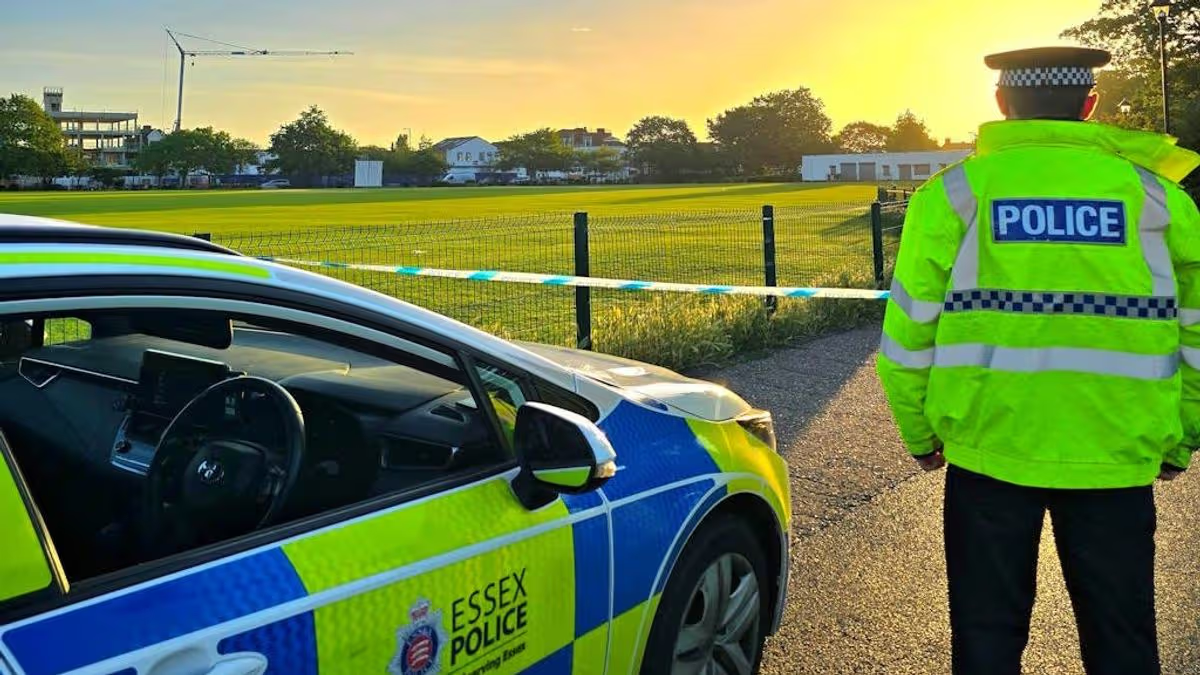



A deeply troubling knife attack occurred in the north London neighbourhood of Golders Green on Wednesday, an area known for its significant and long-standing Jewish community. According to reports from the local Jewish neighbourhood watch group, Shomrim, a man was seen running with a knife, attempting to stab Jewish members of the public. In the ensuing violence, two individuals were stabbed and required immediate medical attention, which was provided by Hatzola, a dedicated Jewish volunteer ambulance service. The swift response from both community groups and the Metropolitan Police led to the suspect being arrested at the scene. The Community Security Trust (CST), a charity that advises on and provides security for British Jewish institutions, confirmed these details and urged anyone with information to come forward, highlighting the close-knit and vigilant nature of the community in the face of such threats.
This violent assault did not happen in isolation but is part of a distressing and escalating pattern of targeted antisemitic attacks in north London over recent weeks. The atmosphere had already been tense following a series of arson attacks on Jewish sites. These acts of vandalism and intimidation began in late March with the deliberate torching of four ambulances belonging to the Hatzola charity. Other community pillars were subsequently targeted, including the Kenton United Synagogue in Harrow, the premises of a Jewish charity, and, just last week, the Finchley Reform Synagogue. This campaign of fear has left the community on high alert, transforming places of worship and communal support into potential targets.
The political response to this latest attack was immediate and unequivocal. UK Prime Minister Keir Starmer addressed the House of Commons, describing the incident as “deeply concerning” and affirming that a police investigation was underway. He stressed a collective determination to confront such offences, acknowledging the recent surge in hate-fuelled crimes. London’s Mayor, Sadiq Khan, echoed this sentiment, condemning what he called an “appalling attack on two Jewish Londoners.” He thanked emergency services and the “heroic volunteers” who responded, explicitly stating that there is “absolutely no place for antisemitism in society.” These strong statements from the highest levels of government reflect the gravity of the situation and the urgent need for societal solidarity.
Behind this wave of attacks lies a complex and ominous geopolitical thread. Police have indicated that 26 individuals have been arrested in connection with the arson incidents, which notably escalated following the start of a US-Iran war on February 28th. Many of these acts have been claimed by a previously little-known group called Harakat Ashab al-Yamin al-Islamiya (HAYI), or The Islamic Movement of the People of the Right Hand, which is believed to have links to Iran. This connection suggests that international conflicts are being violently projected onto the streets of London, where a local community is paying the price for tensions unfolding thousands of miles away. It underscores how global hostilities can manifest as very real, localized terror.
The human impact of these events extends far beyond the physical injuries sustained in the stabbing. For the Jewish community in Golders Green and across London, each attack is a profound violation of their sense of safety and belonging. Synagogues are not just buildings; they are centres of faith, community, and memory. Volunteer ambulances represent a network of mutual care. Their targeting is a direct assault on the fabric of community life. The constant vigilance required—relying on groups like Shomrim and CST—creates an exhausting undercurrent of anxiety, where ordinary neighbourhoods can suddenly become scenes of potential violence, reshaping the daily experience of an entire community.
In conclusion, the stabbing in Golders Green is a stark and violent symptom of a deeply worrisome trend. It represents the convergence of local hate crimes with the fallout from international conflict, creating a perfect storm of intimidation targeted at British Jews. While the arrests and strong political condemnations are necessary steps, they address the symptoms rather than the deeply rooted causes of this antisemitic resurgence. The resilience of the community, demonstrated by its rapid-response volunteers and cohesive networks, is being tested as never before. The fundamental question now is whether broader society can match that resilience with an unwavering commitment to root out hatred and protect the principle that everyone, regardless of faith, should be able to live without fear in their own home and neighbourhood.