



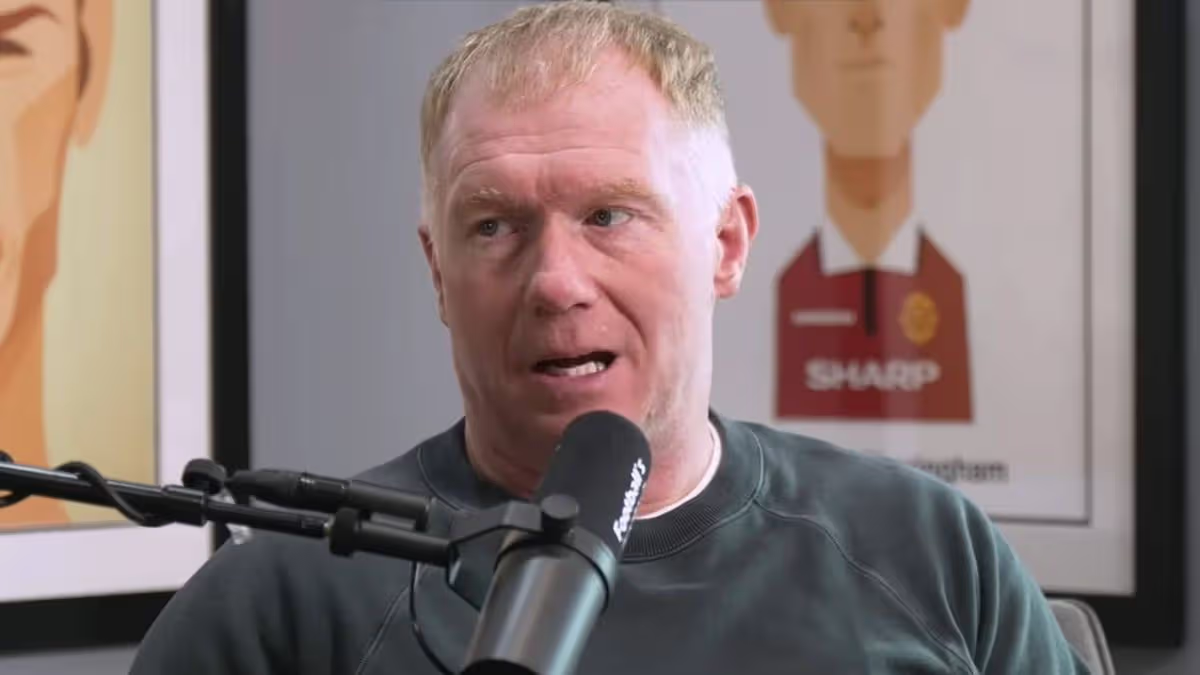
In an unexpected crossover of sporting passions, Manchester United and England legend Paul Scholes recently fulfilled a long-held ambition by attending the World Snooker Championship at Sheffield’s Crucible Theatre. His mission was singular: to witness the genius of Ronnie O’Sullivan, a figure he regards with the awe reserved for transcendent talent. Speaking with palpable enthusiasm on The Good, The Bad & The Football Podcast, Scholes recounted an experience that, despite lasting less than an hour, left an indelible mark on him. He described it as “one of the best things I’ve ever done in my life,” a powerful statement from a man who has experienced the pinnacle of football’s euphoria on the world’s biggest stages. For Scholes, the allure wasn’t just about snooker; it was about observing a master, “a genius at work,” in the intimate, hallowed setting that has defined the sport for decades.
The opportunity arose almost by chance. Noting he lived just an hour from Sheffield, Scholes checked for last-minute tickets online and found a single remaining seat. Its price—£450—and its proximity, just three seats away from where O’Sullivan would be playing, presented a now-or-never moment. “I just thought ‘F*** it. I’m doing it’,” he recalled, highlighting a spontaneous decision driven by years of quiet admiration. This wasn’t merely attending a sporting event; for Scholes, it was a pilgrimage. He admitted to not getting excited about much these days, but the prospect of seeing O’Sullivan at the Crucible cut through that customary reserve, building an anticipation that the actual event would more than satisfy.
Scholes was present for the second session of O’Sullivan’s first-round match against He Guoqiang, where the Rocket, already leading 7-2, needed only three more frames to secure victory. From his front-row seat, Scholes was immersed in what became a breathtaking exhibition of speed and precision. O’Sullivan sealed the match in roughly 45 minutes, crafting two century breaks in the process. BBC commentator and former champion John Parrott, spotting Scholes in the crowd, initially welcomed “one of England’s greatest midfielders” but later humorously apologised live on air as the match sped to its conclusion: “Paul Scholes might have enjoyed this but he’s only going to see three frames of it. Sorry Paul, this man is just too good.” Far from feeling short-changed, Scholes was mesmerized.
The brevity of the spectacle was irrelevant to its impact. Scholes was captivated by the atmosphere of intense concentration and the sheer artistry on display. “Peace and quiet, I could have sat in that chair for two weeks,” he mused, emphasising the profound, almost meditative enjoyment he derived from the experience. In the focused silence of the Crucible, so different from the roaring stadiums of his career, he found a unique form of sporting bliss. He described getting “a bit giddy” during the performance and being on a “high for about three days after it,” a testament to the emotional and aesthetic lift provided by witnessing excellence so clinically and beautifully executed.
Scholes’s reflection offers a fascinating glimpse into how one iconic athlete views another from a completely different discipline. There is a mutual language of genius that transcends sport—the ability to make the extraordinarily difficult appear effortless, to operate on a plane that captivates both peers and public. While O’Sullivan’s tournament would ultimately end in a quarter-final defeat to John Higgins, for Scholes, that first-round masterclass was the pure, unadulterated show he had come to see. His story isn’t about the narrative of the championship, but about a personal moment of connection with sporting greatness, a reminder of the simple, powerful joy of watching a true master at their craft.
Ultimately, Scholes’s anecdote humanises the awe we feel for legendary performers. It’s a relatable tale of fandom, spontaneity, and the worth of investing in a bucket-list experience, regardless of its duration. The image of the famously reserved midfield general, now retired, gleefully spending a small fortune for 45 minutes of quiet rapture, is both charming and profound. It underscores how the magic of live sport lies not just in the contest, but in the shared appreciation for talent so sublime it can leave even a football legend speechless and elated, quietly celebrating from a front-row seat as history unfolds one flawless shot at a time.