



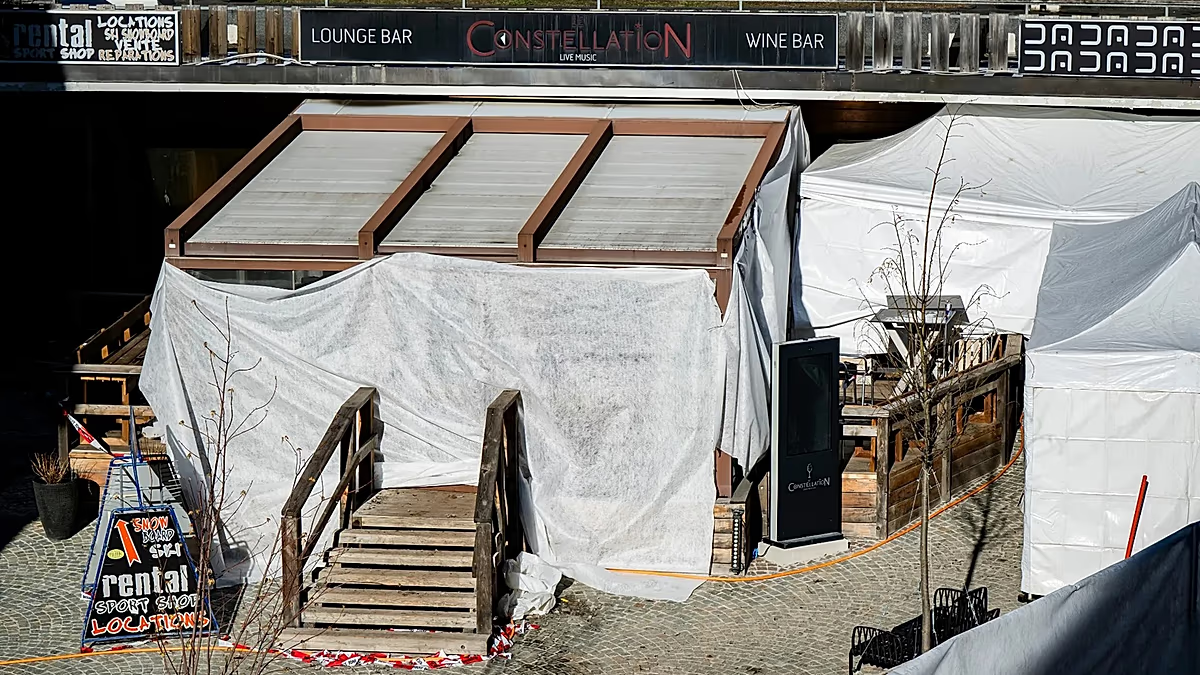
Italy has taken the profound step of filing as a civil party in the Swiss criminal case regarding the catastrophic New Year’s fire at the Le Constellation bar, a tragedy that claimed 41 lives and left 115 injured. The decision, announced on Wednesday, is driven by the immense commitment of Italian resources—medical, psychological, and logistical—to support its six nationals who perished and others affected. This legal move underscores a national determination to seek full accountability, transcending borders in the pursuit of justice for victims who were predominantly young people celebrating the dawn of a new year.
The horror unfolded in the early hours of January 1st in the upscale Alpine resort. According to Swiss prosecutors, the blaze originated in the bar’s basement when revelers raised champagne bottles adorned with sparklers too close to the ceiling, inadvertently igniting flammable soundproofing foam. The rapid spread of the fire turned a night of celebration into a scene of devastation, highlighting haunting questions about safety protocols and preventive measures that might have averted such loss.
Central to the judicial proceedings are the bar’s owners, Jacques and Jessica Moretti, who face serious charges including manslaughter by negligence and arson. They have undergone extensive questioning by prosecutors and civil party lawyers. Compounding the gravity of the situation, the Swiss investigation has revealed a critical lapse: no annual safety inspection had been conducted at the establishment since 2019. This omission points to a systemic failure, a detail that fuels the Italian government’s pursuit of broader accountability.
In a firmly worded statement, the Italian government asserted that the involvement of local Swiss authorities in the chain of events leading to the disaster is “highly probable.” This belief forms the cornerstone of Italy’s legal strategy, justifying a “firm demand for compensation against all parties held civilly liable.” Prime Minister Giorgia Meloni has personally vowed to secure justice for the Italian victims, and Italy has launched a parallel domestic investigation to run concurrently with the Swiss probe, ensuring no element of the tragedy goes unexamined.
The Italian state’s role has extended beyond the courtroom, embodying a protective stance towards its citizens in distress. This was evident when PM Meloni issued a sharp public rebuke in April after learning that a Swiss hospital in Sion had sent exorbitant bills—one reportedly for €70,000—to families of victims for brief hospitalizations. Meloni denounced these charges as “an insult on top of a mockery,” swiftly engaging diplomatic channels to rectify what Swiss authorities later called a mistake, ensuring families would not bear these cruel financial burdens.
Italy now reaffirms its “full and uninterrupted support” for the grieving families, pledging to vigilantly monitor the Swiss legal process to its conclusion. This tragedy, born from a moment of celebration, has evolved into a complex international endeavor for accountability and care. The civil claim is more than a legal formality; it is a manifestation of a nation’s duty to its people, a demand for responsibility from all implicated parties, and a promise to honor the memory of those lost by leaving no stone unturned in the quest for truth and justice.