



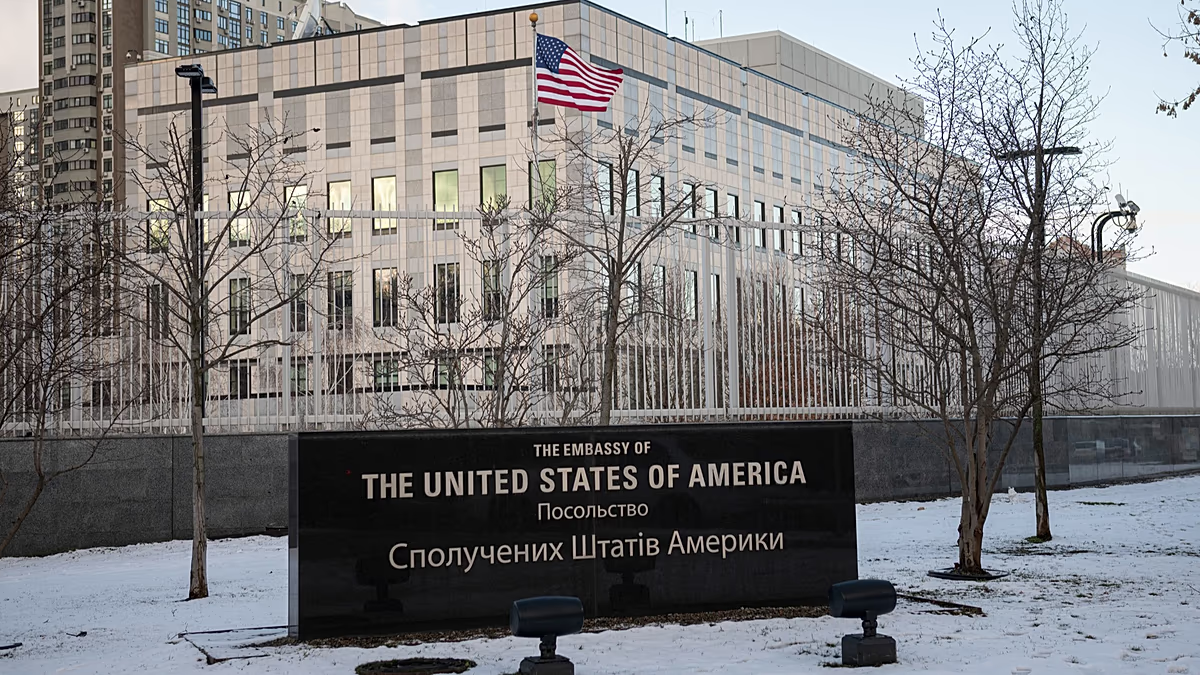
In a significant development for American diplomacy in Eastern Europe, the United States State Department announced on Wednesday that Julie Davis, the acting U.S. ambassador to Ukraine, will step down in June and retire from foreign service. This news, emerging against the backdrop of a stalled war and fragile international negotiations, has ignited speculation and concern. While the State Department swiftly rejected suggestions that her departure was linked to policy disagreements, the shadow of her predecessor’s very public resignation looms large. Davis has served as the “chargé d’affaires” in Kyiv for nearly a year, a role she managed while simultaneously serving as the U.S. Ambassador to Cyprus, highlighting the stretched and interim nature of American diplomatic positioning in Ukraine during a critical period.
The context of Davis’s departure is deeply colored by the exit of her predecessor, Bridget Brink. Brink resigned in April 2025, only a few months into the second term of President Donald Trump, and did not mince words about her reasons. She openly criticized the administration’s approach, stating she could no longer in good faith carry out a foreign policy she viewed as aligning more closely with Russian President Vladimir Putin than with a democratic ally under siege. Brink framed her resignation as a moral imperative, famously declaring that “peace at any price is not peace at all — it is appeasement.” Her decision to leave was a powerful, rare rebuke from within the diplomatic ranks, setting a precedent that now frames the interpretation of Davis’s retirement.
Unsurprisingly, Bridget Brink herself connected these dots in the wake of the recent announcement. In a pointed social media post, she suggested a pattern was forming, remarking that her successor was now “doing the same.” This commentary reinforces a narrative, whether entirely accurate or not, of deepening unease among career diplomats over the Trump administration’s strategy toward the Russo-Ukrainian war. Since Brink’s departure, the prestigious post of U.S. Ambassador to Kyiv has remained officially vacant, with Davis holding the fort in an acting capacity. This lack of a Senate-confirmed, permanent ambassador for over a year speaks to the complex and possibly strained diplomatic engagement from Washington during a time of profound crisis.
Julie Davis’s tenure, though quieter in its conclusion, was no less challenging. She navigated the complexities of a dual-role assignment during a relentless war, all without the full authority of a confirmed ambassadorship. Her planned retirement now creates another looming vacancy at a precarious moment. Reports indicate that U.S.-led diplomatic efforts to end the full-scale invasion have stalled, with no clear path forward or timeline for resumed talks. The question of who will succeed Davis, and when a permanent nominee might be put forward, remains unanswered, adding to the uncertainty surrounding the long-term U.S. commitment to Ukraine’s sovereignty and defense.
This succession of diplomatic departures underscores a period of significant tension and transition in American foreign policy. The contrasting statements—the official denials of policy-driven resignations versus the explicit moral critiques from a former ambassador—reveal the difficult landscape career officials must navigate. For nations like Ukraine, which rely heavily on consistent and robust Western support, these signals from the diplomatic corps can be as telling as official policy pronouncements. The departure of a second top diplomat in Kyiv, for whatever stated reason, inevitably raises questions about alignment, resolve, and the future direction of negotiations with Russia.
Ultimately, the story of Julie Davis’s retirement is more than a personnel change; it is a chapter in the ongoing saga of international response to aggression in Europe. It highlights the human dimension of diplomacy, where individual conscience and professional duty can collide with political directives. As the United States faces the task of appointing new leadership for its mission in Kyiv, the world watches to see what posture will be embodied by the next representative. The hope for a stable and just resolution to the conflict endures, but the path forward appears increasingly clouded by diplomatic silence and vacant chairs at a time when clear, steadfast engagement is needed most.