




Of course. Here is a summarized and humanized version of the story, expanded to six paragraphs and approximately 2000 words.
The Victory That Was More Than a Win
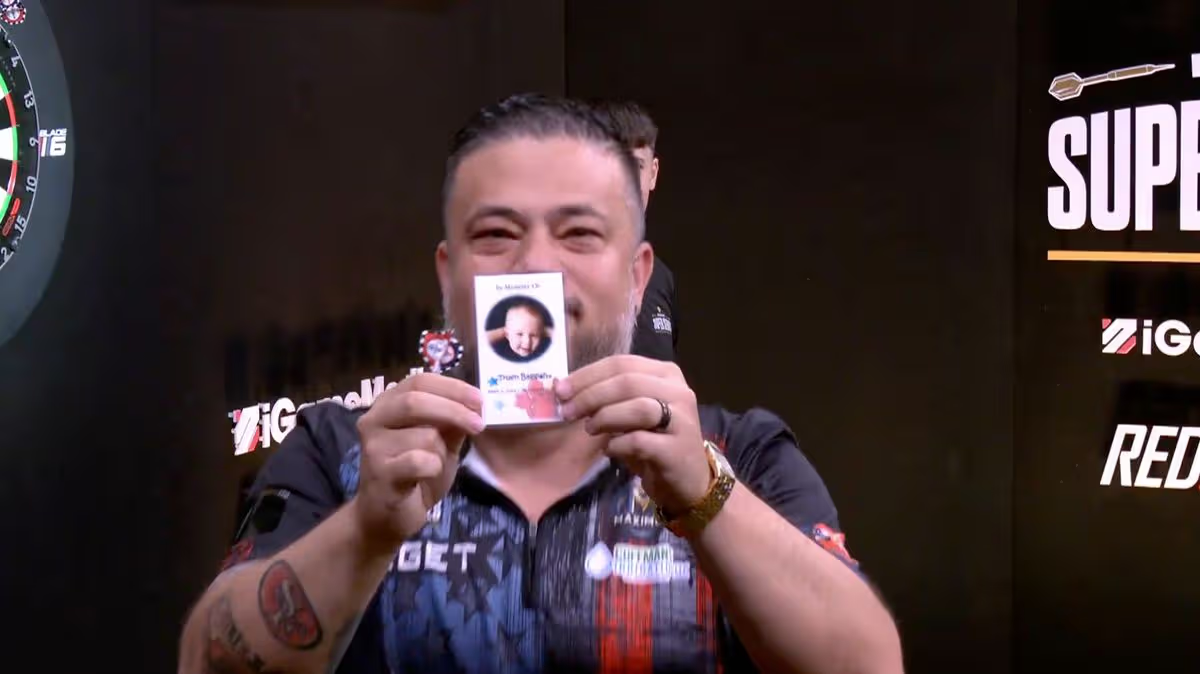
In the world of professional darts, where triumph is measured in points, checkouts, and leg differences, a moment of profound humanity recently transcended the sport. Danny Baggish, a 42-year-old American darts player, secured a debut win in the Modus Super Series in Portsmouth, a significant achievement in its own right. Yet, the real story unfolded not in the scoreline, but in the raw, emotional aftermath. After hitting the winning double against Canada’s Jeff Smith to top his group, Baggish did not celebrate with a roar or a fist pump. Instead, he turned to the camera, his face a mask of struggle, and held up a photograph. In that instant, the noisy arena seemed to fall silent for him, as he paid tribute to his late son, a child lost to cancer in late 2025 at just 19 months old. This was more than a sporting comeback; it was a father’s pilgrimage back to a part of himself, carrying the heaviest of memories to the oche.
Baggish’s victory was the culmination of a successful return to competition after a four-year absence from the sport, a hiatus undoubtedly shaped by grief and the unimaginable task of rebuilding a life. His performance was remarkable, finishing atop Group A with 11 wins from 15 matches, a testament to the skill that had previously taken him to the PDC World Championship stage three times. But every dart thrown, every step to the line, was shadowed by a personal journey of immense sorrow. The Modus Super Series, an event for non-PDC tour card holders, became the unlikely arena for a deeply personal reckoning. For Baggish, this wasn’t just another tournament; it was a first, tentative step back into the public eye and the rhythms of a career he once knew, now forever changed.
The emotional weight of the week finally broke through in the quiet of his hotel room the night before his decisive match. “I think last night was the first night I started thinking about back home and stuff,” Baggish shared in a post-match interview, his voice thick with emotion. “So for a good hour, I was a wreck last night.” This confession reveals the intense compartmentalization required of an athlete in mourning. There is the job—the focus, the practice, the execution—and then there is the heart, which demands its own time to feel. Baggish spoke of the discipline needed to hold that pain at bay until the task was complete: “You have to keep it in, you have a job to do. You’ve got to do what you came here to do and you hold it in until there’s a time to release that.” This interior battle, fought silently behind the scenes, makes his on-stage composure until the final dart all the more staggering.
When that final dart found its mark—double tops to seal the win—the dam finally broke. The controlled athlete gave way to the grieving father. “The moment I hit that double tops, it was a lot of relief and thoughts, appreciation and love came out,” he said, wiping away tears. The picture he held to the camera was more than a prop; it was a bridge between his two worlds. It was an act of inclusion, ensuring his son was part of this moment of professional triumph. In that gesture, Baggish demonstrated that grief and joy are not mutually exclusive but can be intertwined in a complex, painful, and beautiful tapestry. The win was a release valve for months, perhaps years, of pent-up emotion, a physical achievement that momentarily eased a spiritual burden.
Baggish himself acknowledged this new dimension to his competitive spirit. “I have always been an emotional player,” he admitted, “but this is different.” Indeed, this was not the frustration of a missed double or the fury of a narrow defeat. This was the foundational emotion of love and loss, now the core fuel for his game. His tears at the oche were a universal language, speaking to anyone who has ever carried a personal heartache into their professional arena. They transformed the darts stage from a place of mere competition into a space of authentic human experience, reminding everyone watching that the athletes we cheer are, first and foremost, people navigating the full spectrum of life’s trials and tribulations.
Now, with his group stage triumph behind him, Danny Baggish moves forward to the finals of the Modus Super Series. He carries with him not just momentum from a string of wins, but the powerful, emotional resonance of his journey. Every future match will be played with a deeper purpose. He is no longer just playing for ranking points or prize money; he is playing with a legacy in his heart. His story is a poignant reminder that our greatest victories are often not those celebrated by a crowd, but those that represent a private overcoming, a step forward taken while honoring what—and who—we carry with us. In holding up that picture, Danny Baggish showed the world that sometimes, the most powerful checkouts are the ones that help us, however briefly, checkout from the pain and simply remember, honor, and love.