


A Lifeline for Europe’s Farmers, Fishermen, and Truckers: EU Eases State Aid Amid Energy Crisis
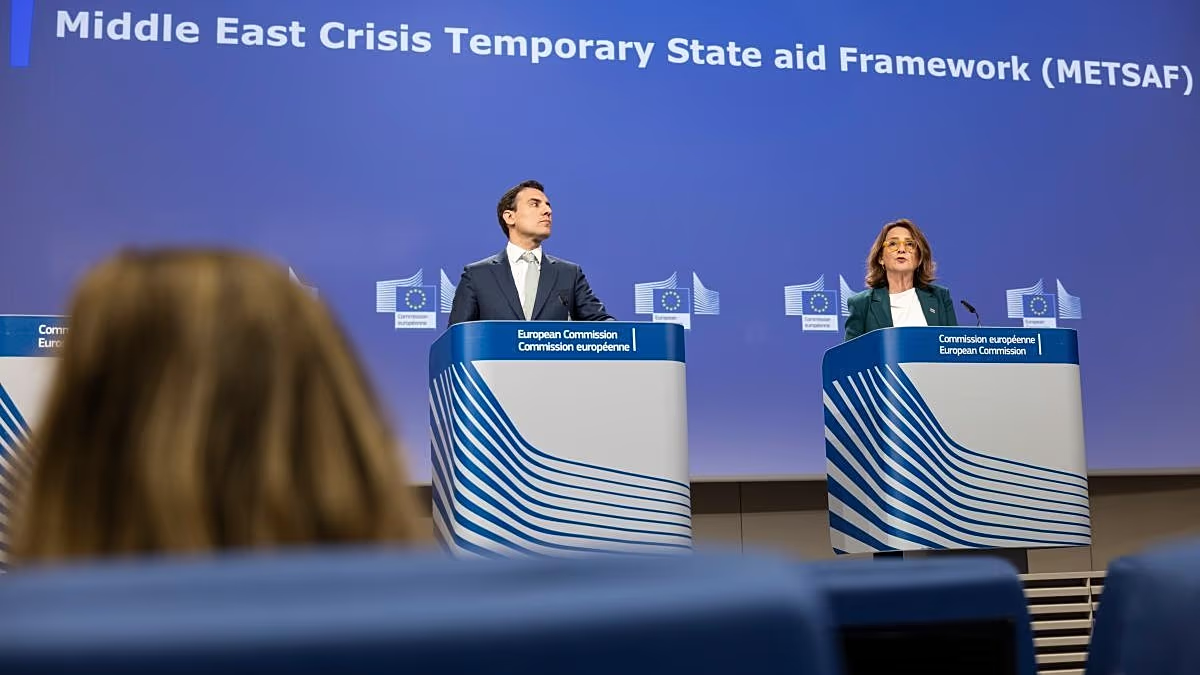
In a decisive move to shield key sectors from economic fallout, the European Union has temporarily relaxed its stringent state aid rules, allowing national governments to provide crucial financial support to industries battered by soaring energy prices. The European Commission announced the emergency measures on Wednesday, framing them as a targeted and temporary response to the economic ripples caused by the ongoing conflict in the Middle East. By enabling member states to subsidise a significant portion of rising fuel and fertiliser costs, the EU aims to offer immediate relief to farmers, fishing fleets, and road transport carriers—groups whose livelihoods have become precarious amid skyrocketing operational expenses. This intervention reflects a pragmatic shift in Brussels’ approach, recognising that extraordinary market conditions demand extraordinary support to prevent widespread disruption across the continent’s single market.
Immediate Pressures on Ground-Level Industries
The human impact of the energy price surge is already starkly visible across Europe. For farmers, the soaring cost of fertilisers and diesel has squeezed already tight margins, forcing difficult choices about crop planning and livestock management. Similarly, fishermen are undertaking careful calculations before each voyage, weighing shrinking profits against the fuel needed to reach fishing grounds, with some considering tying up their boats altogether. In the transport sector, trucking companies—the backbone of EU logistics—face a trilemma: absorb unsustainable cost increases, pass them on to consumers via higher prices, or scale back operations. These pressures extend to energy-intensive industries like manufacturing, where production lines are slowing as electricity bills climb. Behind these broad trends are countless small businesses and family-run operations struggling to stay afloat, underscoring the urgent need for the support measures now being rolled out.
How the New Support Measures Will Work
Under the newly adopted framework, EU countries can now subsidise up to 70% of the extra energy costs incurred by affected businesses—a notable increase from the previous 50% cap. Governments have the flexibility to tailor aid to local economic needs, whether through direct grants, tax relief, or state-backed loan guarantees. To reduce bureaucratic hurdles, smaller operators like hauliers, farmers, and fishermen can access streamlined fixed payments of up to €50,000 without having to submit extensive paperwork. As one EU official noted, beneficiaries “do not need to provide individual receipts from the petrol station,” a provision designed to ensure help arrives quickly. Officials estimate that businesses could begin receiving financial support within the next two months, though the pace will ultimately depend on how swiftly national administrations implement these measures. The overarching goal, as emphasised by EU Commission Vice President Teresa Ribera, is to mitigate immediate economic damage while preserving fair competition within the single market.
Balancing Urgent Aid with Fair Competition
The EU’s state aid rules historically exist to prevent market distortion—ensuring that governments cannot unfairly advantage their domestic companies through subsidies, grants, or tax breaks. The temporary easing of these rules, valid until the end of December, represents a careful compromise between urgent crisis response and the preservation of a level playing field. Notably, the framework requires aid to be justified by genuine market disruption and encourages measures that are proportionate and temporary. However, these very flexibilities have sparked concern among critics, who warn that wealthier member states with greater fiscal resources—most notably Germany—could disproportionately support their industries, potentially triggering a subsidy race across the bloc. Data reveals that Germany accounted for roughly half of all approved state aid since 2022, far outpacing other large economies like France and Italy. This disparity raises difficult questions about equity and long-term market fairness, even in a crisis.
The Broader Debate: Short-Term Relief vs. Long-Term Transition
While the immediate measures address pressing economic pain, they have also ignited a broader debate about Europe’s energy future. Vice President Ribera stressed that the energy transition remains “the most effective strategy for Europe’s autonomy, growth and resilience,” yet acknowledged that recent price spikes require an urgent, interim response. Critics, however, argue that subsidising fossil fuel costs without binding green conditions represents a missed opportunity. Greg Van Elsen of Climate Action Network Europe warned that the changes risked “spending billions subsidising fossil-based energy costs instead of accelerating Europe’s clean industrial transition.” For many observers, the absence of strong decarbonisation strings attached to this aid turns it into a short-term fix rather than a step toward structural resilience. This tension highlights the delicate balance policymakers must strike between providing immediate relief and staying committed to long-term climate and energy security goals.
Looking Ahead: A Temporary Bridge in Uncertain Times
In sum, the EU’s decision to relax state aid rules is a calculated response to an acute crisis, offering a vital lifeline to industries on the frontline of the energy price shock. By allowing national governments to step in with targeted support, the Commission hopes to stabilise vulnerable sectors, protect jobs, and maintain the flow of essential goods across Europe. However, the move comes with recognised risks—including potential market distortions and delayed progress toward a greener economy. As the measures take effect over the coming months, their success will be measured not only by how effectively they cushion businesses from immediate shocks, but also by how well they align with the EU’s broader ambitions for competitiveness, sustainability, and fairness. For now, the package offers a temporary bridge through turbulent times, even as it reminds us that lasting solutions will require more than emergency interventions.