

Paragraph 1: A Delicate Dance of Diplomacy in Troubled Waters
In the tense geopolitical climate of early 2026, a critical and coordinated diplomatic effort is taking shape to address the blockade of the Strait of Hormuz, a maritime chokepoint vital to global energy security. Following the US announcement of a new initiative named the “Maritime Freedom Construct,” aimed at ensuring safe passage through the strait, France’s Foreign Minister, Jean-Noël Barrot, sought to clarify the international response. Speaking from Abu Dhabi, Barrot emphasized that the American-led plan would serve as a complement, not a competitor, to a separate and “advanced” maritime mission being spearheaded by France and the United Kingdom. This careful framing underscores a desire for allied cooperation rather than division, as the world grapples with a crisis that has sent oil prices soaring and severely disrupted global trade networks since the war’s outbreak.
Paragraph 2: Competing Initiatives and a Web of Blockades
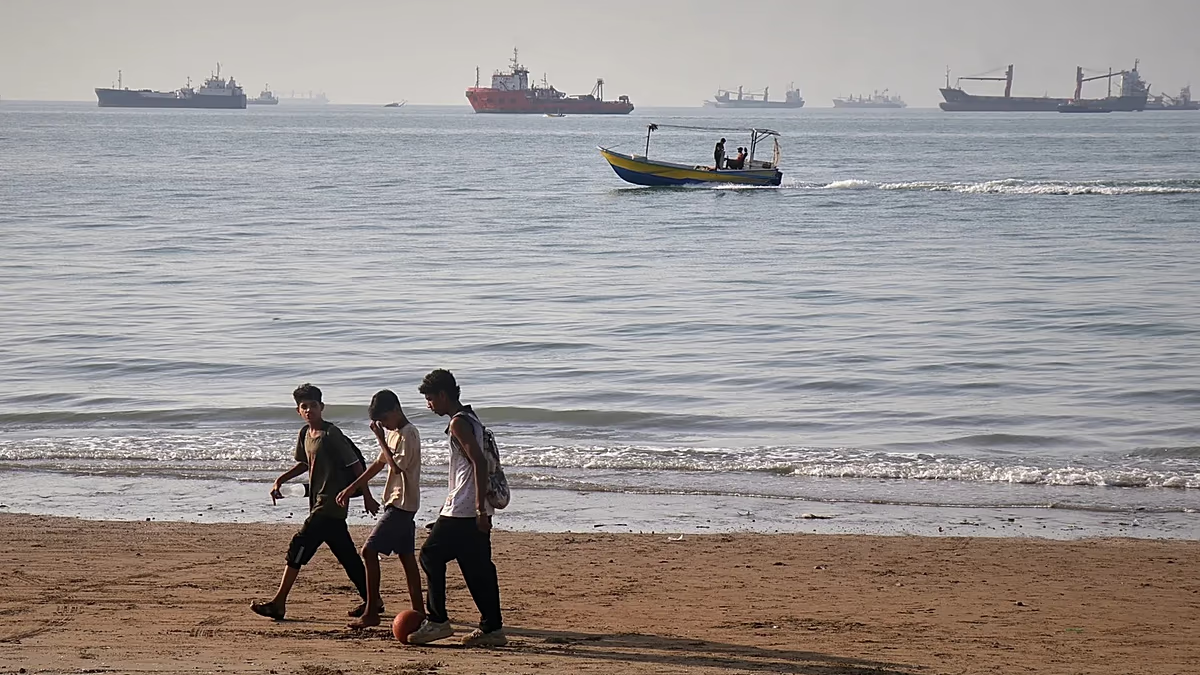
The crisis stems from a devastating stalemate. Iran has effectively blockaded the Strait of Hormuz, through which one-fifth of the world’s oil and liquefied natural gas normally flows, in response to the broader conflict. This action is compounded by a US blockade of Iranian ports and vessels, creating a perfect storm that has choked off this crucial artery. In response, two parallel international efforts have emerged. The UK and France have conducted extensive talks with over 50 countries to build a coalition, with Barrot stating their planning is finalized. Simultaneously, the United States has launched its own construct, described as providing real-time information and coordination for safe transit. Reports suggest the US is actively pressuring other governments to join its initiative, revealing the complex and sometimes overlapping diplomacy at play.
Paragraph 3: Regional Briefings and Underlying Tensions
Minister Barrot’s visit to the Gulf was specifically to brief regional allies on the European initiative, highlighting the importance of their support. However, the shadow of recent transatlantic friction looms. Former US President Donald Trump had previously criticized allies for their reluctance to engage more directly in the US-Israeli war effort against Iran, urging oil-reliant nations to take charge of reopening the strait. When asked if France would participate in the US plan, Barrot remained non-committal, stating he could not comment at this stage. This diplomatic caution reflects the delicate balance Western powers are trying to strike: presenting a united front to resolve the crisis while navigating different strategic approaches and historical pressures.
Paragraph 4: Iran’s Defiant Stance and Conditional Openness
From Tehran, the message is one of defiant resilience mixed with a conditional openness to dialogue. Iran’s judiciary chief, Gholamhossein Mohseni Ejei, stated that Iran has never shied away from negotiations with the US but would absolutely not accept what he termed a “policy imposition.” He insisted that Tehran is not seeking war but is equally unwilling to abandon its core principles and values to avoid one. This rhetoric firmly links any resolution of the strait’s closure to the lifting of the US blockade on Iranian ports, creating a circular deadlock. A single round of talks held in Pakistan in mid-April failed to produce a breakthrough, and discussions have since stalled, leaving the diplomatic channel frozen.
Paragraph 5: Leadership, Nuclear Resolve, and Economic Strife
Adding to the volatility is the question of Iran’s new leadership. Following the death of Supreme Leader Ali Khamenei in the war’s opening stages, his son, Ayatollah Mojtaba Khamenei, has assumed power but has remained unseen in public, fueling speculation about his condition and control. In a statement read on state television, the new leader vowed to protect Iran’s nuclear and missile capabilities at all costs—a direct challenge to US objectives—and delivered a blistering rhetorical attack, suggesting the only place for Americans in the Persian Gulf was “at the bottom of its waters.” These defiant words come as Iran’s economy, already under immense strain, faces new lows with its currency plummeting and its oil industry paralyzed by the blockade, increasing domestic pressure.
Paragraph 6: An Uncertain Path Forward in a Fractured Region
The situation presents a deeply fractured landscape. On one side, Western and allied nations are laboriously, and at times competitively, assembling coalitions to restore freedom of navigation, recognizing the strait’s importance to the global economy. On the other, Iran stands firm, economically battered but politically resolute, vowing not to back down on its strategic interests or under what it perceives as imposed terms. The absence of direct communication channels between the key antagonists, symbolized by the stalled talks, and the mysterious public absence of Iran’s new supreme leader, make the path to de-escalation treacherous. The world now watches to see if the complementary international missions can create enough collective leverage to forge an opening, or if the dangerous impasse in the Persian Gulf will continue to write what Iran’s leadership calls a “new chapter” in the region’s history—one defined by brinkmanship and economic turmoil.