


On a cold Monday in Iran, the state machinery of death turned with ruthless efficiency. In the northeastern city of Mashhad, three young men—Mehdi Rasouli, 25, Mohammad Reza Miri, otusod pnga 21, and Ebrahim Dolatabadi—were hanged at Vakilabad Prison. Their alleged crime was involvement in the January protests that swept the city, demonstrations born from a grinding economic crisis of hyperinflation and poverty. Officially, two were convicted of being agents for Israel’s Mossad, directing unrest, and involvement in the killing of a security force member. The third was charged with “leading disturbances.” The evidence, as presented by the judiciary and the IRGC-linked Fars news agency, consisted of claims they carried homemade weapons and, critically, their own confessions. But a starkly different story emerges from human rights groups. A source told the Iranian Human Rights Activists News Agency that Rasouli confessed only after severe beatings and torture. His family was pressured into silence with promises of a reduced sentence, a cruel hope extinguished when he called to say he was being moved to solitary confinement—a grim precursor to execution.
The case of Ebrahim Dolatabadi highlights a particularly harrowing dimension of this repression. The Hengaw Human Rights Organisation stated that no credible evidence was presented against him and his legal process lacked all transparency. Sources close to him revealed a tragedy of familial hostage-taking: they believe Dolatabadi was executed as a sacrificial pawn to secure the release of his two brothers, Vahid and Esmail, who remain imprisoned in the same facility. Dolatabadi leaves behind a shattered family, including a 14-year-old son, Iman, who was himself arrested during the protests and only recently released from juvenile detention. This execution underscores a pattern where the state’s actions transcend punitive justice, becoming a tool for terrorizing entire families and communities into submission. The regime’s common tactic of labeling dissidents as foreign agents, without proof, provides a convenient, unfalsifiable pretext to justify the severest punishments.
That same Monday, in the central city of Isfahan, four more men were put to death at Dastgerd Prison. Peyman Mohammadi, 37, his brother Mohammadreza, 41, Abbas Rahimi-Azar, 29, and Mehdi Badfar, 33, were executed under the principle of qisas, or retributive “an eye for an eye” justice for murder. Their stories are largely untold by the official machinery, but the detail of Mehdi Badfar’s life breaks through—a farmer from Chabahar who had already lost three fingers in a threshing machine accident and had waited five years in prison. These executions, often for non-political charges, form the relentless background hum of state-sanctioned killing in Iran. While the world’s attention may be grabbed by executions linked to political unrest, a far larger number of individuals are executed annually for drug-related or murder offenses within a judicial system that international observers consistently criticize for its lack of due process and fair trial standards.
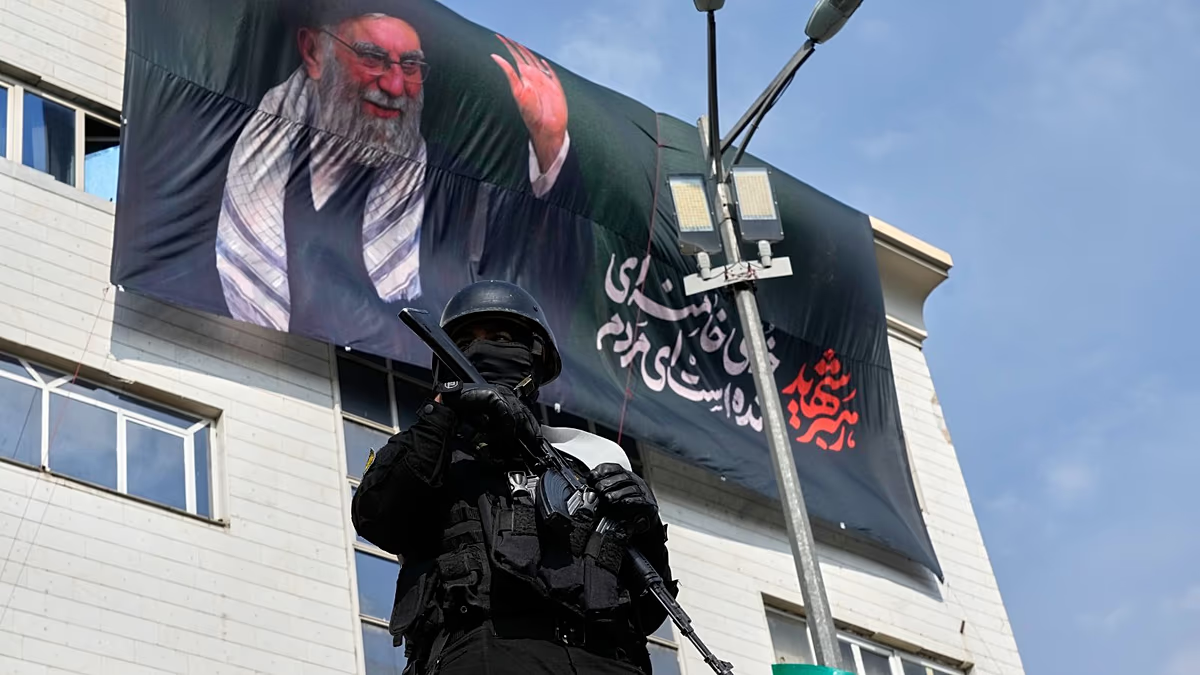
The scale of this killing is staggering, placing Iran as the world’s most prolific executioner after China. According to the Iran Human Rights Organisation, at least 747 people were executed for murder-related charges alone in 2025. The total figure for that year reached at least 1,500 executions. Since the onset of the Iran war in February, this pace has only accelerated. The UN Special Rapporteur on human rights in Iran has noted a sharp rise in executions since the conflict began, with at least 30 people executed since late February specifically in connection to the January protests, alleged opposition membership, or espionage. This surge indicates a regime leveraging a climate of war and national security panic to intensify internal repression, using the gallows as a primary instrument to quell any perceived dissent or instability.
Behind these numbers and legalistic charges lie profound human tragedies—families coerced into silence, sons and fathers used as bargaining chips, and confessions extracted under torture. The executions in Mashhad, tied to the economic protests, reveal a government deeply fearful of the power of public discontent. By conflating domestic protest with international espionage, the state attempts to delegitimize genuine social grievance and justify extreme violence. The parallel executions in Isfahan, operating under different legal statutes, nonetheless feed into the same ecosystem of death, normalizing state execution as a commonplace solution. Together, they paint a picture of a judiciary not as an independent arbiter of justice, but as an arm of state security and control.
Ultimately, this Monday’s seven executions are not an anomaly but a snapshot of a relentless campaign. Each name represents a life abruptly ended, a family plunged into grief, and a community instilled with fear. The international outcry from human rights organizations stands in stark contrast to the official narrative from Tehran, highlighting a global divide in the very definition of justice and human dignity. As the conflict continues and internal pressures mount, the fear is that these seven souls will be swiftly added to a growing tally, their individual stories subsumed by a statistic that Iran leads the world in, one that speaks not of justice, but of survival through terror. The true evidence in these cases may not be found in forced confessions, but in the silencing of whole families and the chilling message sent to a nation: dissent, or even being caught in the wrong place at a wrong time, can be a capital offense.