


The final day of the Dushanbe Grand Slam in Tajikistan brought yet another thrilling chapter to the judo world, captivating a vibrant local crowd with displays of skill, determination, and historic firsts. The atmosphere inside the Kasri Tennis complex was electric, a testament to the sport’s growing passion in the region, as fans witnessed the culmination of a tournament that seamlessly blended high-level athletic competition with celebratory national pride. As the judo family gathered once more in Dushanbe, the stage was set for emerging talents to make their mark and for seasoned competitors to solidify their legacies, all under the watchful eyes of judo dignitaries and an enthusiastic public.
The men’s -90 kg final provided a gripping start to the day’s medal matches, featuring a tense showdown between Mansur Lorsanov and Olympic medallist Theodoros Tselidis. The closely contested battle extended into golden score, where the slightest advantage could decide the champion. Ultimately, Lorsanov was judged to have been the more active fighter, securing a hard-fought victory. The honor of awarding the medals fell to Mr. Ismoil Mahmadzoir, President of the Tajikistan Judo Federation, highlighting the local support and institutional backing for the event. This match set a high standard for intensity, proving that every point and every movement carried the weight of potential glory.
Meanwhile, in the women’s -78 kg category, UAE’s Yelyzaveta Lytvynenko delivered a masterclass performance, establishing herself as the undeniable standout of her division. Her experience shone brightly in the final, where she executed a magnificent O-goshi throw, earning a decisive ippon and the gold medal. This victory marked a significant milestone as the first Grand Slam gold for the promising 22-year-old athlete. She received her medal from Ms. Shabnam Rahimzoda, First Deputy Chair of the Committee for Youth and Sports under the Government of the Republic of Tajikistan, in a ceremony that celebrated both the athlete’s achievement and the host nation’s commitment to sporting excellence.
Historic moments continued in the men’s -100 kg final, where Fuchun Huang faced Adam Sangariev. In a stunning display of technique, Huang unleashed a superb O-uchi-gari to defeat his opponent, claiming the gold medal. This victory was particularly noteworthy as it made Huang the first Chinese man to win a world tour gold medal in nine years, signaling a resurgence for his nation’s judo program. The significance of the achievement was honored by the presence of world champion and double Olympic silver medallist Neil Adams, who presented the medals, connecting the sport’s storied past with its bright future.
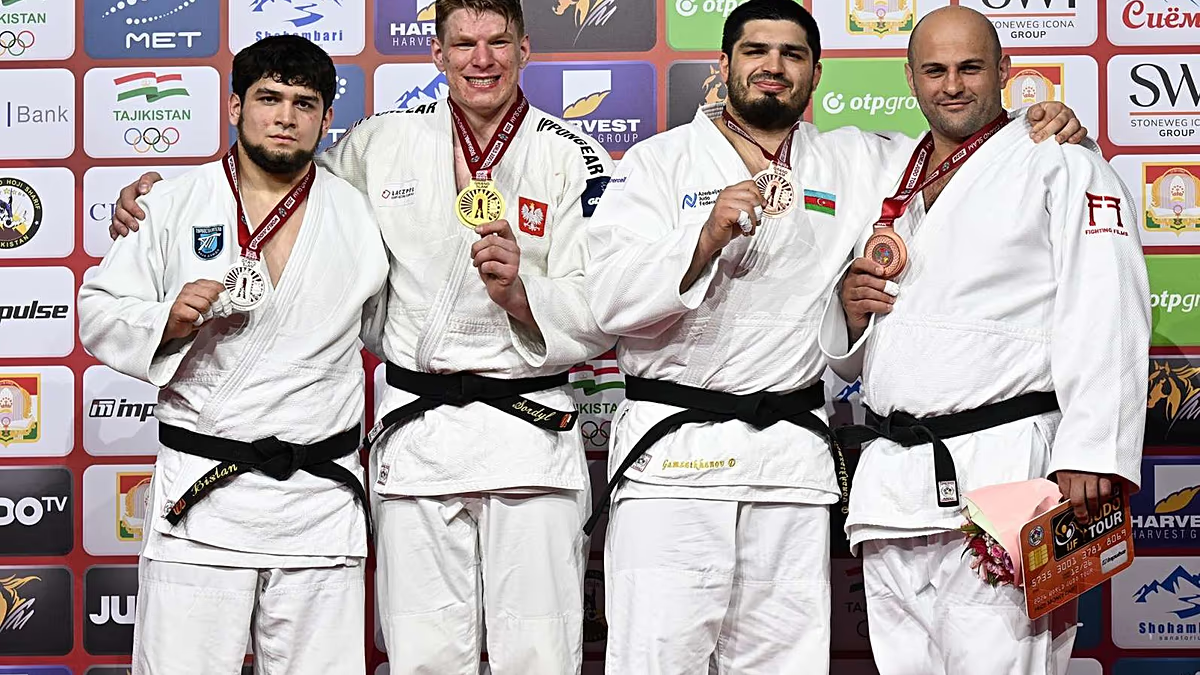
The women’s heavyweight +78 kg category saw a successful title defense as Italy’s Asya Tavano faced Jinesinuer Ayman. Demonstrating tactical brilliance, Tavano utilized a deft O-uchi-gari to secure her victory, clinching the gold medal for the second consecutive year in Dushanbe. Her consistency and skill were celebrated by Mrs. Matlubakhon Sattoriyon, Minister of Culture of the Republic of Tajikistan, who awarded the medals. The tournament’s final gold was claimed in the men’s +100 kg division by Poland’s 22-year-old Jakub Sordyl, who overcame Bislan Katamardov with a commanding turn and hold. This first world tour gold for the Polish athlete was presented by International Judo Federation Executive Committee Member Mrs. Louisa Agius Galea, capping off the individual competitions.
As the curtains closed on another memorable Dushanbe Grand Slam, the judo community reflected on a spectacular event defined by an infectious party atmosphere and outstanding performances, particularly from the host nation’s stars who secured three gold medals. The electric crowd, the warm hospitality, and the seamless organization reinforced Tajikistan’s place as a beloved stop on the world judo tour. With the echoes of this successful tournament still lingering, the global judo family now looks ahead, ready to reconvene next week in Astana for more high-flying action and camaraderie.