

In an era defined by both soaring demand and acute geopolitical instability, the world’s supply chains are being relentlessly tested. Against this backdrop of volatility, the Mediterranean Shipping Company (MSC), a titan of global container shipping, has made a decisive and strategic move. The company has announced the launch of a new express service directly linking major European ports with key commercial hubs in Saudi Arabia and the broader Middle East via the Red Sea. This initiative, reported by Laila Humairah, is a direct response to the mounting disruptions crippling traditional trade routes, primarily stemming from the ongoing US-Iran conflict. MSC’s new service is not merely an additional shipping line; it represents a calculated pivot towards resilience, offering what the company describes as a faster, more efficient, and multimodal alternative for its clients navigating an increasingly treacherous maritime landscape.
The operational blueprint of this new route is designed for maximum efficiency and reach. Ships will originate from ports across Northern Europe, including the Baltic region, and travel southward through the Suez Canal. Their primary destinations are the critical Middle Eastern gateways of Aqaba in Jordan, and King Abdullah Port and Jeddah in Saudi Arabia. MSC emphasizes that its extensive European network will feed into this express corridor, ensuring connectivity from virtually any European point of origin—from the North Sea to the Black Sea. Perhaps most notably, the service leverages King Abdullah Port as a multimodal springboard; from there, cargo destined for other vital Gulf hubs, particularly those in the United Arab Emirates, will be transferred to land transport networks, completing the final leg of the journey by truck or rail.
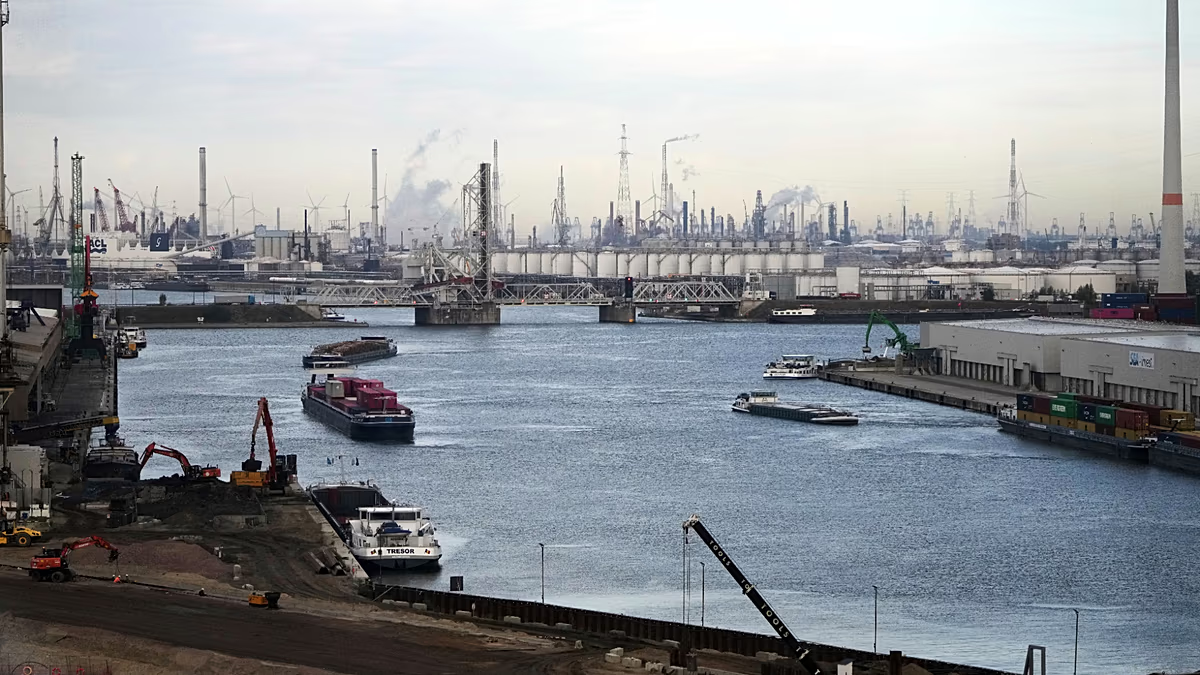
The urgency and strategic intent behind MSC’s announcement are crystallized by the planned departure of the first vessel from Antwerp on May 10th. This swift implementation underscores the critical nature of the challenge it aims to solve. At the heart of the disruption is the Strait of Hormuz, the narrow and historically vital maritime chokepoint situated between the Persian Gulf and the Gulf of Oman. This corridor, through which a significant portion of the world’s seaborne oil and container traffic once flowed, has become effectively restricted. Iranian measures and the heightened military tensions with the United States have transformed this waterway from a global artery into a zone of extreme risk and uncertainty, making it a primary sticking point in international diplomacy.
MSC’s new route is, therefore, a masterclass in logistical adaptation and risk mitigation. By designing a service that sails from Europe directly into the Red Sea and to Saudi ports, the company has entirely bypassed the need to transit the Strait of Hormuz. This rerouting is a profound shift, acknowledging that the traditional pathway through the Persian Gulf is currently untenable for reliable, schedule-conscious container shipping. The decision reflects a broader industry imperative: in the face of persistent geopolitical friction, resilience is no longer just about speed and cost, but about designing redundancy and safer pathways into the very architecture of global trade.
The implications of this move extend far beyond a single shipping schedule. It signals a potential realignment of Middle Eastern logistics, elevating Red Sea ports like King Abdullah Port and Aqaba to new prominence as preferred, safer gateways for European trade. This could have lasting economic repercussions, shifting investment and infrastructure development toward these hubs. For European and Middle Eastern businesses, the service offers a lifeline—a predictable and secure alternative amidst chaos, potentially preventing costly delays and ensuring the continuity of commerce in essential goods and materials.
In conclusion, MSC’s launch of its Europe-Red Sea-Middle East express service is a powerful testament to how global commerce adapts under pressure. It is a direct, operational response to the dangers posed by the US-Iran conflict, specifically the precarious situation in the Strait of Hormuz. By choosing to bypass this flashpoint entirely and leveraging multimodal connections from safer ports, MSC is providing its customers with much-needed stability. This initiative highlights a crucial evolution in modern logistics, where geopolitical risk assessment is now as important as freight rates and transit times. As the first vessel prepares to sail, it carries not just cargo, but a blueprint for navigating a world where trade routes must be as dynamic as the conflicts that threaten to disrupt them.