

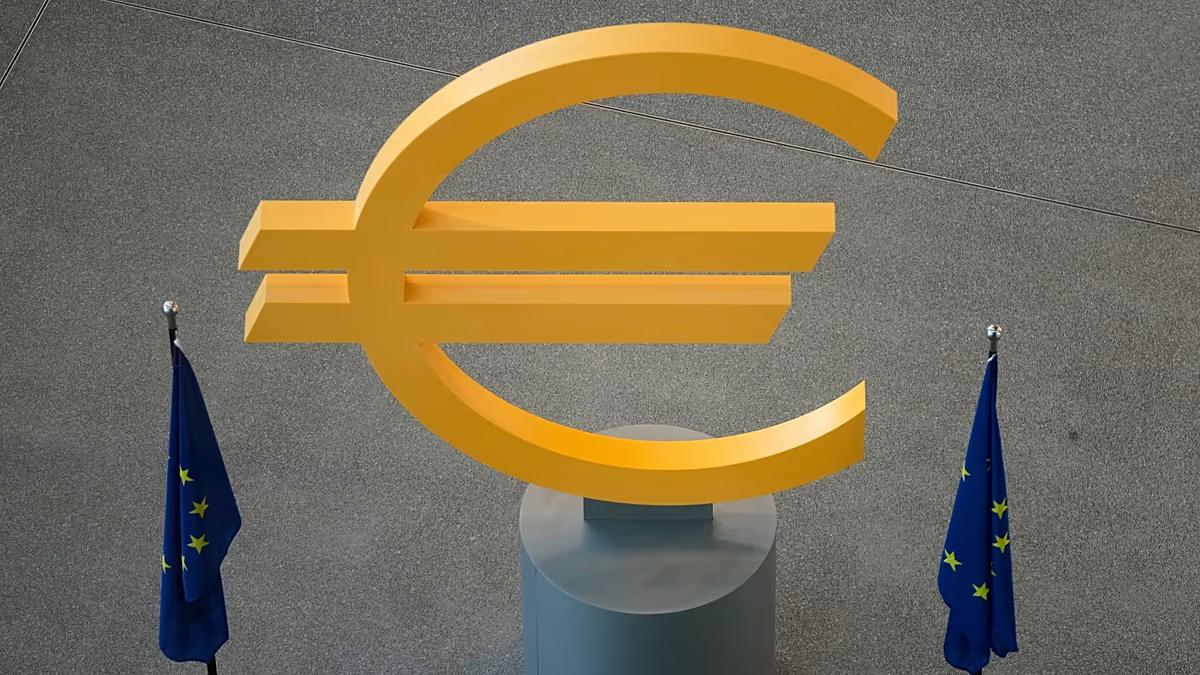
The European Central Bank, as widely anticipated, has chosen to keep its key interest rates on hold. At its latest meeting, the Frankfurt-based institution maintained its deposit facility rate at 2%, marking the third consecutive pause after a prolonged period of hikes. This decision reflects a cautious, watchful stance from policymakers who find themselves navigating an economic landscape of alarming complexity. While the bank reaffirmed its unwavering commitment to taming inflation and returning it to the 2% target, its statement acknowledged a precarious and shifting balance of risks. On one hand, threats to price stability are building; on the other, the very foundations of economic growth are showing signs of weakening.
This delicate and dangerous balancing act is being conducted against a backdrop of profound geopolitical turmoil. The ongoing conflict in the Middle East, specifically referenced by the ECB, has unleashed a powerful wave of economic uncertainty. President Christine Lagarde has described a “stop-start nature” to the hostilities—characterized by fleeting ceasefires, collapsed peace talks, and the imposition and lifting of naval blockades—that makes assessing the economic outlook “exceptionally hard.” The most immediate and painful consequence has been a dramatic surge in energy prices, which directly fuels inflation and simultaneously corrodes business and consumer sentiment. This volatility was starkly illustrated just as the ECB met, with the price of Brent crude oil briefly soaring above $126 a barrel, injecting fresh inflationary pressure into an already strained system.
The latest economic data paints a troubling picture that economists often describe as stagflation—a toxic combination of stagnant growth and persistent inflation. While headline inflation in the eurozone jumped to 3% in April, significantly above target, the more telling core inflation figure, which excludes volatile energy and food costs, held at 2.2%. More concerning is the growth data, which shows the eurozone economy slowing to a crawl. This confluence of high prices and weak expansion has forced major economies like Germany and Italy to downgrade their growth forecasts, as businesses and households reel from elevated energy costs. The ECB is thus caught in a classic policy dilemma: how to avoid suffocating a faltering economy with high rates while also preventing a new wave of inflation from becoming entrenched.
For now, the Governing Council’s strategy is one of heightened vigilance. Policymakers have entered a clear wait-and-see mode, using this period of stability in borrowing costs to observe how the economic shocks propagate through the system. Their primary concern is whether the current energy-driven spike in prices will begin to feed into broader, more stubborn inflationary pressures—affecting wages and the costs of other goods and services. The core inflation rate offers a glimmer of hope that this broader contagion has not yet fully taken hold, but the risk remains acute. Every new development in the Middle East, every fluctuation in the oil market, sends a new ripple through the ECB’s calculus, making any forward guidance exceptionally difficult.
Consequently, the path forward for monetary policy in the eurozone is shrouded in uncertainty. The ECB’s statement and recent communications suggest that any discussion of interest rate cuts has been pushed firmly into the future, dependent on a sustained decline in inflation that the current environment simply cannot guarantee. The bank must constantly weigh the intensifying downside risks to growth against the potent upside risks to inflation. Each meeting from here will involve parsing a torrent of data, filtered through the lens of an unpredictable war. The “duration and depth of the consequences,” as Lagarde noted, are unknown, forcing a policy of reactive patience.
In essence, the ECB is attempting to steer a fragile economic vessel through a perfect storm. With one hand on the wheel of interest rates, held steady for now, and the other shielding its eyes from the blinding spray of geopolitical chaos, the institution’s primary task is to prevent a crisis on either front. The decision to pause is not an indication that the battle against inflation is won, but rather a recognition that the battlefield has become dangerously unstable. The coming months will require a masterful blend of data analysis, economic forecasting, and resilience against external shocks, as Europe’s central bankers strive to secure stability for the continent’s economy in an increasingly unstable world.