


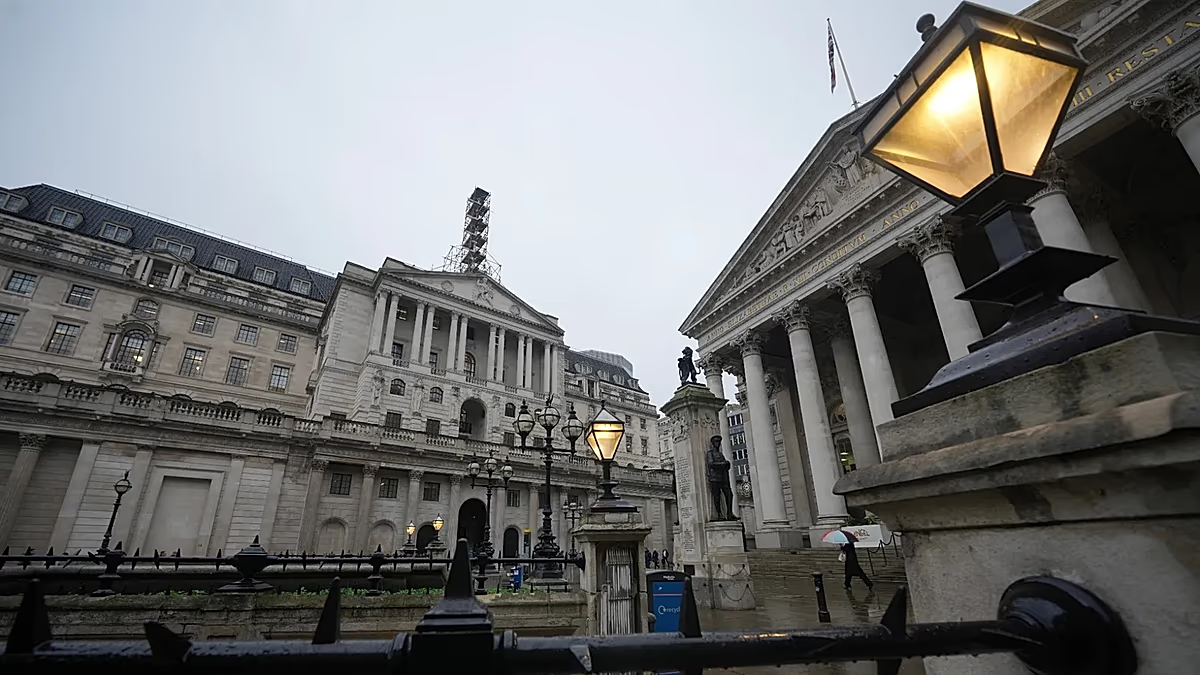
In a world where geopolitical turmoil often dictates economic realities, the Bank of England has opted for stability, holding its key interest rate steady at 3.75%. This decision, announced in late April, reflects a global financial landscape transformed by conflict. The central trigger is a war in Iran and Tehran’s consequential closure of the Strait of Hormuz—a vital maritime artery. This action has sent oil prices soaring to heights not seen in four years, briefly pushing the benchmark Brent crude above $126 per barrel. This price spike echoes the surge witnessed after Russia’s invasion of Ukraine, underscoring how modern conflicts immediately reverberate through global markets. The strait’s closure is particularly disruptive, as roughly one-fifth of the world’s crude oil supply traverses this narrow passage during peaceful times. Consequently, the Bank’s decision to pause, widely anticipated after similar holds by the US Federal Reserve and Japan’s central bank, is a pragmatic response to an unpredictable and volatile external shock.
This unwavering stance marks a sharp departure from the economic expectations that prevailed just months earlier. Before the conflict ignited on February 28th, financial markets were optimistic, anticipating that the Bank of England would soon begin cutting interest rates. Inflation in the UK appeared to be on a steady path back toward the central bank’s 2% target, promising relief for households and businesses. The war has brutally upended that narrative, replacing forecasts of easing pressures with a new reality of spiking costs. The immediate and most visible impact has been on energy. Oil and gas prices have climbed sharply, and uncertainty over the prolonged shutdown of the Strait of Hormuz has caused these costs to race higher in recent days. This energy shock has already translated into measurable economic pain: UK inflation rose to 3.3% in March, a three-month high, driven significantly by a sharp jump in fuel prices at the pump since the conflict began.
The internal deliberations of the Bank’s Monetary Policy Committee (MPC) likely reflected this tense balancing act. While the majority of its nine members voted to hold rates, there may have been one or two dissenting voices advocating for a modest quarter-point increase. Such a hike would be a preemptive strike against the threat of further inflation, a cautious move given the precarious situation. Economists note that even as the MPC held steady this time, it may signal a readiness to increase rates in the future if the Middle East conflict continues to exert upward pressure on prices. Currently, a fragile ceasefire holds, but the situation remains fraught. As Sandra Horsfield, an economist at Investec, observed, the “repercussions of the conflict are still keenly felt and uncertainty about how the situation could evolve also remains high.” The committee’s primary challenge is navigating this uncertainty, guarding against a resurgence of inflation without stifling economic growth.
Beyond the rate decision itself, the accompanying quarterly economic projections and the press conference led by Governor Andrew Bailey carry significant weight. These forecasts, the first since the US and Israel initiated strikes on Iran, are anticipated to paint a gloomier picture of the UK’s economic outlook. They are likely to raise the Bank’s inflation projections, acknowledging the persistent upward push from energy costs, while simultaneously lowering growth estimates. This potential stagflationary scenario—where inflation persists alongside sluggish growth—poses a complex dilemma for policymakers. The updated forecasts will formalize the revised reality that the conflict has injected into the British economy, setting the tone for future monetary policy decisions and informing public and market expectations.
The economic ramifications extend far beyond the halls of the Bank of England, directly impacting government policy and everyday lives. Chancellor Rachel Reeves has acknowledged that the Middle East crisis has thrown her cost-of-living support plans off course. The initial strategy, designed to alleviate financial pressure on households and businesses, must now be recalibrated in response to an external shock that has driven up essential costs across the board. Reeves has stated she is prepared to provide additional support when and if needed, indicating that the Treasury is standing ready to act. This interplay between monetary policy (the Bank’s realm) and fiscal policy (the government’s domain) highlights the multi-front response required to stabilize an economy buffeted by international conflict.
Ultimately, the Bank of England’s decision to hold interest rates is a story of adaptation to a suddenly altered world. It underscores how the threads of global stability are fragile; a conflict in a distant region can swiftly tighten the financial constraints on families in Britain. The steady 3.75% rate is not a sign of calm, but a pause in a storm. It represents a cautious, watchful stance by policymakers who must now factor in the enduring risk of blocked oil routes and protracted warfare alongside traditional economic indicators. The path forward is fraught with uncertainty, where future decisions on rates will hinge not only on domestic data but on the unfolding events in the Middle East, reminding us that the economic well-being of nations is deeply and inextricably linked to the geopolitical peace of the world.