

The Human Cost of Economic Warfare: Iran’s Currency Collapse and Deepening Crisis
The ongoing conflict between the United States and Iran has decisively shifted from overt military strikes to a grinding war of economic attrition. The frontline is no longer marked solely by missiles and drones, but by the plummeting value of Iran’s currency and the tightening vise of a naval blockade. In late April 2026, this strategy was starkly underscored when the Iranian rial traded at an unprecedented 1.8 million to the US dollar—a staggering figure that would have been unimaginable before hostilities erupted in late February. This collapse represents more than a statistical milestone; it is a direct assault on the livelihoods of ordinary Iranians, signaling an intensification of pressure aimed at crippling the nation’s economy from the outside in.
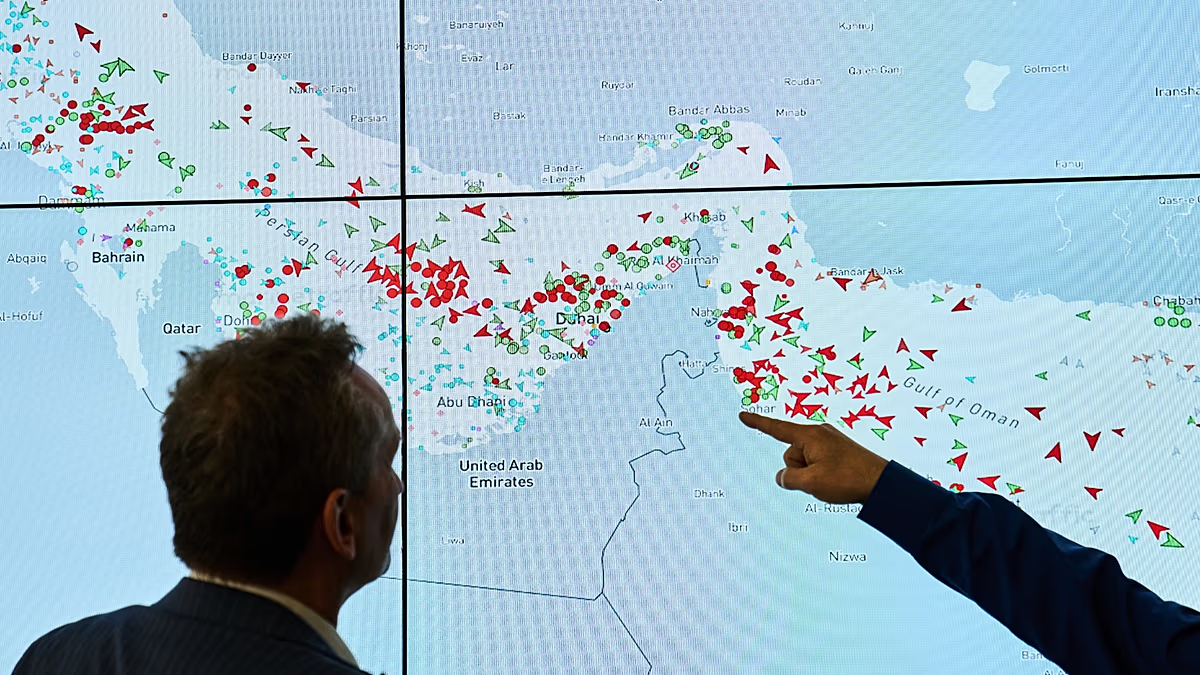
The architect of this pressure, the Trump administration, has made its intentions brutally clear. President Trump explicitly rejected a potential diplomatic overture from Tehran—an offer to reopen the critical Strait of Hormuz in exchange for lifting the US naval siege of Iranian ports. Dismissing the proposal, he framed the blockade not as a military tactic but as a more efficient stranglehold, stating, “The blockade is somewhat more effective than the bombing. They are choking like a stuffed pig.” This sentiment was operationalized in meetings with oil executives and advisors, where the White House discussed maintaining the blockade for “months if needed.” The goal is twofold: to exert “maximum economic pressure” on the regime while attempting, however tenuously, to insulate American consumers from the resulting global oil market disruptions.
This external pressure has acted as a catalyst for an internal economic meltdown. While the rial initially held a shaky stability in the war’s immediate aftermath—primarily because markets and businesses shut down—its decline accelerated violently as commercial activity tentatively resumed. The sudden release of pent-up demand crashed directly into the reinforced wall of sanctions and the blockade, causing the currency’s freefall. This latest plunge is part of a terrifying trend for Iranians; just months prior, the rial had dropped from 1.4 million to 1.6 million per dollar in a single week, a shockwave that helped trigger the widespread popular protests of January, which were met with deadly state repression.
The human impact of these abstract numbers is devastatingly concrete. Iran is already grappling with an inflation crisis of historic proportions, with annual rates soaring above 53%—the highest recorded since the Second World War. More telling is the point-to-point inflation figure of 73.5%, which translates to a near halving of ordinary citizens’ purchasing power in less than a year. This statistical horror manifests in daily life as profound hunger and anxiety. Reports detail the cost of chicken soaring by 75% in a month, beef and lamb by 68%, and basic dairy products by up to 50%. For families, these are not percentage points but impossible choices between nutrition and other essentials.
Beyond the supermarket, the collapsing rial creates a cascade of desperation. Imported goods, including vital medicines and the raw materials needed by Iranian industries, are priced in dollars, making them exponentially more expensive and increasingly scarce. The blockade directly exacerbates this by physically restricting the flow of goods and the government’s ability to inject stabilizing foreign currency into the economy. Medical shortages compound the trauma of war, and factory slowdowns or closures threaten employment. Experts warn that if the blockade holds, the rial will shatter further psychological thresholds, deepening a severe recession and pushing more of the population into absolute poverty.
Thus, the conflict has entered a perilous new phase. The United States, betting on economic suffering to achieve its strategic ends, is systematically constricting the Iranian economy. Meanwhile, the Iranian government faces a dual crisis: the external American pressure and the simmering, justifiable rage of its own people, whose lives are becoming unbearably expensive and precarious. The historic low of the rial is more than a financial data point; it is a meter counting down the pressure inside a sealed vessel. The question is no longer just about nuclear weapons or regional influence, but about how much suffering a population can endure before something—whether it be political change, humanitarian catastrophe, or a desperate escalation—becomes inevitable. The war’s true battlefields are now Iran’s kitchens, pharmacies, and market squares.