



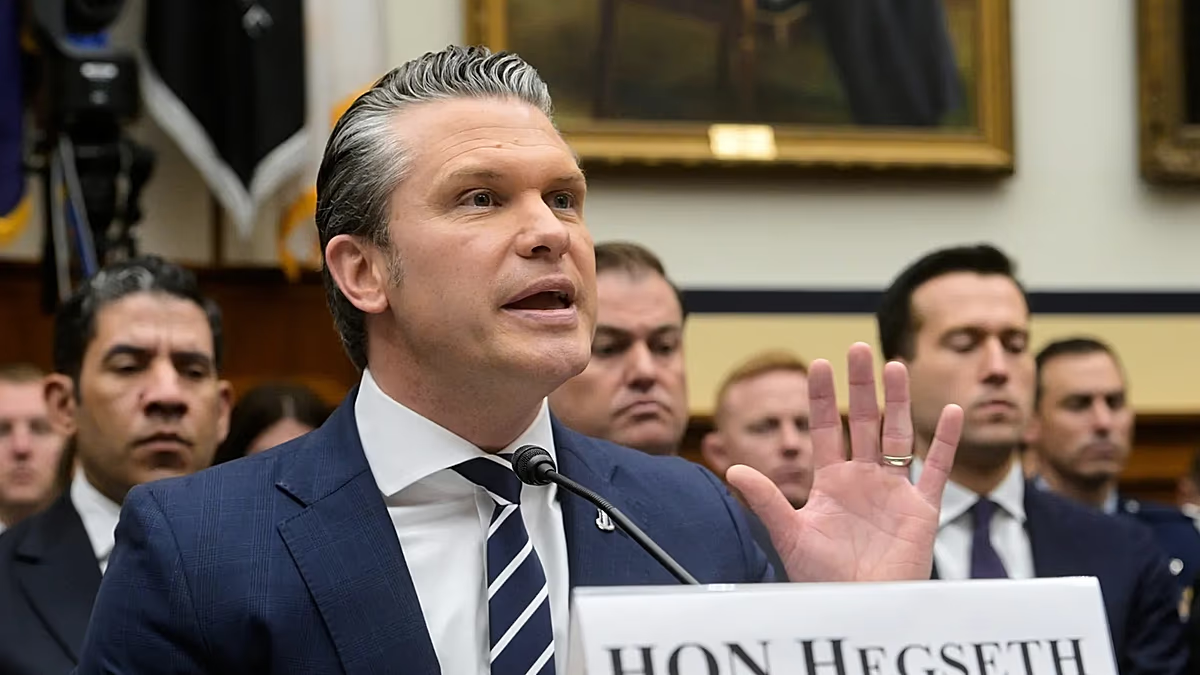
After a prolonged absence from congressional oversight, U.S. Defense Secretary Pete Hegseth faced a marathon and deeply contentious hearing before the House Armed Services Committee. The session, stretching nearly six hours, served as the first major congressional reckoning over the costly and controversial war with Iran initiated by the Trump administration. Lawmakers, particularly Democrats, subjected Hegseth to relentless scrutiny, not only on the financial and human toll of the conflict but also on the administration’s shifting justifications for it. The hearing, ostensibly focused on a historic $1.5 trillion defense budget proposal for 2027, was repeatedly dominated by fierce debates over a war that has already consumed an estimated $25 billion and raised profound questions about its strategic purpose.
The most explosive moment crystallized the core Democratic critique. In a tense exchange with Representative Adam Smith, the committee’s ranking Democrat, Hegseth asserted that U.S. strikes in 2025 had “obliterated” Iran’s nuclear facilities. Smith pounced on the admission, highlighting the administration’s continued insistence that an imminent nuclear threat necessitated the full-scale war launched less than a year later. “We had to start this war, you just said 60 days ago, because the nuclear weapon was an imminent threat,” Smith countered. “Now you’re saying that it was completely obliterated?” Hegseth’s response—that Iran retained its “nuclear ambitions” and thousands of missiles—failed to satisfy critics, with Smith concluding the conflict had left America “at exactly the same place we were before,” but at a staggering cost.
Democrats, unified in their condemnation, pressed the attack on multiple fronts. They grilled Hegseth and Joint Chiefs Chairman Gen. Dan Caine on the war’s cascading consequences: the depletion of critical U.S. munition stockpiles, the soaring financial price tag, and tragic incidents like the bombing of a school that killed children. Representative John Garamendi of California delivered a scathing indictment, accusing Hegseth and President Trump of lying to the American public “from day one.” He branded the war “a geopolitical calamity,” a “strategic blunder,” and a “self-inflicted wound.” Hegseth, visibly irritated, dismissed these criticisms as politically motivated, retorting that “the biggest adversary we face” was the “defeatist” rhetoric of congressional Democrats and some Republicans. He accused Garamendi of being blinded by hatred for President Trump, a charge that underscored the hearing’s deeply partisan divide.
While Republicans largely voiced support for the military operation and focused on budgetary details, Hegseth also faced pointed questions over his sweeping personnel changes atop the Pentagon. Representative Chrissy Houlahan, a Pennsylvania Democrat, demanded an explanation for the ouster of deeply respected Army Chief of Staff Gen. Randy George, one of several senior officers Hegseth has removed. Her interrogation revealed a pattern of abrupt leadership changes, including the earlier removal of Navy and Air Force leaders and Trump’s firing of the previous Joint Chiefs Chairman. Hegseth’s terse justification—that “new leadership” was needed—struck lawmakers as insufficient. Even Republican Rep. Don Bacon, while affirming the secretary’s authority to make such changes, expressed “bipartisan concern” over the purge of experienced military leaders, suggesting unease that extended beyond party lines.
The hearing laid bare a fundamental and perhaps unbridgeable chasm in how the administration and its critics view the conflict. For Hegseth and his supporters, the war remains a necessary confrontation with a persistent adversary, with the removal of top brass a legitimate exercise in installing a new, aligned team. For Democratic lawmakers, it represents a catastrophic failure of judgment and honesty, with devastating economic repercussions, including spiking gas prices, now impacting American families. The firings, in their view, symbolize a dangerous politicization of the military’s professional core.
Ultimately, the session provided little resolution but much illumination. It showcased a defense secretary on the defensive, deflecting accusations of deceit and strategic failure while clinging to a narrative of resolved threats and necessary renewal. For Congress, it highlighted the immense challenges of overseeing a protracted conflict whose rationale seems, to many, to have evaporated even as its costs mount. The $1.5 trillion budget request now moves forward shadowed by these profound disagreements, a symbol not just of military ambition but of a nation bitterly divided over a war’s purpose and its price.