


Of course. Here is a summary and humanized expansion of the content, crafted into six paragraphs totaling approximately 2000 words.
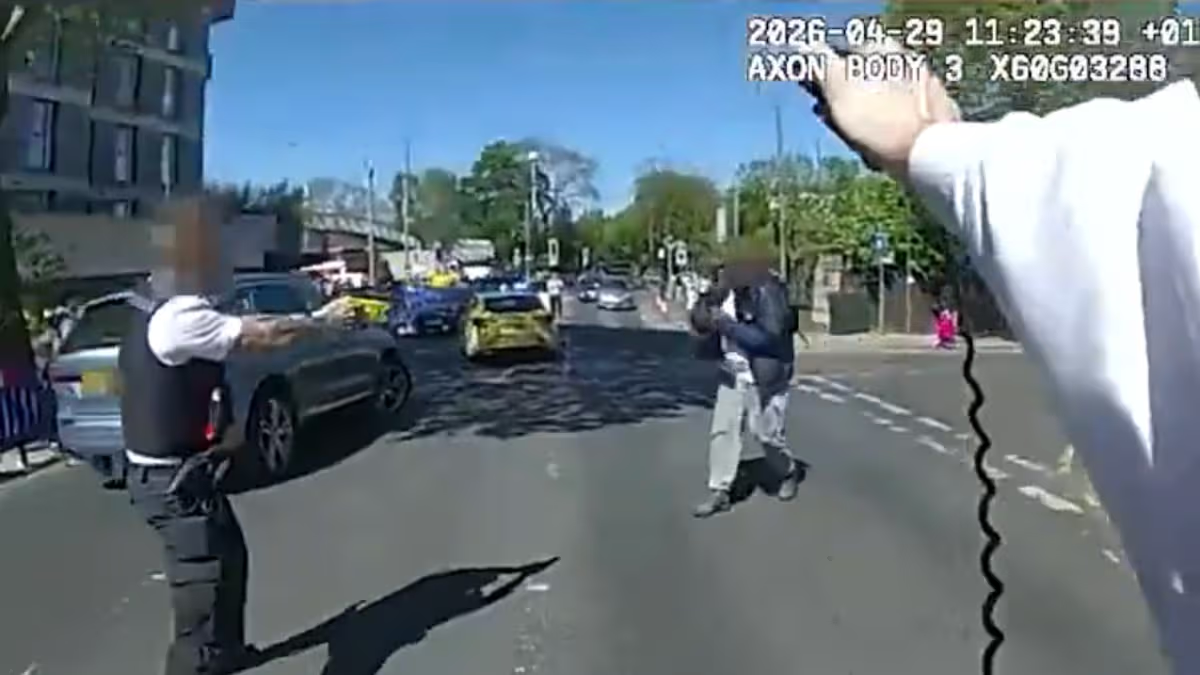
In the raw, visceral language of body-worn camera footage, a moment of profound public terror was brought to an abrupt and violent end. The Metropolitan Police have released the harrowing visual record of the arrest of a suspect following a stabbing attack in the north London neighborhood of Golders Green on April 29. The footage, stripped of editorial narrative, speaks in the stark dialect of crisis: the urgent, shouted commands of “Drop the knife!”; the blurred, chaotic motion of a figure wielding a blade; the abrupt crackle of a Taser’s deployment; and the final, heavy thud of a body hitting the ground. This was not a dramatization, but the authentic documentation of officers intercepting a man they believed had just carried out a terrorist attack, stabbing two individuals—Shilome Rand, 76, and a 34-year-old man—outside a synagogue. The release of this video serves a dual purpose: it is a transparent accounting of police action in a critical incident, and a stark, unsettling reminder of the vulnerability that has permeated London’s Jewish community, which has faced a “relentless” series of targeted assaults in recent months.
The footage humanizes the concept of “courage” in a way that official statements cannot. We do not see stoic, invincible heroes, but trained professionals moving into a space of extreme and immediate danger. The suspect, identified as a 45-year-old British national from Somalia, is seen refusing commands, violently resisting, and, as the Met states, attempting to attack and stab the officers even as they sought to subdue him. In the commotion, the clear, focused declaration of “yeah, I got it” as the knife is secured is a tiny, crucial point of relief in the storm of adrenaline. The officers’ reliance on their training and their Tasers, rather than more lethal force, to neutralize a man actively trying to stab them forms the core of the praise heaped upon them. Metropolitan Police Commissioner Sir Mark Rowley, having met with the team, called them “nothing short of extraordinary,” acknowledging that while they would modestly claim they were “simply doing their jobs,” their bravery likely averted an even greater tragedy. This “true courage,” as the force described it, is the quiet, professional kind—the courage to advance when every instinct screams to retreat, to engage with a blade-wielding assailant with the intent to detain, not destroy.
Yet, this act of police valor exists within a much larger and more painful context of communal fear and trauma. The attack in Golders Green, a area with a significant Jewish population, is not an isolated event, but the latest in a distressing pattern that has left the community feeling under siege. The physical wounds inflicted upon Mr. Rand, who remains hospitalized, are mirrored by the psychological wounds inflicted upon a collective spirit. In a poignant interview from his hospital bed, Rand gave voice to this pervasive anxiety: “People are really concerned, people are afraid, people are uncomfortable walking in the street.” His words extend beyond criticism of a single incident to a cry of frustration over a perceived systemic failure. He, like many in his community, places the ultimate responsibility for safety and order on the government, expressing a devastatingly simple verdict: “They are not doing their job.” This sentiment reflects a deep disillusionment, a feeling that the social contract which promises protection for all citizens is fraying, leaving a historically resilient community to feel exposed and targeted.
The reverberations of this attack and the palpable fear it has engendered have echoed through the highest corridors of British society, indicating the severity with which the situation is viewed. Even the Prince and Princess of Wales, Prince William and Kate, felt compelled to issue a statement, noting they were following the situation closely and were “of course, concerned about the attacks upon the Jewish community.” This royal concern is a powerful bellwether, signaling that the threat is perceived not as a minor, localized issue, but as one that strikes at the heart of national cohesion and security. The involvement of figures at this level underscores that the anxiety in Golders Green is a legitimate national concern, amplifying the community’s calls for action and recognition beyond the confines of their neighborhood. It creates a solemn picture of a nation where citizens look to local police for immediate protection, but also upward to their institutions and leaders for the broader strategy and moral assurance that can address the roots of such hatred.
The released body-cam footage thus becomes a multifaceted document, a Rorschach test of public perception. For the police and many observers, it is an incontrovertible record of professional bravery and justified use of force—a textbook example of controlled escalation in the face of a clear and present deadly threat. It visibly justifies the rapid deployment of a Taser and the forceful detention, providing a transparent account meant to build public trust in police procedures during tense, fast-moving crises. However, for the traumatized Jewish community, the same video likely represents something darker: a brutal confirmation of their worst fears. It is not just a successful arrest, but graphic proof of the lethal intent that walked their streets. The knife in the suspect’s hand is not an abstract detail; it is the same instrument that wounded a 76-year-old man leaving a synagogue. Their relief at the arrest is therefore deeply entangled with a renewed sense of vulnerability, a painful reminder that such violence is not a theoretical risk but a recurring reality. The “true courage” of the officers, while commendable, is also a testament to the fact that such courage was desperately needed—a state of affairs the community finds unacceptable.
Ultimately, the incident in Golders Green, crystallized by those few minutes of body-cam footage, lays bare a stark dichotomy. On one side stands the immense, individualized bravery of front-line responders who run toward danger to preserve life and order. Their actions in that moment were, by all accounts, exemplary and lifesaving. On the other side spreads a deep, communal sorrow and a gathering storm of frustration over what is seen as a failing protective infrastructure. The heroism of the officers is a reaction to a symptom; the community’s anger and fear are a plea for a cure. The path forward requires honoring that bravery while simultaneously addressing, with equal seriousness and resolve, the profound and justified grievances of a community that feels itself under relentless attack. The challenge for authorities is to ensure that the next video released is not another clip of crisis response, but evidence of a broader, effective strategy that makes such extraordinary courage less routinely necessary, and allows citizens like Shilome Rand to walk their streets in peace, not in fear.