



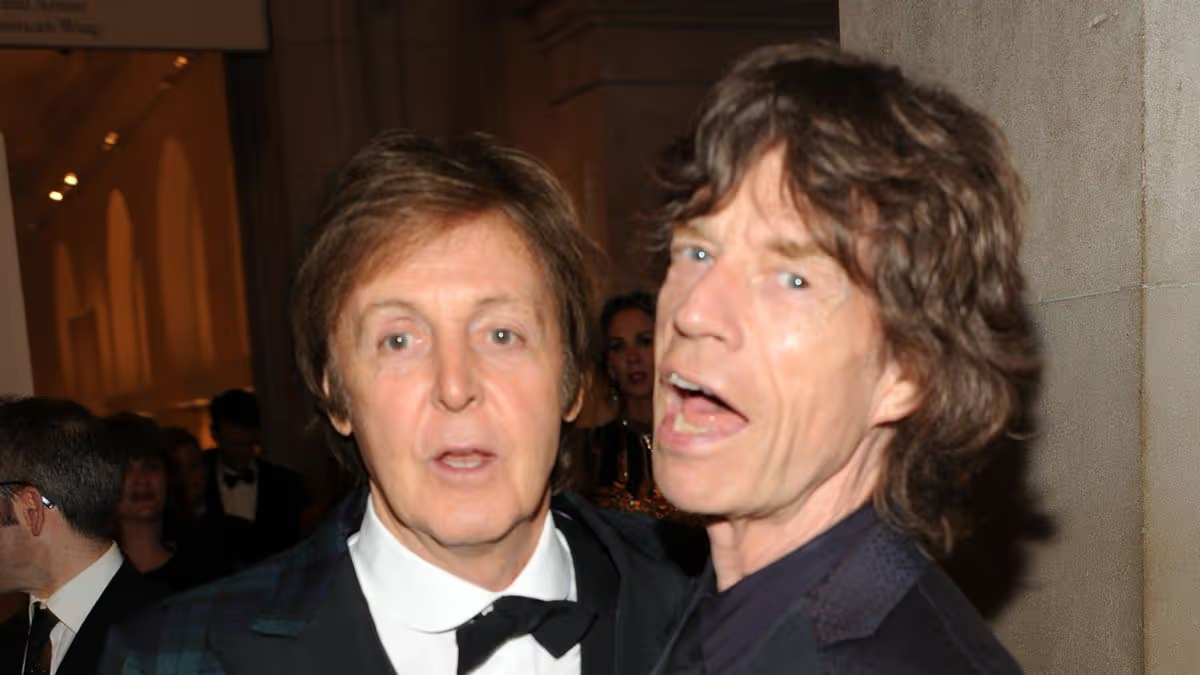
The enduring narrative of 1960s rock music has often been framed as a simple rivalry: The Beatles versus The Rolling Stones. The Fab Four, with their melodic genius and charming personas, against the Stones, the gritty, blues-infused rebels. While this competition did fuel creativity, a fascinating new dimension emerges from music journalist Bob Spitz’s comprehensive biography, The World’s Greatest Rock n Roll Band. It reveals that behind the scenes, a potentially industry-altering alliance was being plotted by the groups’ two most business-savvy members: Paul McCartney and Mick Jagger. Far from being mere “frenemies,” these canny operators saw past the manufactured rivalry and came remarkably close to forming a business supergroup—a “Rolling Beatles” conglomerate designed to dominate the British music scene. Their vision included shared recording studios and a joint record label, a move that would have consolidated unprecedented power. As Spitz notes, both Paul and Mick were the strategic minds of their respective bands, and in the wake of the Stones losing their manager in 1967, they sensed a unique opportunity to seize control of the industry they were already leading artistically.
This ambitious plan went beyond mere concepts. McCartney, in particular, was dreaming big, scouting a headquarters at a disused brewery in Camden, London, complete with a heliport for ferrying bands in and out. Jagger inspected the site and approved, with investment money reportedly set aside. However, the grand scheme ultimately foundered on the rocks of internal band dynamics and differing temperaments. John Lennon and George Harrison were not interested, preferring the independence of their own Apple Corps. Furthermore, Spitz suggests that while McCartney was a visionary “fantasising quite a bit,” Jagger was “a straight head cold blooded businessman” for whom the sprawling plan eventually “did not make sense.” The collapse of this potential partnership meant the two groups continued on their parallel, legendary paths. The Stones, fueled by the songwriting alchemy of Jagger and Keith Richards, would go on to sell hundreds of millions of records and become one of the highest-grossing touring acts in history. Yet, as Spitz’s book details, the perfect harmony they achieved on stage was often absent behind the curtains, where a deep but fractious personal bond was repeatedly tested.
The core of the Stones’ story, as Spitz frames it, is the “unique, fraught, alchemical bond” between Jagger and Richards—a “love story from the very beginning” that was perpetually strained by the extremes of rock and roll life. By the mid-1970s, Richards’ drug use, a formidable appetite for heroin and cocaine, had spiraled dangerously out of control. Spitz recounts shocking episodes from a 1976 European tour where a “seriously f*cked up” Richards, “courting disaster,” would nod off on stage or even fall asleep at the wheel. A near-fatal car crash on the M1 motorway, from which all occupants miraculously walked away, led to his arrest after police discovered drugs in the wreckage. His physical state was dire: emaciated, with sunken eyes and blackened teeth. This behavior eroded Jagger’s tolerance, creating a rift exacerbated by Jagger’s own solo ambitions in the 1980s. Richards, in turn, resented what he saw as Jagger’s neglect of the band. Their relationship, as Spitz wryly observes, involved renewing their vows “so many times it is ridiculous,” yet it endured because their roles within the band’s ecosystem were complementary and non-competitive: “Mick was the peacock and Keith was the master of riffs.”
The chaotic lifestyle also ensnared other members. Ronnie Wood, who joined the Stones in 1975, battled his own infamous addictions. Spitz shares anecdotes of Wood and former Rolling Stones Records president Marshall Chess indulging in massive amounts of cocaine in New York. By the early 1980s, Wood’s addiction had become a critical liability. As the band prepared for a major tour, Jagger threatened to replace him, even approaching other guitarists. Richards, understanding the band as a vital “safety net” for someone in the grip of addiction, fiercely defended his bandmate. Tensions boiled over when Richards caught Wood using drugs secretly during the tour, leading to a physical confrontation. Jagger’s solution was to isolate Wood during the European leg, housing him separately and putting him on a strict weekly allowance to restrict his access to drugs—a drastic measure highlighting the severity of the problem and the pragmatic, if harsh, lengths Jagger would go to preserve the band.
In a remarkable turnaround, the surviving Stones today present a picture of hard-won stability and health. Ronnie Wood, now 78, celebrates 16 years of sobriety. Keith Richards, who long defied every health expectation, finally quit drinking in 2018 and gave up cigarettes in 2020. Mick Jagger, after undergoing heart valve replacement surgery in 2019, maintains a rigorous fitness regimen of cardio, flexibility, ballet, and yoga five to six days a week. This collective rejuvenation has allowed the band not only to continue touring but to create new music. In a fitting full-circle moment, their upcoming 25th studio album, Foreign Tongues, reportedly features none other than Paul McCartney—an echo of that long-ago aborted partnership now realized in pure artistic collaboration.
Spitz’s biography ultimately paints a portrait of a band that navigated the darkest corners of rock excess, losing members like Brian Jones and Mick Taylor along the way, but whose central gravitational force—the complex, codependent relationship between Jagger and Richards—held firm. Whether they sold their souls at the crossroads or simply absorbed their blues heroes’ essence, their connection to each other and to the music has proven unbreakable. From the heights of their early rivalry with The Beatles and the brink of a business merger, through decades of internal strife and personal turmoil, they have emerged, cleaner and wiser, in a “category of one.” Their story is less a simple tale of rebellion and more a profound, decades-long saga of negotiation—with the music industry, with personal demons, and with each other—securing their indelible status as the world’s greatest rock and roll band.