

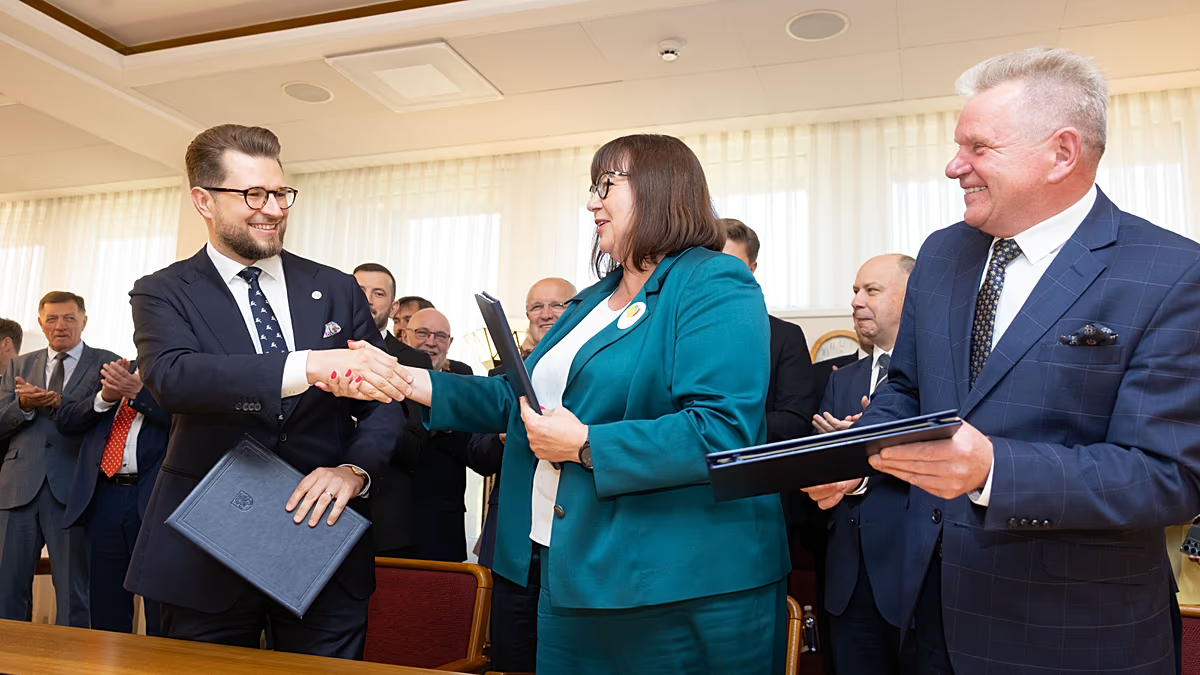
In a significant political realignment, Lithuania’s fragmented parliamentary landscape has coalesced into a new governing coalition. After weeks of negotiation, three major parties—the Social Democrats, the Democrats “For Lithuania,” and the Farmers and Greens Union—alongside their partner, the Electoral Action of Poles in Lithuania–Christian Families Alliance, signed a coalition agreement on Thursday. The deal, heralded by Social Democrat Mindaugas Sinkevičius with the phrase “Third time’s the charm,” marks a deliberate shift toward centrist stability following a period of political turbulence. This new alliance, holding a slim majority of 75 out of 141 seats in the Seimas, aims to project an image of sober governance, moving away from the populist influences that have recently destabilized the government. The formation represents a calculated regrouping of traditional political forces seeking to steady the nation’s course.
The cornerstone of the coalition’s agenda is a twin focus on national security and social welfare, reflecting the pressing concerns of a nation situated on NATO’s eastern flank. In a firm commitment to defense, the partners have pledged to allocate no less than 5% of Lithuania’s GDP to military spending, a figure that would place it among the top contributors in the alliance. This investment is strategically directed toward enhancing air threat detection and defense systems, as well as fortifying the country’s cybersecurity infrastructure. Alongside this hardened external posture, the agreement emphasizes internal social security, aiming to cushion citizens from economic pressures. Perhaps most critically, the coalition has also instituted a principle of resolving internal disputes privately—a rule explicitly designed to present a united front to the public and avoid the public infighting that has plagued previous governments.
A notable and potentially transformative foreign policy shift embedded in the agreement is the aim to “normalise diplomatic relations with China.” As Mindaugas Sinkevičius pointedly observed during the press conference, “Poland, Germany, all countries have [diplomatic relations with China], except us.” This statement underscores a deliberate move away from Lithuania’s uniquely hardline stance, which was championed by the previous government. The new coalition appears to be advocating for a pragmatic, European-consensus approach, with Sinkevičius humorously noting that while Lithuania sometimes enjoys being unique, “maybe we shouldn’t stand out.” This recalibration seeks to reintegrate Lithuania’s economic and diplomatic posture with that of its EU partners, signaling a departure from a more confrontational isolation.
The practical mechanics of governing this diverse coalition are now underway, with the delicate process of dividing ministerial portfolios being a key test of its unity. The Social Democrats, as the largest party in parliament, are set to retain control of nine crucial ministries, including Defense, Finance, Foreign Affairs, and the Interior. The Democrats “For Lithuania” will oversee three: Health, Agriculture, and Energy. Meanwhile, the Farmers and Greens Union, together with its allies, will assume responsibility for the Economy and Justice ministries. While the specific appointments are to be announced next week, Mindaugas Sinkevičius has confirmed his readiness to lead the new government as Prime Minister. The outgoing Prime Minister, Inga Ruginienė, is assured a continued role as “an important member of the team,” and Social Democrat Juozas Olekas is expected to remain Speaker of the Seimas, ensuring some continuity amidst the change.
This new political configuration is a direct result of the expulsion of the populist Dawn of Nemunas party from the previous ruling coalition. The Social Democrats made the decisive move to eject the party, citing concerns that its leader, Remigijus Žemaitaitis, was “becoming more radical.” Žemaitaitis had been barred from handling classified information and was convicted for antisemitic statements, making his party a liability for a government seeking international credibility and domestic stability. The Democrats “For Lithuania,” who had previously refused to govern with Dawn of Nemunas, agreed to return to the fold, enabling this new alliance. This reshuffle effectively rectifies a previous misstep where, instead of ousting the troublesome populists, the Social Democrats had instead sidelined the Democrats, bringing in the Farmers and Greens and their sometimes-controversial Polish-Alliance partners. The current deal is thus presented as a correction—a return to a more predictable and cooperative center-ground.
The formation of this coalition represents a conscious choice by Lithuania’s mainstream parties to prioritize governance over political drama. Acknowledging the challenges ahead, Democrats “For Lithuania” interim leader Virginijus Sinkevičius admitted, “It won’t be easy… this will not be a stroll in the park.” The coalition’s success hinges on its ability to maintain discipline, honor its private dispute-resolution clause, and deliver on its ambitious promises of strengthened defense and social security. By removing a source of radical rhetoric and institutional turmoil in the Dawn of Nemunas, and by seeking to harmonize its foreign policy with European allies, this government aims to offer Lithuanians a period of steady and reliable leadership. The world will be watching to see if this “third time” indeed proves to be the charm for a nation navigating complex geopolitical currents.