

Paragraph 1
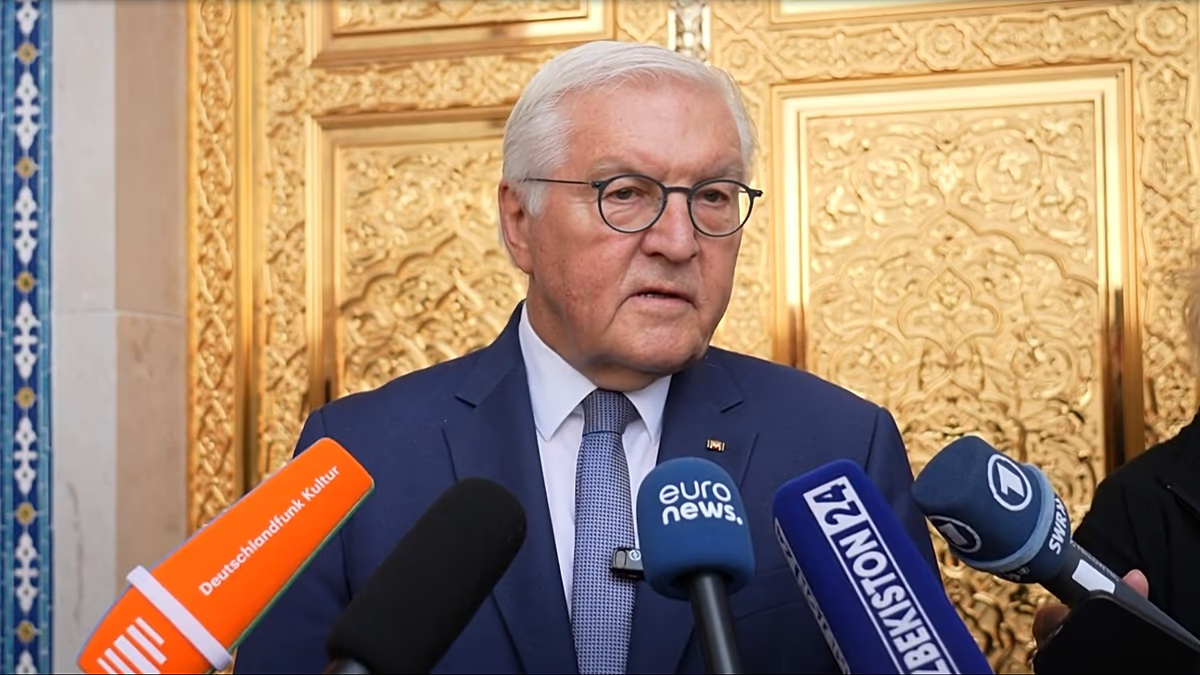
German President Frank-Walter Steinmeier’s recent visit to Tashkent, Uzbekistan, was more than a diplomatic formality; it was a personal reflection on a decades-long effort to build bridges. Speaking to Euronews, Steinmeier expressed profound gratitude for the transformation he has witnessed since first championing deeper German engagement with Central Asia as Foreign Minister in 2006. He acknowledged that the path was not always smooth, but the vibrant dialogue and warm reception he received from Uzbek leaders proved how far the relationship has come. This visit, part of a broader Asian tour, was underpinned by a clear conviction: “We have partners here,” Steinmeier stated, signaling a mature and confident partnership ready for deeper strengthening across political and economic spheres.
Paragraph 2
The heart of the visit was a series of high-level talks at the Uzbek presidential residence, Kuksaroy, between Steinmeier and President Shavkat Mirziyoyev. Their discussions mapped out an ambitious future, covering political dialogue, trade, investment, education, and critical transport links connecting the region. Both leaders reaffirmed a shared commitment to deepen cooperation in very practical sectors—from industry, energy, and mining to agriculture, healthcare, and logistics. President Mirziyoyev paid special tribute to Steinmeier’s longstanding personal contribution to fostering ties not just between their two nations, but between the entire European Union and Central Asia. Satisfied with the current momentum, they agreed to translate these discussions into action by preparing a comprehensive roadmap to implement their new agreements.
Paragraph 3
The economic dimension of this partnership is both robust and growing. Germany stands as one of Uzbekistan’s most crucial European economic partners, with bilateral trade surpassing $1.4 billion last year and continuing to climb. The foundation is solid, with cumulative German investment reaching approximately $2 billion. This visit built upon recent successes like the “Days of German Economy” in Tashkent last May, which yielded over $1 billion in new trade and investment deals. Steinmeier noted the ever-increasing interest from German businesses, stating, “German technology is well known and recognised here.” He highlighted specific new projects, including investments in manufacturing and logistics, and pointed to expanding plans from corporate giants like Volkswagen and Henkel as proof of the relationship’s dynamic potential.
Paragraph 4
A particularly forward-looking aspect of the talks addressed human capital. Recognizing Germany’s pressing need for skilled workers and Uzbekistan’s growing, youthful population, the two countries are forging a unique connection. A recently signed migration and mobility agreement paves the way for recruiting qualified Uzbek specialists for the German labour market. This official framework is bolstered by strong organic cultural ties: over 400,000 Uzbeks are currently learning the German language, and more than 2,000 Uzbek students are pursuing higher education in Germany. To institutionalize this exchange further, the leaders celebrated an agreement to establish an Uzbek-German University of Applied Sciences in the historic city of Samarkand, a landmark project in educational cooperation.
Paragraph 5
The partnership extends far beyond boardrooms and government halls into the rich soil of culture and education. The leaders pledged to continue academic and professional exchanges by planning a second Forum of Universities and a third Uzbek-German Medical Forum in Tashkent. Steinmeier personally immersed himself in Uzbekistan’s heritage during a visit to the stunning Centre for Islamic Civilisation, where he explored exhibits tracing the region’s profound history. He described the center as a beacon for learning and research, emphasizing that these people-to-people and cultural connections form the indispensable soul of the bilateral relationship, fostering mutual understanding that sustains political and economic ties.
Paragraph 6
In summary, President Steinmeier’s visit was a powerful testament to a relationship that has evolved from cautious diplomacy to a multifaceted strategic partnership. From a solid economic base of billions in trade and investment, to innovative collaborations addressing workforce needs, to deep academic and cultural exchanges, the foundations for cooperation are stronger than ever. The tour highlighted a relationship no longer focused on potential but on active, confident collaboration. For both Germany and Uzbekistan, this strengthened bond offers a pathway to greater prosperity and understanding, positioning Uzbekistan as a key partner for Germany and the EU in Central Asia, and showcasing how sustained engagement can yield tangible results for both nations.