


The Global Green Bond Initiative: A Sustainable Vision Confronts Geopolitical Realities
The European Union’s Global Green Bond Initiative stands as one of its most ambitious financial instruments, designed to mobilize between €15 and €20 billion for sustainable infrastructure and climate projects in partner nations worldwide. Conceived as a cornerstone of the European Green Deal, its goal is to channel investments into vital projects like solar farms in Algeria, wastewater treatment plants in India, and light rail systems in the Dominican Republic. By leveraging the European Investment Bank (EIB) and other development institutions as anchor investors, the initiative aims to foster a global transition to a greener economy. However, the noble intentions behind this vast funding mechanism are now colliding with a transformed and tense geopolitical landscape, revealing significant unintended risks that threaten to undermine the EU’s own strategic priorities.
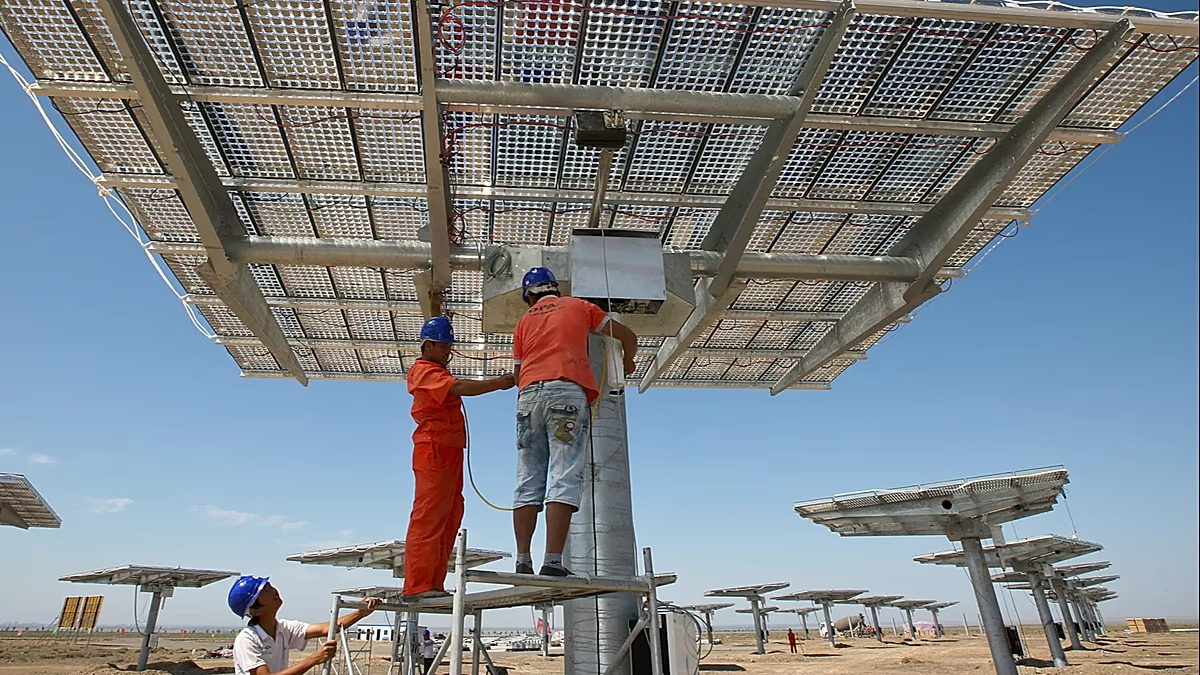
At the heart of the dilemma is a stark economic reality: the overwhelming dominance of Chinese companies in the global renewable energy technology market, particularly in the production of solar panels and inverters. EU officials anonymously express a grave concern that without specific safeguards, a substantial portion of the Green Bond Initiative’s funds will inevitably flow to Chinese suppliers. This prospect directly conflicts with Brussels’ urgent policy of “de-risking”—reducing strategic dependencies on Beijing in critical supply chains. The initiative’s governance framework, finalized only in April 2024, was designed before the EU fully crystallized its economic security doctrine, resulting in a critical absence of a “China clause” that would restrict or discourage the use of Chinese vendors in EU-funded projects abroad.
The risks extend far beyond economic dependency into the realm of national and energy security. The European Commission has explicitly cited cybersecurity threats posed by “high-risk” solar inverters—a category dominated by Chinese manufacturers like Huawei. The fear is that such embedded technology could be remotely manipulated to destabilize energy grids, potentially causing blackouts. While the Commission has issued guidance to phase out these components in EU-funded projects, this does not yet comprehensively apply to external initiatives like the Green Bond Initiative. This creates a dangerous paradox: the EU could be financing infrastructure in partner countries that introduces vulnerabilities into their energy systems and, by extension, into interconnected grids, especially in neighboring regions like North Africa.
This tension has ignited a bureaucratic and philosophical struggle within the EU’s own institutions. The European Commission, as the political body, is pushing for the strict application of its cybersecurity and de-risking rules across all financial instruments. On the other side, development finance institutions like the EIB prioritize financial viability and return on investment, arguing that mandating more expensive non-Chinese suppliers can make projects commercially unfeasible. They have resisted blanket bans and sought exemptions. This conflict leaves the initiative’s future execution unclear, caught between the imperative of rapid green investment and the new imperative of strategic autonomy.
The resolution of this conflict now hinges on complex governance. The initiative’s day-to-day fund manager is Amundi, a major asset manager whose primary fiduciary duty is to its investors. The Commission is expected to pressure Amundi to incorporate geopolitical risk into procurement decisions, but this must be applied to a project pipeline developed without such stringent requirements. The fundamental challenge remains: Brussels has so far been reluctant to cover the significant cost differential that would incentivize partner countries to choose more expensive, non-Chinese technology, leaving them with a powerful financial motive to opt for Chinese suppliers.
Ultimately, the story of the Global Green Bond Initiative encapsulates the EU’s broader struggle to reconcile its ambitious climate leadership with a hardening geopolitical posture. It highlights how policies crafted for one era can be upended by the realities of another. The initiative’s success is no longer measured solely by gigawatts of renewable energy installed or cubic meters of water treated, but also by whether it strengthens or inadvertently undermines European security and strategic resilience. The ongoing “back and forth” between EU bodies signifies a pivotal moment where financial tools are being reassessed through a national security lens, a process that will define the bloc’s ability to project its values and protect its interests in a contested world.