



The AI-Powered Workplace: How Salesforce is Reinventing the Enterprise
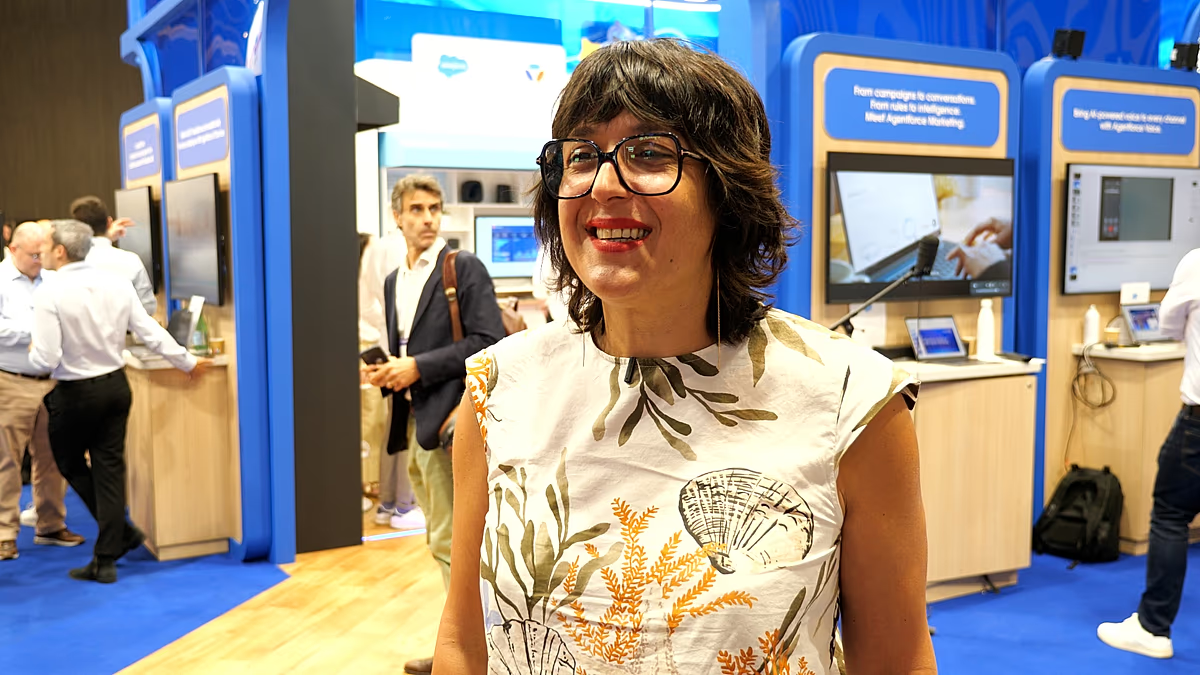
Once synonymous with customer relationship management (CRM) software, Salesforce is strategically pivoting to place artificial intelligence at the core of its vision for the future of business. Moving beyond its legacy of tracking sales leads and service requests, the company is now championing what it terms the “agentic enterprise.” This model envisions a seamless partnership where AI agents operate collaboratively alongside human employees across every business function, from marketing and sales to customer support and human resources. This shift represents a fundamental evolution in how the company sees its role, transitioning from a provider of organizational tools to an architect of intelligent, autonomous business ecosystems. As Emilie Sidiqian, CEO of Salesforce France, explained at the Vivatech conference in Paris, the journey has been from “data to AI, AI to the agentic enterprise,” with a core mission to “reinvent the way all enterprises need to embrace the AI revolution.”
Building the Agentic Infrastructure: Acquisitions and Platforms
To realize this ambitious vision, Salesforce is actively building and acquiring the necessary technology. In 2024, the company launched Agentforce, its dedicated AI-agent platform designed to integrate conversational AI directly into business workflows. A significant acceleration of this strategy came with the recent announcement of a $3.6 billion deal to acquire Fin, a customer-service AI company. Fin’s technology specializes in autonomously answering customer questions and resolving support cases, a capability that perfectly complements Salesforce’s service cloud ambitions. These moves signal a massive financial and strategic commitment to embedding sophisticated, action-oriented AI deeply into the fabric of business operations, moving far beyond simple chatbots to systems capable of independent task resolution.
Tangible Results: From Support Cases to Job Placements
The promise of the agentic enterprise is already translating into measurable outcomes for early adopters, according to Salesforce. The company cites impressive metrics from its Agentforce platform, including 66% autonomous resolution of customer service cases, a 15% increase in marketing pipeline generation, and lead conversion rates nearly doubling. Real-world implementations provide concrete examples: SharkNinja, a global home appliance maker, now uses these AI agents to provide 24/7 customer support across 30 countries. Perhaps more strikingly, the Swiss staffing giant Adecco has leveraged AI-powered conversations to engage with 1.2 million job candidates, a scale of interaction that helped accelerate 50,000 successful job placements. These cases demonstrate AI’s potential not just for efficiency, but for scaling human-centric services like recruitment to unprecedented levels.
A Leadership Imperative, Not Just a Tool
For Sidiqian, integrating AI is not a mere IT upgrade but a profound leadership challenge and strategic inflection point. She emphatically states that enterprise AI is “for everyone,” from small startups to multinational corporations, but its successful adoption hinges on executive vision. “This is not a tool,” she argues. “This is a small wave of a new kind of innovation… When you really reinvent your business model, it is the leaders who need to understand how they will transform every single job in the company.” She positions this as a paramount question that must be “carried by the CEO and by every single executive committee.” The goal is not displacement but transformation—creating a “hybrid” work model where humans remain “at the centre” for strategy, creativity, and complex judgment, while AI agents manage routine, repetitive, or data-intensive tasks.
Leading by Example: AI as the Daily Cockpit
Sidiqian personally embodies this top-down adoption, using AI tools daily to navigate her own workload. She highlights her use of Slack (owned by Salesforce), where an AI assistant acts as a “concierge,” summarizing overnight activity from global teams and flagging items requiring her approval. This approach aims to combat application fatigue by using AI as a unified “cockpit” for work—a central intelligence that organizes tasks, data, and permissions. By actively using and advocating for these tools, she believes leaders can demystify AI and foster a culture of experimentation. “When you have the right leadership, when you have the right adoption, when you carry this revolution at the heart of your business model, there is a huge opportunity for growth,” she asserts, framing conscious adoption as a direct competitive advantage.
The Human-Centered Future of Work
Ultimately, Salesforce’s narrative is one of augmentation over automation. The agentic enterprise is framed not as a driver of job elimination, but as a catalyst for job transformation and business growth. By allowing AI to handle high-volume, repetitive interactions and administrative burdens, the company argues that human employees can be freed to focus on more meaningful, strategic, and creative work that requires emotional intelligence and complex problem-solving. The rapid pace of this change, as Sidiqian notes, impacts “all types of jobs, all types of activities,” making thoughtful leadership and ethical implementation more critical than ever. The challenge and opportunity for businesses lie in navigating this transition deliberately, ensuring that the AI revolution enhances human potential and drives inclusive growth, rather than leaving workforces behind.