



Unearthing Earth’s Cosmic Scars: A Spanish Crater Holds Clues to Martian Mysteries
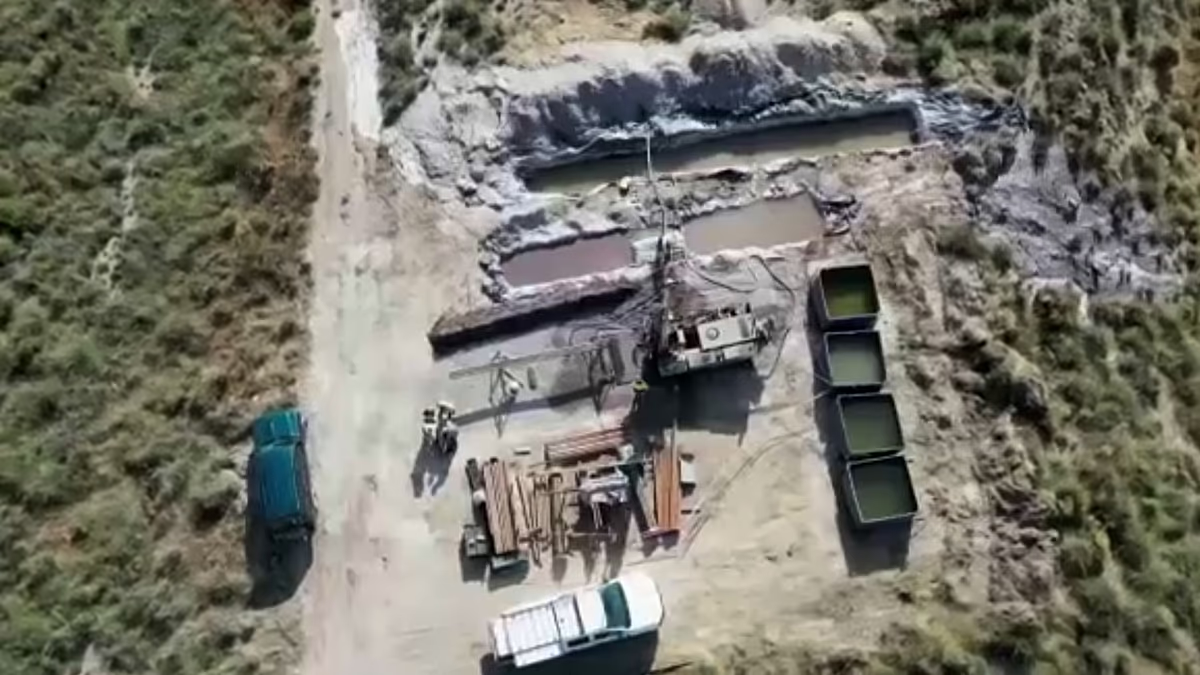
In the sun-baked province of Almería in southern Spain, a team of scientists is undertaking a profound journey into deep time. Their mission: to drill 500 meters into the heart of the country’s only internationally recognized meteorite crater, a scar left by a cataclysmic event roughly eight million years ago. This isn’t merely an archaeological dig into rock; it’s a voyage to a moment of violent celestial contact. By extracting long, cylindrical cores from deep beneath the surface, the researchers aim to piece together a geological detective story. They seek to understand how the unimaginable force of the impact—a sudden release of energy greater than any earthly volcanic eruption—instantly reshaped and melted the surrounding bedrock, and how, over eons, the colossal wound was slowly healed by the patient hands of erosion and sedimentation. This core sample is a time capsule, preserving a layered history of recovery written in stone.
The primary treasure hunters in this subterranean quest are searching for a specific, telling mineral signature known as “shocked quartz.” To the untrained eye, quartz is a common, crystalline mineral found worldwide. However, when subjected to the extreme pressures and temperatures of a hypervelocity meteorite impact—forces far beyond any terrestrial volcanic event—its crystalline structure is deformed in unique, telltale ways. Finding these microscopic fingerprints locked within the rock would be the definitive proof of the crater’s extraterrestrial origin and a direct measure of the impact’s staggering power. It is the geological equivalent of finding gunpowder residue at a crime scene, incontrovertible evidence of a singular, explosive event that forever altered the local landscape millions of years before humans walked the Earth.
This research, however, stretches its significance far beyond the arid hills of Andalusia. The scientists explicitly frame their work as a mission of cosmic comparison. By meticulously studying how this crater formed, deformed the crust, and subsequently eroded, they are creating a detailed playbook of impact geology. This playbook becomes an invaluable tool for understanding the surfaces of other worlds, particularly Mars. The Red Planet is littered with impact craters, both vast and small, but its cold, dry climate and lack of plate tectonics have preserved them in a state of suspended animation, far older and less weathered than most on Earth. By comparing the Almería crater—a relatively young and well-understood example—with Martian counterparts, researchers can better interpret the forces that shaped our planetary neighbor and estimate the timing of its most dramatic events.
Furthermore, the project promises to illuminate the broader environmental consequences of such an impact on Earth itself. While this particular meteorite struck long before the dawn of humanity, understanding its effects provides a template for similar events in our planet’s history, some of which have been linked to mass extinctions. The core samples will reveal not just the immediate shock effects on rock, but also how the crater basin evolved afterward. Did it become a lake, collecting sediments and perhaps fossilized evidence of recovering ecosystems? The slow fill of the crater, layer by layer, is a narrative of the region’s climatic and ecological history following a global-scale trauma, offering a case study in planetary resilience.
The practical execution of this endeavor is a feat of modern engineering and international collaboration. Utilizing a specialized drilling rig, the team must carefully extract the deep core samples without disturbing their delicate structural integrity. Each segment of the core, as it is brought to the surface, is meticulously cataloged and prepared for analysis by geologists, mineralogists, and astrobiologists. The data gathered here will join a global repository of impact research, contributing to our defense strategies for planetary protection and refining models used to assess future impact risks. It’s a reminder that studying these ancient collisions is not purely an academic pursuit; it is part of understanding the ongoing dynamic relationship between Earth and the solar system we inhabit.
In essence, the quiet, determined work in the Spanish desert transcends its location. It connects a specific point on our map to the grand canvas of the solar system. The Almería crater is a terrestrial proxy, a natural laboratory where scientists can decode the universal language of impact violence. As they analyze the shocked quartz and the layered sediments, they are not only reconstructing a single, forgotten moment from eight million years ago but are also developing the lexicon needed to read the history of Mars and the Moon. This drill site, therefore, is a bridge between worlds, a place where Earth’s past is excavated to clarify the geology of other planets, reminding us that our world is part of a cosmic environment where such dramatic encounters are not merely possible, but a fundamental part of our shared history.