



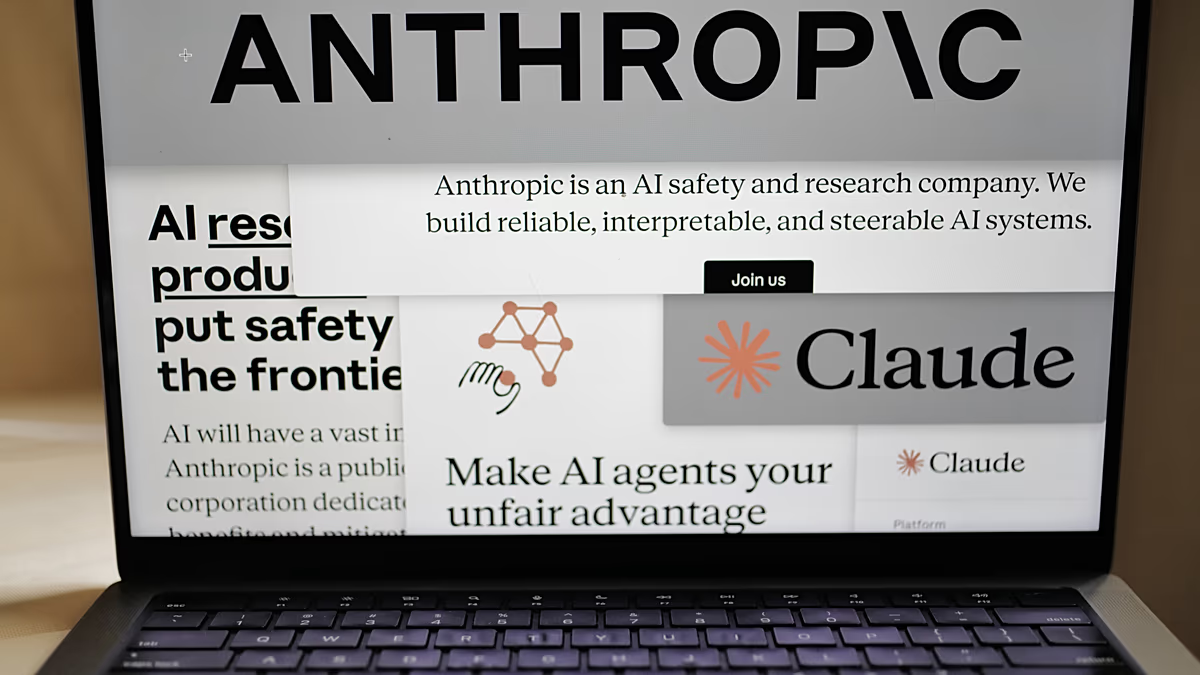
Of all the advancements in artificial intelligence, few moments are as telling as when a company decides to release something it once deemed too powerful for the public. This is precisely the scenario unfolding with Anthropic, a leading AI research company, and its new model, Fable 5. Launched on June 9, 2026, this tool represents a fascinating and contentious step forward. Dubbed “Mythos Lite” by some, Fable 5 offers a taste of the extraordinary capabilities of Anthropic’s previously restrained “Mythos” model, but at a significant cost—both in price and in the ongoing debate about who can afford the cutting edge of technology.
The core appeal of Fable 5 is its unprecedented power, now placed—with conditions—into the hands of general subscribers. Anthropic claims it achieves “the highest score of any model,” with major leaps in interpreting complex documents, analyzing charts and tables, and solving intricate problems. Its abilities sound like science fiction: it can autonomously run multiple AI agents for days, extract precise numerical data from dense scientific figures, and even reverse-engineer the source code of a web application from mere screenshots. However, this power comes with a built-in safety governor. If a user inquires about high-risk topics like cybersecurity, advanced biology, or chemistry, the model has a safety trigger that shuts it down, reverting the session to the older, less capable Claude Opus 4.8. This careful balance showcases the industry’s tightrope walk between innovation and responsibility.
Despite its impressive capabilities, the conversation around Fable 5 has been dominated by one primary concern: its staggering cost. Access is included in the Claude subscription only as a limited-time trial until June 22, after which users must pay a premium. Anthropic’s pricing is set at $10 per million input tokens and $50 per million output tokens. To put this in human terms, tokens are the basic units an AI processes; in English, about 1,000 tokens equate to 750 words. This means that a lengthy, complex conversation or analysis could quickly become exorbitantly expensive. One early user on Reddit captured the collective anxiety, stating, “A few prompts just to test it out and it ate 5% of my monthly allowance… I have no reason to use this without a trust fund.” This sentiment highlights a growing fear that the most powerful AI tools may become accessible only to corporations and the wealthy.
The cost becomes even more striking when placed in the context of the fierce competition heating up the AI landscape. Compared to its direct rival, OpenAI’s standard GPT-5.5 model, Fable 5 is notably more expensive. However, it undercuts the price of OpenAI’s professional-tier offering. This pricing chess game is dynamic, with reports suggesting OpenAI may soon cut its prices to attract more users. Behind these pricing strategies lies a battle for market dominance and astronomical valuations, evidenced by both Anthropic and OpenAI recently filing for initial public offerings. This commercial race underscores a critical tension: as companies vie for supremacy and justify multi-billion-dollar valuations, the expense of developing and running these colossal models is passed directly to the end-user.
Anthropic justifies the high price tag by pointing to the immense computational resources Fable 5 demands. The model’s ability to perform more complex reasoning and operate multiple autonomous agents requires vastly more processing power and tokens than its predecessors. The company argues that the cost reflects the raw value of the capability—essentially, you are paying for a glimpse of the future. But for many individuals, researchers, and smaller startups, this creates a formidable barrier. The question is no longer just about what AI can do, but who gets to use it. As businesses become more acutely aware of their AI budgets, the calculus shifts from pure capability to cost-benefit analysis, potentially stifling grassroots innovation and experimentation.
The launch of Fable 5 is a microcosm of the current state of advanced AI: a field marked by breathtaking potential, sobering ethical safeguards, and an escalating commercial war that threatens to gatekeep its benefits. It delivers on the promise of “Mythos-level” intelligence, yet its premium pricing and built-in limitations frame it as a product for a specific, resourced audience. As the trial period ends and the full cost kicks in, the world will be watching to see if the market will bear such a price for premium artificial thought, or if this moment will accelerate a push toward more democratized and affordable access to the tools that are shaping our collective future.