




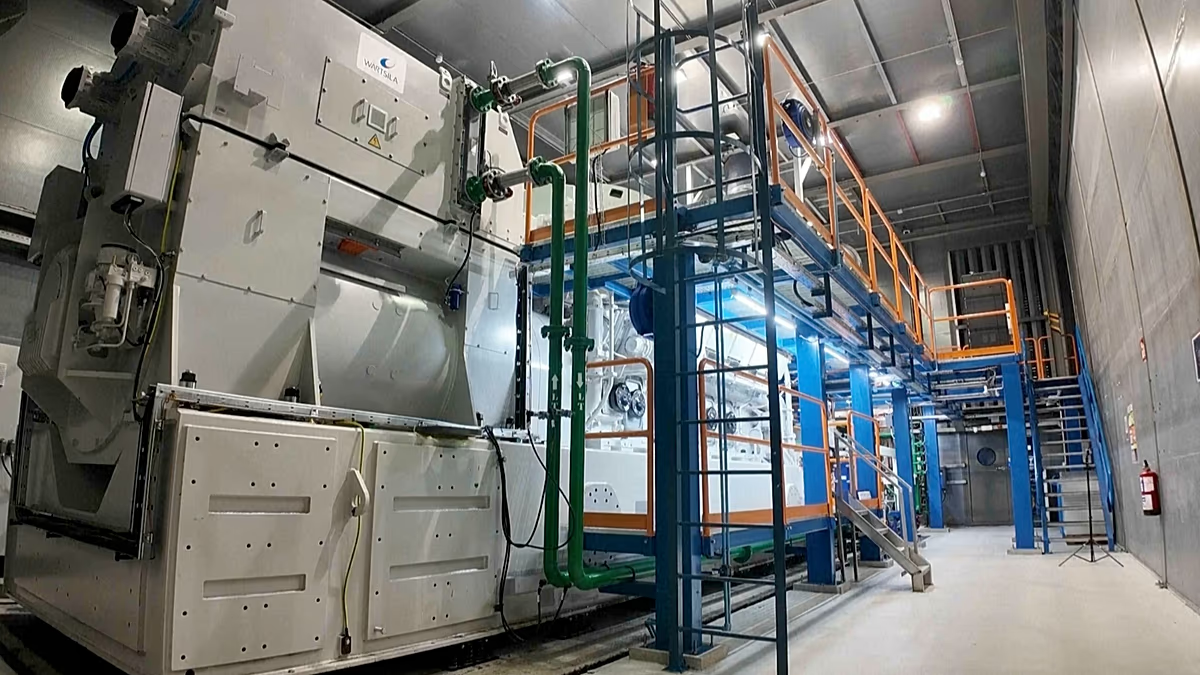
A Pioneering Leap for Clean Energy: Hydrogen Power Connects to the Spanish Grid
In a landmark achievement for the future of clean energy, a massive engine running entirely on hydrogen has successfully delivered electricity to Spain’s national power grid. This milestone, announced by the Finnish technology company Wärtsilä from its testing facility in northern Spain, is heralded as a world-first for large-scale power generation using hydrogen in a combustion engine. The successful test represents more than just a technical triumph; it signals a tangible step toward solving one of the most persistent challenges in the global shift to renewables: how to keep the lights on when the sun isn’t shining and the wind isn’t blowing. This hydrogen engine is positioned as a potential cornerstone for future energy grids, offering a flexible and powerful backup that could fill those critical gaps without the carbon emissions of traditional fossil fuel plants.
The technology at the heart of this breakthrough is distinct from the more commonly discussed hydrogen fuel cells. Instead of generating electricity through an electrochemical process, Wärtsilä’s system utilizes a large internal combustion engine that has been meticulously adapted to burn pure hydrogen. This combustion-driven approach leverages established engine manufacturing and power plant architecture, allowing for the potential rapid scaling of the technology. Company officials envision multiple such units being combined to create utility-scale power plants capable of delivering hundreds of megawatts of electricity on demand. This flexibility makes it an ideal complement to solar and wind farms, acting as a reliable “dispatchable” power source that grid operators can call upon within minutes to stabilize the network and prevent shortages.
The timing of this innovation is particularly significant for Spain, a nation that has become a European leader in the renewable energy transition. The country has aggressively expanded its wind and solar capacity, with these sources now accounting for a dominant and growing share of its electricity mix. However, this very success underscores the need for solutions like hydrogen power. As Spain and other nations increase their reliance on weather-dependent sources, the grid requires intelligent, clean backup to manage their inherent variability. This hydrogen engine test provides a promising glimpse of a tool that can ensure energy security and grid resilience while deepening decarbonization efforts, moving beyond fossil-fueled “peaker” plants that are traditionally used for this purpose.
Despite the excitement surrounding this world-first, experts are quick to temper expectations with a dose of practical reality. The engine itself is a marvel of engineering, but it is only one piece of a much larger and more complex puzzle. For hydrogen power to become a widespread grid solution, enormous investments must be made in the entire supporting ecosystem. This includes scaling up the production of truly “green” hydrogen—made using renewable electricity to split water molecules—as well as building the extensive networks needed for storage, transportation, and refueling. Currently, such infrastructure is in its infancy. Furthermore, strong and consistent policy support from governments will be essential to de-risk these investments and create a viable market for green hydrogen as an energy commodity.
The path forward, therefore, requires a dual track. On one hand, technological demonstrations like Wärtsilä’s successful grid connection are crucial for proving feasibility and building confidence in hydrogen’s role in power generation. They provide a concrete model for utilities and policymakers to evaluate. Concurrently, parallel and monumental efforts must be undertaken to build the green hydrogen economy from the ground up. This includes incentivizing massive new renewable energy projects dedicated to hydrogen production, developing pipeline networks or other transport methods, and creating international standards and markets. The engine solves the problem of how to use hydrogen for power; now society must solve the challenge of how to produce and deliver it sustainably and economically.
In conclusion, the successful integration of a hydrogen-powered engine into Spain’s grid is a profound proof of concept. It moves the conversation about hydrogen from theoretical potential to demonstrated capability in the critical arena of electricity generation. While significant hurdles in infrastructure and cost remain, this achievement marks a pivotal moment. It showcases a practical, scalable technology ready to partner with wind and solar, helping to form the bedrock of a stable, fully decarbonized power system. As nations like Spain continue their renewable energy journeys, innovations such as this provide an essential tool for navigating the last mile of the transition—ensuring a clean, reliable, and resilient power supply for future generations.