

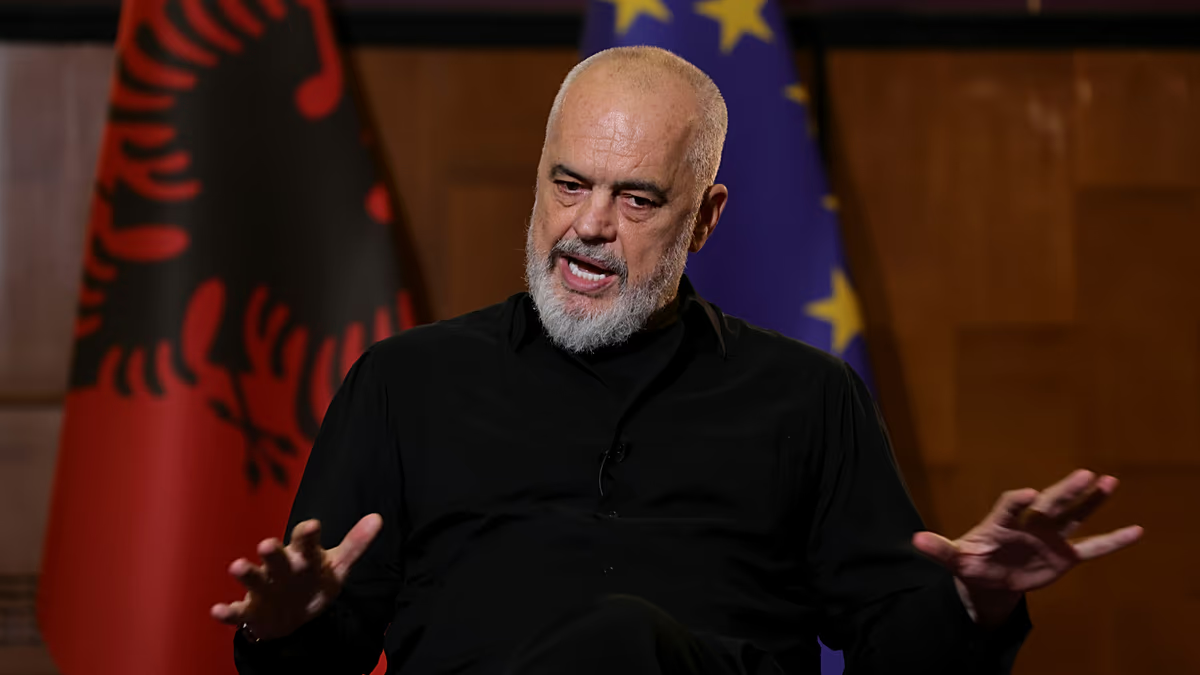
In the symbolic heart of a once-divided continent, Albanian Prime Minister Edi Rama stood before German business leaders in Berlin and issued a profound challenge to the European Union. He invoked the city’s own history of transformation, urging Europe to find the same strategic courage that propelled German reunification under Chancellor Helmut Kohl. Rama framed Europe’s current crossroads as a “defining moment,” arguing that the continent is clinging to bureaucratic procedures and inherited assumptions in an era that demands decisive leadership. He cautioned that this institutional hesitation is becoming more dangerous than the act of taking bold, strategic decisions itself—a perilous inertia in a world where geopolitical rivals are moving with purpose and clarity.
Central to Rama’s vision is the urgent need to fully integrate the Western Balkans, including Albania, into Europe’s strategic fabric. He contends that the EU is making a critical error by debating its future while leaving this region in a perpetual waiting room. The energy corridors, digital networks, and critical raw materials essential for European resilience and autonomy, he noted, all traverse or reside within the Western Balkans. “China understands this. Russia certainly understands it. Europe understands it too. Yet sometimes forgets it when writing its own plans,” he observed. For Albania, EU accession is a transformational national project, but Rama proposed a pragmatic, immediate alternative: gradual integration. His plea was for Europe to “give us seats before giving us vetoes,” inviting candidate countries into the Energy Union, Digital Union, and common security frameworks now, granting responsibility and participation long before the final institutional ornaments of full membership are conferred.
Rama then pivoted to a second, equally pressing threat facing democracies: the weaponization of artificial intelligence and digital platforms. He warned that technological leadership in this century will determine not only wealth but sovereignty itself. While proudly detailing Albania’s own ambitious digital transformation, he raised a stark alarm about algorithm-driven manipulation, which can achieve in minutes what old propaganda machines took years to build. He questioned the overwhelming focus on military and infrastructural shields, asking, “What value will all these shields have if our societies remain defenceless against the systematic manipulation of human minds?” His argument was that Europe must forge a “shield for the age of algorithms” to protect the very minds of its citizens, or risk rendering its physical defences meaningless.
This warning was delivered with acute personal relevance, as Rama’s government is currently navigating a massive public controversy over a proposed high-end tourism development on Albania’s coast, linked to Jared Kushner. The project has sparked large-scale protests, with environmentalists fearing for protected habitats and the movement broadening into calls for Rama’s resignation. Addressing the situation without naming it directly, Rama used it as a case study in digital-age distortion. He described a process where claims of environmental catastrophe and corruption were declared as proven facts online, narratives circled the globe instantly, and outrage generated millions of impressions before official facts or documented procedures could be presented. He framed this not as an isolated Albanian issue, but as a “European phenomenon” where the architecture of social media detaches public debate from verifiable reality, a challenge every democracy now faces.
Rama’s appeal for European courage and integration is underpinned by his government’s ongoing efforts to demonstrate compliance with EU standards, particularly regarding the rule of law and anti-corruption. Recent high-profile operations by Albania’s Special Anti-Corruption Structure, targeting vast alleged drug trafficking and money laundering networks, are showcased as evidence of this commitment. Yet, he subtly shifted the burden of proof. The core question for Rama is evolving from whether Albania is ready for Europe to whether a cautious, bureaucratic Europe is ready for the strategic imperative that enlargement represents. He sees the integration of the Western Balkans not as an act of charity or a reward for completed homework, but as a geopolitical necessity for a stronger, more coherent, and secure Europe.
In conclusion, Prime Minister Edi Rama’s Berlin speech was a multifaceted call to action. He appealed to Europe’s historical conscience, summoning the spirit of leaders like Kohl who saw beyond administrative hurdles to geopolitical necessities. He presented a practical roadmap for gradual Balkan integration into core European systems. And he issued a sobering warning about the new, diffuse battlefield of algorithmic manipulation that threatens democratic sovereignty from within. Ultimately, Rama’s message is that Europe’s future will be decided by its courage—the courage to reunify its continent fully, to innovate against emerging digital threats, and to recognize that strategic enlargement is an act of self-preservation, not merely a diplomatic process. The challenge now lies with the European Union to answer his call.