




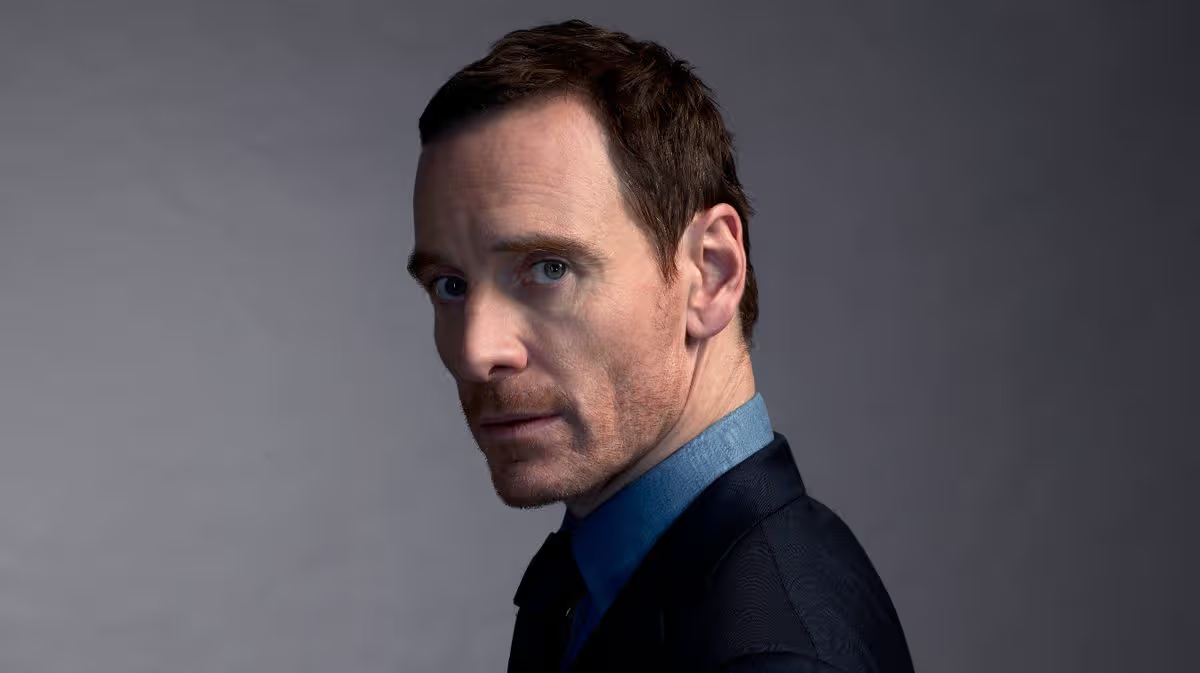
Michael Fassbender, the acclaimed actor and dedicated professional racing driver, seamlessly navigates two demanding worlds, a duality that mirrors the covert life of the character he portrays. This month, he returns as CIA operative Brandon “Martian” Colby in the second season of the spy thriller The Agency. Despite his personal capacity for high-stakes performance and intense focus, Fassbender himself reveals he would make a terrible spy. In preparing for the role, his research led to a pivotal conversation with a real-life intelligence agent, who suggested that to excel in such a shadowy profession, one would likely need to be a sociopath—a clinical condition characterized by a disregard for the rights and feelings of others. For Fassbender, this insight became a “real gateway” into understanding Martian’s fractured psyche and the moral compromises that define his existence.
The new season, premiering June 21 on Paramount+, finds Martian in dire straits. After abandoning his undercover assignment in Ethiopia—where he fell in love with the doctor Samia Fatima (Jodie Turner-Smith)—and compromising her safety in London, he has betrayed his country to protect her. Now a hunted double agent, his world is collapsing. As Fassbender outlines, Martian’s desperate mission is to secure Samia’s freedom, but in doing so, he has sacrificed everything: his integrity, his colleagues, and his standing. A haunting trailer captures his grim acceptance, stating he would not hesitate to make the same choices again. This season delves into his struggle to reclaim some humanity after years of isolated, morally ambiguous fieldwork, exploring his strained relationships with both Samia and a daughter in London he hasn’t seen in years.
Fassbender’s own path to this point was shaped by an early exposure to performance. Born in Germany and raised in Ireland from age two, his time as a Catholic altar boy served as an unintentional primer for facing an audience. Though he initially dreamed of being a heavy metal guitarist, a role in a local play at seventeen redirected his ambitions toward acting. He later studied at London’s Drama Centre, leaving early to begin his professional career on stage. His film breakthrough came with Steven Spielberg’s Band of Brothers in 2001, leading to a series of powerful, physically transformative roles in films like Hunger, Shame, and 12 Years a Slave, which earned him an Oscar nomination. He received another nomination for portraying Steve Jobs, cementing his reputation for immersive dedication.
This dedication borders on the obsessive, a hallmark of Fassbender’s process. For Hunger, he famously lost 40 pounds; for Shame, he read the script hundreds of times to inhabit the mind of a sex addict. For The Agency, he jokes about reining himself in, having read the script a mere “150 times.” He describes a ritual of repeated reading until the dialogue “seeps into the bones,” ensuring he never arrives on set unprepared. This meticulousness stems from a profound professional ethic, a fear of failing his colleagues, and a personal drive for mastery. Ironically, as he notes, this very sense of duty and empathy is what disqualifies him from being an effective real-world spy, contrasting sharply with the sociopathic detachment his research identified as a professional asset.
Parallel to his acting, Fassbender has pursued another all-consuming passion: motorsport. For nearly a decade, and most intensively between 2019 and 2023, he stepped back from Hollywood to race professionally in Porsche’s development program. His “first dream” was always racing, and his crowning achievement was competing in the grueling 24 Hours of Le Mans in 2022, a journey documented in Road to Le Mans. True to his character, he does nothing by halves; racing was never a mere hobby but a second career demanding the same total commitment he applies to his acting. This balance between the solitary focus of the driver and the collaborative interpretation of the actor reflects the multifaceted discipline he brings to each role.
Now settled in Lisbon with his wife, actress Alicia Vikander, and their two young sons, Fassbender bridges his high-octane pursuits with family life. As he returns to our screens in The Agency, he brings not only the technical precision of a master craftsman but also a deep, researched understanding of the cost of a life lived in shadows. His portrayal of Martian is less a glorification of espionage and more a study of a man clinging to shards of his own humanity after two decades of crossing moral lines. In Fassbender’s own journey—from altar boy to actor, from racer to family man—we see a thread of relentless pursuit, but one always tempered by an awareness of connection and consequence, making him the perfect artist to explore a spy’s imperfect soul.