




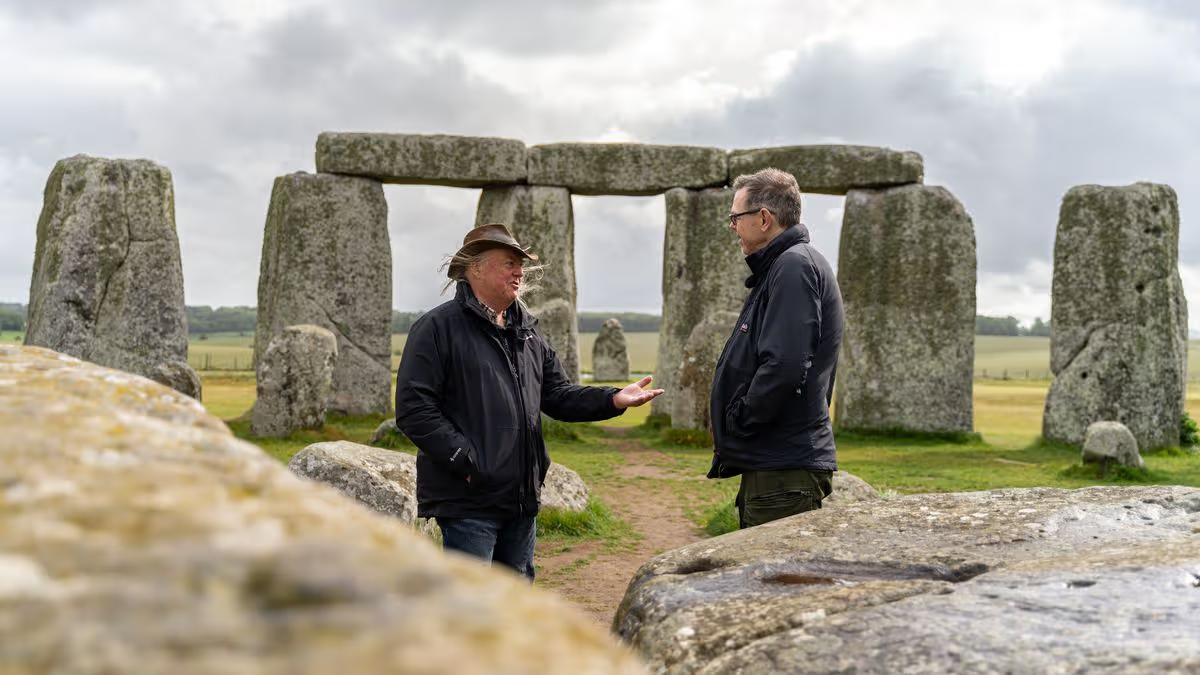
Of all the landscapes imbued with ancient mystery, the plains surrounding Stonehenge hold a singular power. For centuries, the iconic circle of sarsen stones has stood as a profound, yet enigmatic, testament to the beliefs and engineering prowess of our Neolithic ancestors. A recent discovery, however, is fundamentally reshaping our understanding of this sacred site, pushing its origins back by half a millennium and revealing a more nuanced, evolving spiritual tradition. Just three miles from the famous stone circle, archaeologists have uncovered what they describe as a ‘prototype’ for Stonehenge—a simpler, older structure that nonetheless shares its most defining feature: a precise alignment with the sun’s path on the longest and shortest days of the year.
Led by veteran archaeologist Phil Harding of Wessex Archaeology, the team made their initial discovery in Bulford a decade ago, during ground-clearing for new army housing. The excavations between 2015 and 2017 revealed a series of 48 pits, radiocarbon dated to around 2950 BC—some 500 years before the great sarsen stones were erected at Stonehenge. At the heart of this earlier site were two simple holes in the ground. To the untrained eye, they might seem insignificant, but to Harding, they spoke volumes. These postholes once held substantial timber posts, and their positioning was anything but random. “Two post pits tell me [much] more about the people 5,000 years ago,” Harding reflected. “This tells me about the whole community, this tells me about how they were thinking, how they were behaving, how they were revering the heavens.”
This reverence for the heavens became undeniably clear through meticulous analysis. By turning back the celestial clock, researchers, including Skyscape Archaeologist Dr. Fabio Silva, confirmed that the two wooden posts were strategically placed to frame the sunrise on the summer solstice and the sunset on the winter solstice. This mimicry of Stonehenge’s solar geometry is astonishing. At the later monument, if one stands at the centre, the summer solstice sun rises over the Heel Stone to the northeast, while the midwinter sun sets over the Altar Stone to the southwest. The Bulford posts created a similar, if more intimate, observational gateway. This finding dramatically alters the Stonehenge narrative. As Dr. Silva explained, “This discovery helps us understand Stonehenge not as a singular creation, but as part of a much longer conversation between people, the land, and the sky.”
The Bulford site was more than just an astronomical observatory; it was a vibrant social hub. The archaeological dig yielded pottery, flint tools, and animal bones—telltale signs of gatherings, feasts, and communal rituals. Among these artefacts was one object that stood out for its exquisite craftsmanship: a rare Neolithic knife that had been carefully rounded and polished into a disc-shaped form. Harding labelled it their “star find.” He marvelled, “What is so special about it is the workmanship that’s gone into it. That is the work of real craftsmanship.” Intriguingly, the knife was discovered upright, as if it had been deliberately and ceremonially placed, perhaps as an offering or a marker of significance, connecting the earthly community with the cosmic cycles they so diligently observed.
For Phil Harding, whose career spans decades of exploration, the Bulford discovery ranks among his most significant. It provides a tangible, human-scale link to the people who first imbued this landscape with sacred meaning. “Up ‘till now, our knowledge of this ancient feat of astronomy was based on Stonehenge and other monuments of a similar period,” he noted, “but what we’ve discovered at Bulford is 500 years earlier than the famous stones we know so well.” This ‘prototype’ reveals a society already deeply engaged with sophisticated astronomical concepts, practising and perfecting their alignment techniques generations before embarking on the colossal stonework we find so awe-inspiring today.
Ultimately, the story emerging from the two simple postholes in Bulford is one of deep-rooted tradition and evolving monumental expression. Stonehenge no longer appears as a sudden, inexplicable burst of genius onto the Salisbury Plain. Instead, it emerges as the magnificent culmination of centuries of observation, ritual, and communal practice. The earlier wooden structures, like the one at Bulford, were the conceptual and spiritual forerunners, places where knowledge was honed and traditions solidified. As Dr. Silva concluded, “Rather than marking the beginning of a story, Stonehenge now more clearly appears to have emerged from traditions and practices with much deeper roots in this landscape.” This profound connection between land, sky, and community, it seems, was woven into the very fabric of Neolithic life long before the first massive stone was ever raised.