


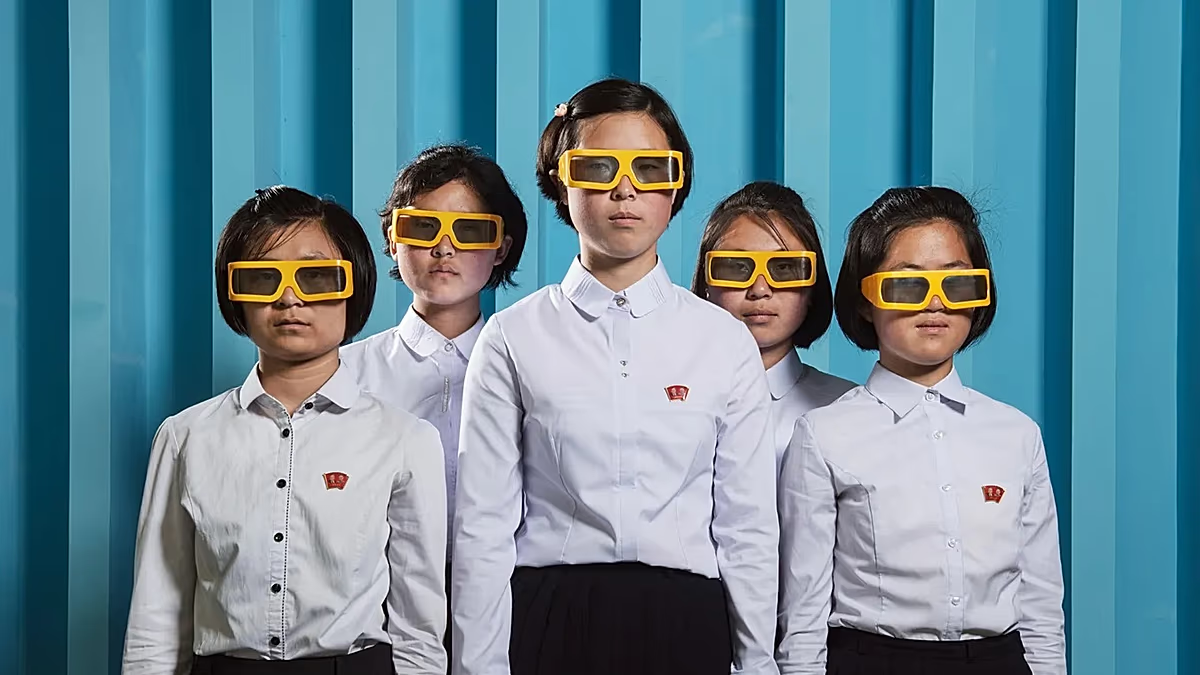
The gaze is direct, unwavering. In a striking photograph, five North Korean schoolchildren, dressed in immaculate white shirts, stand before a vivid blue wall. Their faces are shielded by bright yellow sunglasses, their tinted lenses a barrier that both conceals and invites scrutiny. They look at the viewer just as the viewer looks at them, creating an immediate, silent dialogue. This image is part of French photographer Stéphan Gladieu’s profound series, ‘North Korea’, born from a deliberate choice. When his travel request was approved, Gladieu insisted he would not photograph empty architecture or landscapes. His mission was singular: to capture the people of a nation he felt were rendered invisible—by their own regime’s propaganda and by a world that often overlooks the humanity within the hermetic state. For him, the portrait is a mirror, a meeting place where those viewing the image might learn as much about themselves as about the subject before them.
Gladieu arrived at this project with a refined artistic philosophy, honed over years of global documentary work. In places like post-revolution Romania and Namibia, where communities grapple with the legacies of genocide, he developed a style he calls “iconic portraiture.” He was drawn to the power of religious icons—not for dogma, but for their stark, universal visual language designed to convey messages directly and memorably. He transplants studio techniques to the street, using a portable flash and a consistent, respectful distance to frame his subjects. His goal was to create a humanist message through a strict code: a uniform frame, a controlled light, and a palette often reduced to three dominant colours. This methodical approach transforms ordinary citizens into iconic figures, elevating the individual to a subject of quiet, dignified study.
The resulting portraits possess a luminous, almost surreal quality. A doctor stands with calm authority in her clinic; a family poses solemnly before stocked grocery shelves. The lighting echoes fashion photography, yet the settings are palpably real. Gladieu never constructed scenes; he waited in locations he found compelling—a street corner, a store, a office—and photographed the people who inhabited them. This juxtaposition walks a fascinating line between stark reality and symbolic representation. The consistent technical approach strips away context in one sense, focusing intensely on the person, while the authentic backdrop roots them firmly in their daily life. It was a strategy that, amid the extreme control of the North Korean environment, helped carve out a “bubble of freedom” for his artistic vision, initially making his state-assigned guides more comfortable with his static, studio-like process.
Navigating this controlled environment was a complex dance of aesthetics and understanding. Gladieu was constantly accompanied, driven to locations rather than wandering freely—a reality he describes as psychologically challenging. He discovered that his guides and subjects held a profoundly different relationship with imagery, one deeply tied to notions of perfection and completion. Photographing something unfinished, like workers at a renovation site, was undesirable not for political reasons, but simply because it was incomplete. This cultural gap sometimes led to disagreement, yet at other times, it serendipitously aligned with Gladieu’s eye for symmetry. Once, at a shooting range, his request to photograph soldiers was refused, but the guides suggested the hostesses instead. Their brown uniforms against a wooden target backdrop created a perfect, harmonious composition he could never have staged—a testament to the unexpected collaborations that emerged within the constraints.
The act of taking a portrait became a delicate, patient ritual. Gladieu notes that individuals are rarely photographed alone in North Korea, making solo portraits a particular challenge. Even in groups, he observed a collective self-organization, a subtle negotiation of presence within the frame. His technique involved deliberate slowness—fiddling with lights, adjusting his equipment—to allow his subjects time to settle into their own posture and presence. “I try not to ask them anything,” he explains, allowing them to simply “be completely in their shoes.” This patience is palpable in the work; the subjects are neither smiling performatively nor arranged artificially. They are present, composed, and profoundly themselves, offering a rare glimpse of individual identity within a collective society.
Through five trips taken between 2017 and 2020, Gladieu pieced together a remarkable collection that transcends mere reportage. ‘North Korea’ is a humanist encounter, a bridge built frame by frame. The photographer acknowledges he never fully knew what his guides or subjects saw in his pictures, nor why they allowed him to return. He believes, however, that they must have recognized something of themselves in his respectful, iconic approach. For a global audience, these portraits perform a vital act of reclamation. They restore visibility to over 26 million people, presenting them not as political symbols or statistical abstractions, but as individuals—doctors, children, soldiers, shoppers—engaging the world with a steady, unforgettable gaze. Gladieu had the chance to meet them in life; through his work, he offers us the profound chance to meet them in art, fostering a connection where one scarcely seemed possible.