

For Antoni Gaudí, the completion of his masterwork, the Sagrada Família, was never a question of artistic vision but of simple, relentless time. He carried the intricate, celestial blueprint for its six central towers in his mind, a vision interrupted by his untimely death in 1926. What the architect could not have foreseen was that a century later, the realization of his dream would hinge not only on the enduring hands of craftsmen but on a startlingly humble and invisible hero: a specialized construction adhesive. The recent completion of these majestic towers, timed poignantly for the centenary of Gaudí’s passing, marks a visual and symbolic milestone. Yet, the true narrative of this achievement is found in the seamless marriage of ancient stone and modern engineering, made possible by a powerful glue that binds them as one.
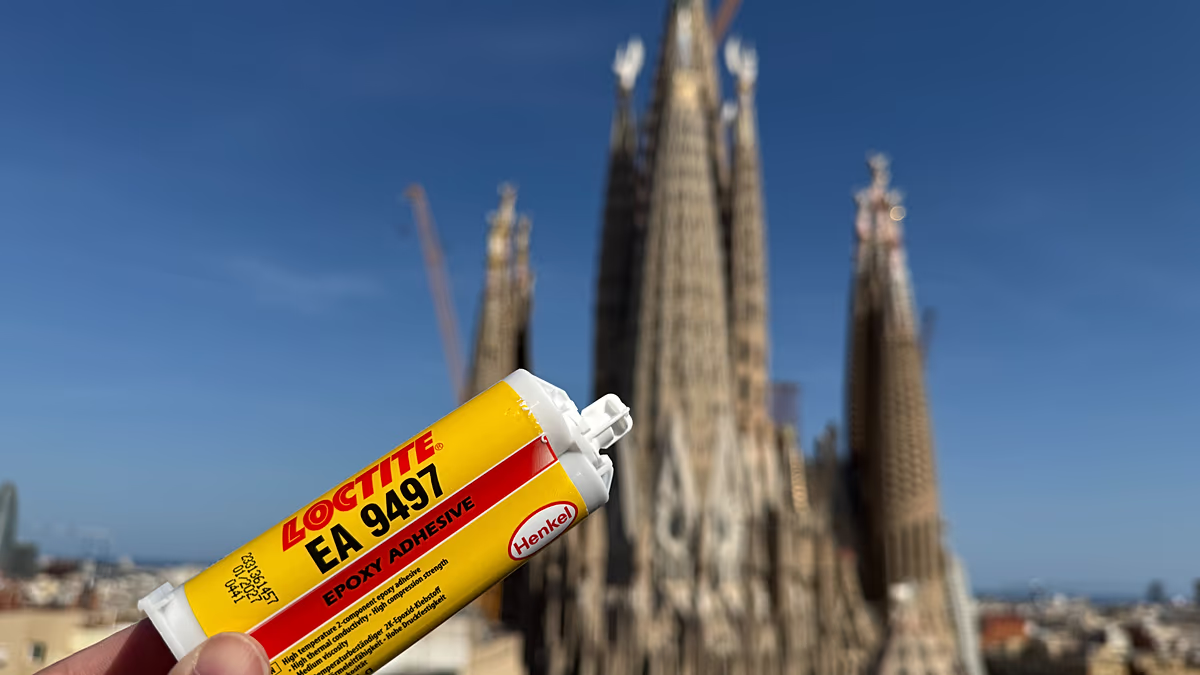
The engineering challenge was of a scale befitting the basilica itself. The towers were constructed using a revolutionary modular system of prestressed stone panels—826 in total, comprising over 2,100 individual stone elements painstakingly joined to an internal metal skeleton. The critical agent in this fusion is Loctite EA 9497, an adhesive from the German company Henkel. Applied in liquid form, approximately 30 kilograms per panel, it was meticulously poured to fill every microscopic cavity between stone and steel. In total, 24 tonnes of this advanced adhesive were used, each application requiring a precise 24-hour curing process to achieve its full, formidable strength. This substance is the unsung linchpin, transforming separate materials into a singular, monolithic force.
The result of this chemical and architectural alchemy is a bond of almost unimaginable resilience. Engineers calculate that the adhesive joints can withstand pressures equivalent to 100,000 people standing on a single square meter—the entire capacity of Barcelona’s Camp Nou stadium, or the collective weight of 1,600 African elephants. This extraordinary figure is not merely theoretical; it is the practical assurance that the Tower of Jesus Christ, soaring to 172.5 meters as the pinnacle of the complex, can steadfastly bear the immense weight and wind loads of the colossal cross that crowns it. The adhesive ensures not just connection, but absolute stability, without a single compromising millimeter of shift, allowing Gaudí’s stone forest to reach safely for the heavens.
This resilience is tested by more than just gravity and wind. The basilica’s very location presents a relentless environmental onslaught. Situated a mere two kilometers from the Mediterranean Sea, the structure is perpetually bathed in salt-laden air, posing a constant threat of corrosion to its metal components. Beneath its foundations, the rumble of two active metro lines sends subtle but persistent vibrations through the stone. The adhesive was thus selected not only for its strength but for its durability—its ability to act as a flexible, impervious barrier against moisture, salt, and constant stress, ensuring the long-term integrity of the union it creates between the stone skin and the steel sinews.
The collaboration between Henkel and the Sagrada Família foundation is a story of patience and profound adaptation, mirroring the project’s own unique nature. This partnership spans over a decade, involving rigorous testing that far exceeded standard industrial protocols. The logistics of supplying a continuous, reliable flow of specialized material had to conform to a reality rare in global construction: a project funded exclusively by the donations of visitors, operating without a traditional fixed budget or a rigid completion timetable. This required a synergy of purpose, where the commercial timelines of a multinational company gracefully aligned with the patient, generations-long pilgrimage of a living architectural monument.
The culmination of this intricate dance between past and present, artistry and innovation, is now etched into the skyline of Barcelona and the record books of history. At its completed height, the Sagrada Família stands as the tallest church building in the world, surpassing Germany’s Ulm Minster. It is a testament to a visionary artist and the countless hands—and minds—that have carried his vision forward. As Adrián Orbea, President of Henkel Ibérica, reflects, “This project highlights how innovation and collaboration continue to drive progress.” One imagines that Gaudí, the architect who saw nature as the greatest teacher, would have appreciated this elegant fusion of organic form and human ingenuity. In the silent, potent grip of an adhesive, his timeless dream found its final, steadfast anchor.