



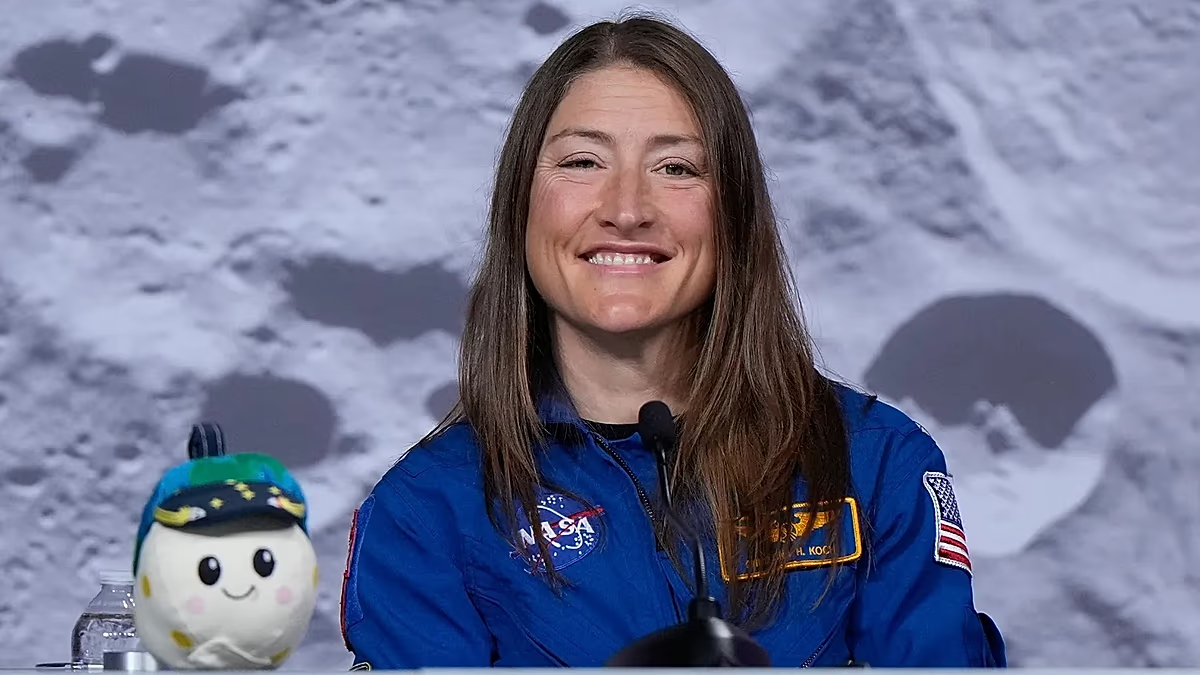
Christina Koch, a NASA astronaut whose career has become a powerful symbol of perseverance and human potential, has been honored with Spain’s prestigious Princess of Asturias Award for Concord. The award committee highlighted her extraordinary work in helping to “extend the frontiers of humanity,” framing her journey not just as a series of technical triumphs, but as a profound inspiration for future generations. In recognizing Koch, the jury emphasized that her story reflects our collective “ability to overcome challenges and adversity through hard work, collaboration and empathy.” This award, therefore, celebrates more than individual accomplishment; it honors the universal human qualities her career exemplifies and their role in uniting people toward common, ambitious goals.
Koch’s selection is deeply significant as she is the first woman to be part of a lunar mission, serving as a mission specialist on NASA’s Artemis II flight. This historic mission, which successfully flew around the Moon in April of this year, marked the first crewed lunar flyby in over half a century, signaling a bold new chapter in space exploration. More than a milestone in engineering, Artemis II represents a renewed commitment to exploring deep space, with Koch playing a pivotal role. At 47, her presence on this crew is widely seen as paving the way for her to be a leading candidate for future missions that aim to land astronauts, including the first woman, on the lunar surface, directly shaping the next era of human presence on the Moon.
Her journey to this point is a testament to remarkable endurance and dedication. Long before Artemis II, Koch had already secured her place in the record books by completing the longest single spaceflight by a woman, spending an incredible 328 days aboard the International Space Station. This extended mission provided invaluable data on the effects of long-duration spaceflight on the human body, crucial knowledge for future journeys to Mars. Furthermore, alongside fellow astronaut Jessica Meir, she participated in the first all-female spacewalk, a moment that captivated the world and visibly broke a significant barrier in a historically male-dominated field. These achievements underscore a career built not on fleeting moments of fame, but on sustained courage, expertise, and a commitment to expanding what is possible.
The Artemis II mission itself, with Koch as a key crew member, achieved a breathtaking milestone. During their journey, the four astronauts traveled farther from Earth than any humans in history, reaching a distance of 406,771 kilometers. This record-breaking vantage point, looking back at our fragile planet from the deep darkness of space, serves as a potent metaphor for the award’s theme of Concord. It underscores a shared human identity that transcends terrestrial borders and conflicts, reminding us of our collective home and destiny. Koch’s role in reaching this literal and figurative frontier powerfully embodies the award’s spirit of fostering global cooperation and a broader perspective on human coexistence.
The Princess of Asturias Award for Concord is one of Spain’s highest honors, part of a suite of eight prizes awarded annually by the foundation named for Princess Leonor, heir to the Spanish throne. The Concord category specifically recognizes exceptional efforts to promote “human coexistence, solidarity and global cooperation.” With its €50,000 prize, it has previously honored a diverse array of contributors to the global good, including the grassroots charity Mary’s Meals, chef José Andrés for his humanitarian disaster relief work, and Spain’s health workers for their heroic efforts during the COVID-19 pandemic. Placing Koch among these recipients frames space exploration not as a detached scientific endeavor, but as a unifying human project that advances shared knowledge and inspires international collaboration.
In bestowing this award upon Christina Koch, the foundation celebrates her not only as an explorer of physical space but as a builder of aspirational space for all of humanity, particularly for women and girls in STEM fields. Her career trajectory—from record-setting endurance on the Space Station to making history around the Moon—charts a course of relentless progress. By honoring her, the award connects the tangible, technical marvel of spaceflight to the intangible, essential human qualities of empathy, perseverance, and unity. Christina Koch’s story, now recognized by this distinguished prize, stands as a beacon, demonstrating that in reaching for the farthest horizons, we ultimately learn more about our own capacity for harmony and collective achievement here on Earth.