


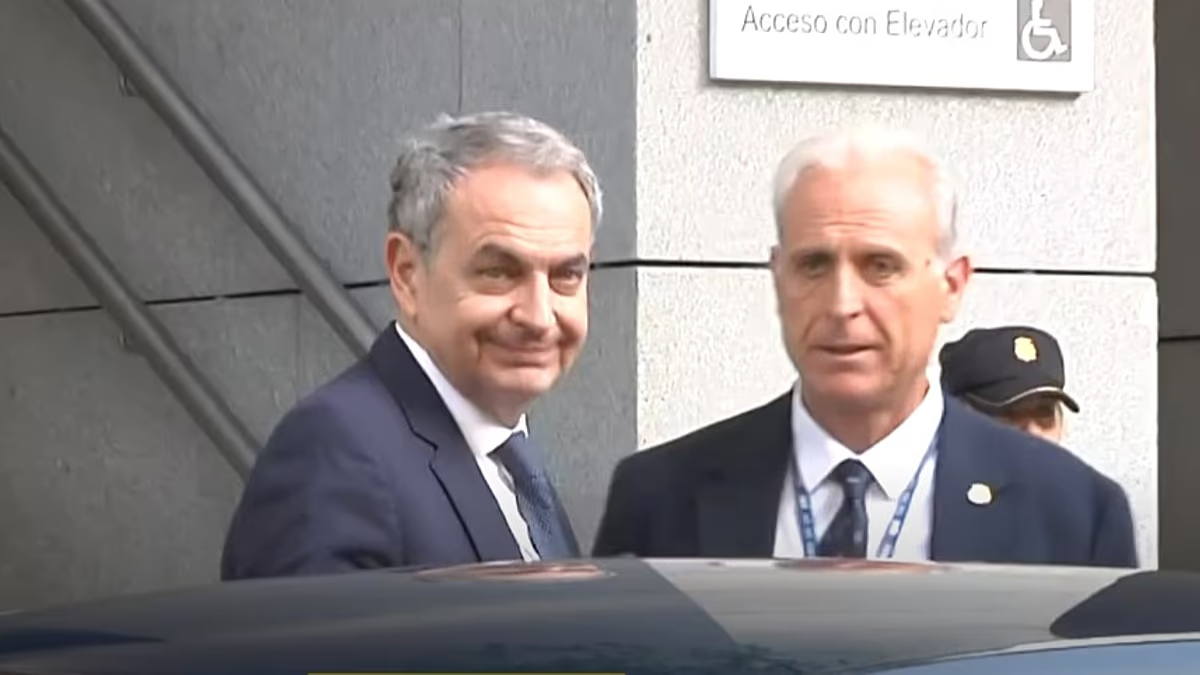
In a historic and deeply unsettling moment for Spanish democracy, former Prime Minister José Luis Rodríguez Zapatero appeared before a judge this week, formally accused in a corruption investigation. This marks the first time a former head of the Spanish government has been named a suspect in a criminal probe since the country’s transition to democracy, lending the proceedings an immense symbolic and political weight. The hearing, conducted behind closed doors, aims to unravel a complex web of allegations that have sent shockwaves through the political establishment. For Zapatero, a figure who once embodied the hope of a modern, progressive Spain, the courtroom appearance represents a profound personal and professional downfall, transforming his legacy from that of a two-term leader into that of a defendant answering serious charges.
The case itself revolves around two distinct but potentially interconnected scandals. The first concerns a controversial public bailout of 53 million euros granted to the struggling airline Plus Ultra during the COVID-19 pandemic. Investigators are scrutinising whether this substantial government rescue package was awarded improperly. Simultaneously, the investigation took a dramatic turn when luxury jewellery, provisionally valued at a staggering 1.3 million euros, was discovered during a search of an office linked to Zapatero on Ferraz Street. The origin of these high-value items remains officially unjustified, prompting the judge to open a separate line of inquiry. The court order paints a picture of a sophisticated operation, alleging Zapatero was at the head of an “organised network.”
Further complicating the matter are the business dealings of a company owned by Zapatero’s daughters, What The Fav. This firm reportedly received up to 2 million euros for consultancy and layout work. Investigators are examining whether these contracts were legitimate or, as the judge suggests, a mechanism to disguise the payment of alleged kickbacks, potentially connecting the flow of money to the decisions made during Zapatero’s tenure. The former prime minister’s defence team, led by lawyer Víctor Moreno Catena, sought to separate the jewellery allegations from the initial questioning, but the judge rejected this, asserting it did not impair his client’s right to a defence. This sets the stage for a comprehensive and challenging interrogation covering all facets of the allegations.
Beyond the courtroom, the political reverberations are severe, creating what can only be described as a ‘horribilis’ week for the current government led by Pedro Sánchez. Zapatero is far from a distant political relic; he has remained one of the Socialist Party (PSOE)’s most vital and charismatic assets. His active presence at rallies, his role in key campaign closings, and his well-publicised good rapport with Prime Minister Sánchez have kept him firmly within the party’s inner circle. Consequently, his legal troubles are not a contained historical matter but a direct and acute crisis for the present administration, threatening to stain the party’s brand and destabilise its political standing with a weary electorate.
The spectacle of a former socialist prime minister facing such grave accusations deals a devastating blow to the morale and credibility of the PSOE. It provides potent ammunition to opposition parties, who can frame the case not as an isolated incident but as evidence of systemic corruption within the party that has held power. For Sánchez, navigating this scandal requires an almost impossible balance: demonstrating respect for the independence of the judiciary while distancing his government from the alleged misdeeds of a former leader with whom he has been closely aligned. The public’s trust, already fragile, is being tested anew.
As the closed-door hearing continues, Spain watches and waits. The proceedings against José Luis Rodríguez Zapatero are more than a legal case; they are a pivotal moment for the nation’s democratic institutions. They test the judiciary’s ability to hold the highest powers to account without fear or favour, and they challenge the political system to withstand the turbulence of such a unprecedented scandal. Regardless of the final verdict, the image of a former prime minister in the dock marks a sombre chapter, forcing a national reflection on power, accountability, and the enduring shadows that can fall upon even the most celebrated political legacies.