

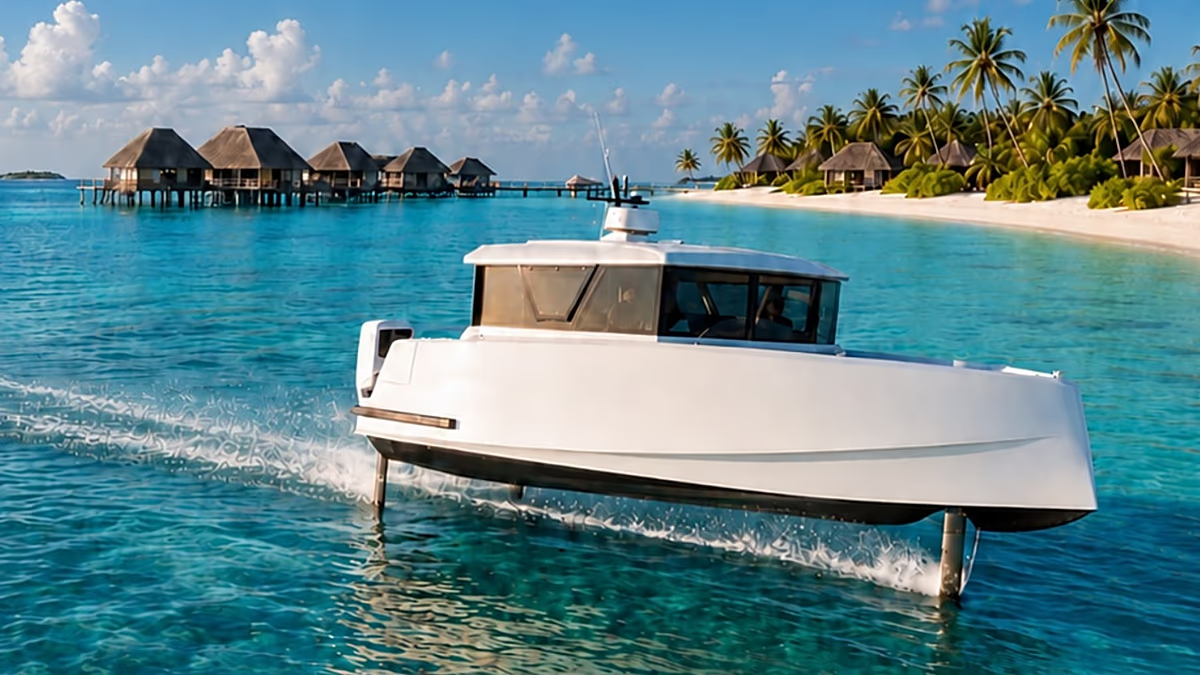
The iconic journey from Velana International Airport to a private island resort in the Maldives—a rite of passage for millions of luxury travelers—is poised for a quiet revolution. Soon, the roar of diesel engines and the bumpy ride across the lagoon may be replaced by a smooth, silent glide. A landmark partnership between US maritime tech pioneer Navier and Dubai-based JIH Global Investment has pledged $100 million to create the “Navier Network,” a software-driven fleet of up to 100 electric hydrofoil boats. This ambitious project aims to transform the fragmented web of speedboats and ferries into a standardized, sustainable maritime corridor connecting airports, resorts, private villas, and local islands across the archipelago. It promises not just an upgrade in transportation, but a fundamental reimagining of the aquatic gateway to paradise.
For the traveler, the difference will be immediately palpable. The current transfer, while often thrilling, can be a noisy, fuel-scented, and sometimes jarring conclusion to a long international flight. The Navier N30 vessels propose an alternative: a premium water taxi experience. As these boats accelerate, hydrofoils—underwater wings—lift the hull above the water’s surface, drastically reducing drag. The result is a journey that is not only faster but astonishingly quieter and smoother, with minimal wake and vibration. Inside, passengers can expect air-conditioned comfort, lounge-style seating, and seamless Starlink internet, turning transit time into an extension of the resort’s luxury. This shift from a necessary logistical step to a serene, connected experience modernizes a defining element of the Maldivian holiday.
The scale of this rollout underscores its potential impact. Beginning with five vessels later this year and expanding to as many as 100 over the next three years, the network addresses a colossal need. The Maldives welcomed over 2.2 million visitors in 2025, nearly all of whom depend on marine transport. Currently, around 3,000 fuel-powered boats crisscross the nation’s waters, forming the lifeblood of its tourism economy but also contributing significantly to its carbon footprint. Navier’s founder and CEO, Sampriti Bhattacharyya, recognizes the unique opportunity: “The Maldives is one of the most important maritime transportation markets in the world… the perfect place to prove that maritime transportation can be cleaner, quieter, standardized, software-driven, and dramatically better for the guest experience.”
Beyond passenger comfort, the project carries profound environmental implications for a nation on the frontlines of climate change. The Maldivian government has committed to reaching net-zero emissions by 2030, an enormous challenge for an island nation where boats are as essential as cars. The electric hydrofoils, with a range of up to 75 nautical miles on battery power alone (extendable to 150 nm in hybrid mode), consume far less energy than conventional boats. They produce zero emissions at point of use, less noise pollution for marine life, and no fuel fumes to taint the pristine air. As Mohamed Ali Janah, Chairman of JIH Global Investment, stated, this initiative allows the Maldives to leverage its leadership in luxury tourism to “help define what the future of waterborne transportation looks like,” creating a blueprint for other vulnerable island nations.
The vision, however, extends far beyond a fleet of futuristic taxis. The “Navier Network” is conceived as an integrated, software-driven system. This suggests a streamlined booking and dispatch platform, potentially allowing travelers to coordinate their entire inter-island journey with the ease of a ride-sharing app. Such a system could bring new efficiency to resort operations and even enhance connectivity for local communities. It represents a holistic approach to decarbonizing a critical sector, proving that sustainability and high-end service are not just compatible, but mutually reinforcing. The network is designed to be a scalable model, offering a template for coastal cities and island communities worldwide seeking to modernize their water transit without sacrificing ecological integrity.
In essence, this partnership is about transforming a functional necessity into a signature experience that aligns with the values of the modern traveler and the urgent needs of the planet. It seeks to preserve the magic of the Maldives—the stunning atolls, the vibrant marine ecosystems, the sense of tranquil escape—by reengineering the very way people move through it. By marrying cutting-edge hydrofoil technology with electric propulsion and smart software, the Navier Network aims to ensure that the journey to one’s resort is no longer a stark contrast to the serenity that awaits, but a harmonious, sustainable, and luxurious prologue. It is a bold step toward ensuring that the Maldives remains a paradise not just for visitors today, but for generations to come.