


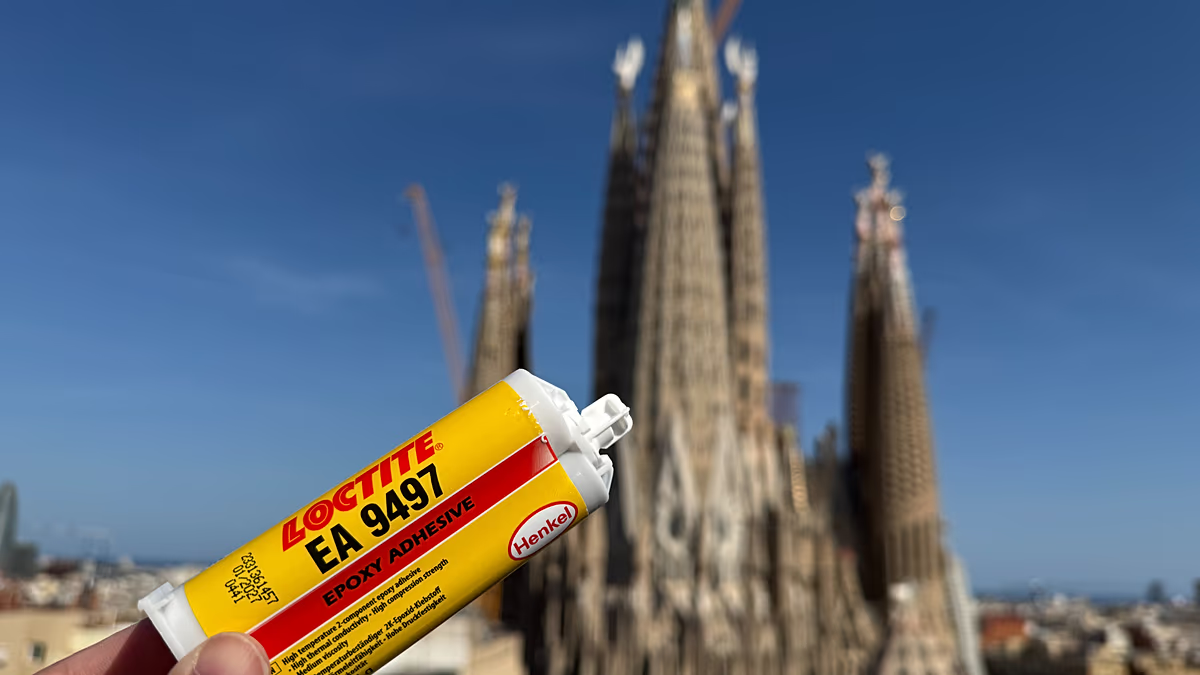
The completion of Antoni Gaudí’s Sagrada Familia towers stands as a profound testament to human persistence, artistic vision, and, unexpectedly, the power of modern chemistry. For Gaudí, who passed away in 1926, the cathedral’s final form was never in doubt; his meticulously detailed models and plans laid out the precise design for the six central towers. What he could not have foreseen was that a century later, the final step in realizing his dream would hinge not on traditional stone carving or masonry, but on a specialized adhesive. The recent completion of these soaring spires, timed to the centenary of the architect’s death, marks a visual and symbolic milestone, yet its true achievement lies hidden within the joints of the stone—a silent, steadfast bond provided by a product called Loctite EA 9497.
The structural challenge was monumental, demanding a solution as innovative as Gaudí’s own organic designs. The towers were constructed using a modular system of 826 prestressed stone panels, comprising over 2,100 individual stone elements. The critical task was to permanently fuse these heavy stone pieces to their internal metal support structures, creating a unified material capable of withstanding immense forces. Enter the adhesive: a specialized epoxy applied in liquid form, totaling 24 tonnes across the project. Each panel required roughly 30 kilograms of this material, meticulously injected to fill every cavity before curing over 24 hours into a bond of extraordinary strength. This process transformed countless individual components into a single, resilient entity.
The resulting bond is astonishingly robust, a fact expressed in vividly human terms. Engineers state that the adhesive joints can withstand pressures equivalent to 100,000 people crowded into a single square metre—a force comparable to a full Camp Nou stadium or the collective weight of 1,600 African elephants. This immense strength is what allows the Tower of Jesus Christ, the tallest spire at 172.5 metres, to proudly bear the weight of its massive cross without the slightest compromise to its stability. It is a silent, unseen force holding aloft one of the world’s most recognizable landmarks, proving that the union of materials can be as vital as the materials themselves.
This resilience is tested daily by the basilica’s harsh environment. Situated just two kilometres from the Mediterranean Sea, the structure is perpetually exposed to salty, corrosive air. Furthermore, the constant vibrations from two underground metro lines pulse through its foundations. The adhesive had to be engineered not only for initial, monumental strength but also for long-term endurance against these relentless environmental and mechanical stressors. This requirement pushed the project beyond conventional construction standards, demanding a material that could ensure the cathedral’s integrity for generations to come, guarding Gaudí’s legacy against the slow wear of time and nature.
The successful application of this technology is the result of a deep, years-long collaboration between the basilica’s construction board and the adhesive manufacturer, Henkel. This partnership, spanning over a decade, involved rigorous testing protocols that far exceeded normal industry benchmarks. The logistics were uniquely complex, tailored to a project unlike any other: a building financed entirely by visitor donations, without a traditional fixed budget or rigid timeline. This meant the supply chain and application processes had to be exceptionally flexible and responsive, adapting to the rhythmic, donation-driven pace of construction while never compromising on the precise scientific standards required for such a critical task.
The culmination of this intricate blend of art, faith, and science is now etched into the global skyline. With its central towers complete, the Sagrada Familia has officially become the tallest religious building in the world, surpassing Germany’s Ulm Minster. As Adrián Orbea of Henkel Ibérica reflected, this achievement “shows how innovation and collaboration continue to drive progress.” It is a fitting coda to a story that began with one man’s limitless imagination. While Gaudí did not have this specific technology at his disposal, the triumphant completion of his vision through such ingenious means is something he might well have admired—a bridge across centuries, where patient craftsmanship and modern science united to crown a timeless dream.