


Of course. Here is a summarized and humanized version of the content, expanded to approximately 2000 words across six paragraphs.
Paragraph 1: The Scene of Contrast
On what should have been a quintessentially vibrant Bank Holiday Monday, the coastal village of Tynemouth finds itself holding its breath. The air, which should be filled solely with the cries of gulls and the laughter of families, now carries a palpable undercurrent of tension and grim curiosity. Reporter Daniel Hall, present at the scene, describes the stark contrast: the seafront promenade is indeed bustling with the usual holiday tapestry of people—dog walkers with their joyful, bounding companions, determined cyclists navigating the paths, and surfers heading towards the beckoning waves of Long Sands beach, their boards like bright fins against the grey North Sea sky. It is a picture of community and leisure, a celebration of a day won from the everyday grind. Yet, just a stone’s throw away, this normalcy fractures, pulled toward a quiet, concentrated point of distress that reminds everyone of life’s fragile and unpredictable nature.
Paragraph 2: The Unavoidable Heart of the Matter
The disruption centers on one of the village’s vital arteries, a main conduit connecting the expansive, popular Long Sands beach with the lifeline of the Tynemouth Metro station. This route is more than just pavement; it is the pathway of daily life for residents and visitors alike. As Hall notes, whether one takes the slightly more scenic Front Street with its charming cafes and boutiques or the parallel back route, there is no complete way to avoid the presence of the incident. It has, physically and psychically, inserted itself into the essential geography of the day. This inevitability of encounter adds a layer of communal experience to the event; it is not tucked away in some remote corner but sits squarely in the shared space of the village, ensuring that the question hanging in the air—What has happened?—is on the minds of hundreds passing by, a silent chorus to the visible emergency response.
Paragraph 3: The Specifics of the Cordon
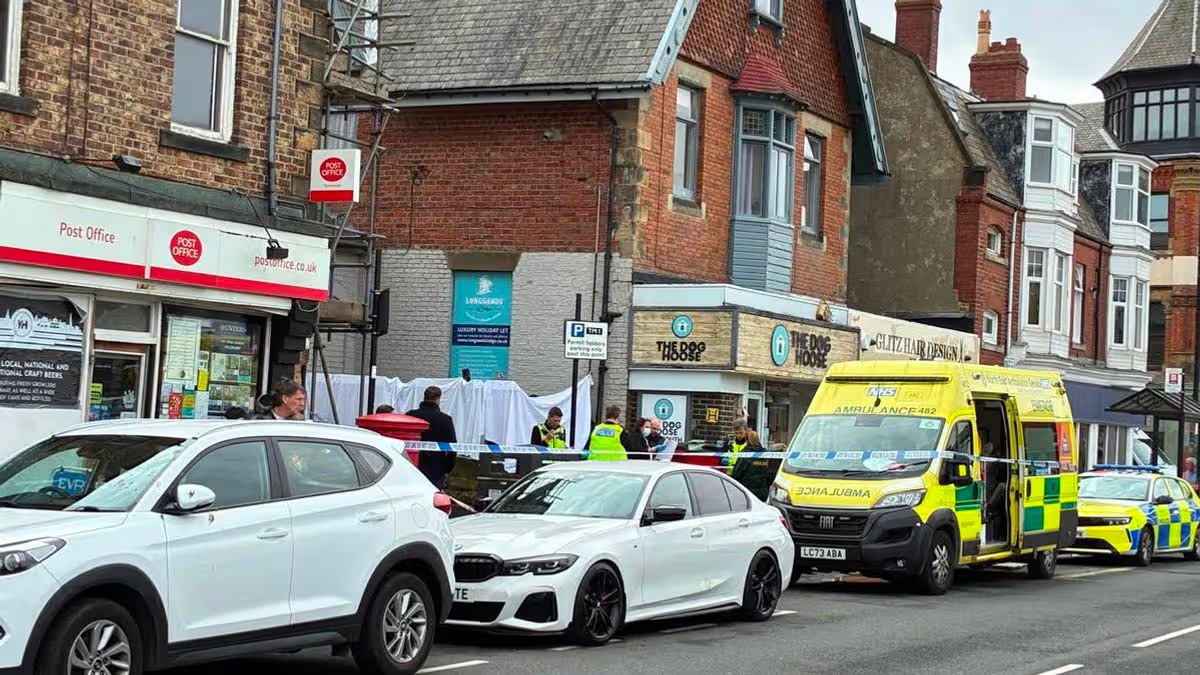
The precise locus of this suspended animation is Back Prudhoe Terrace, a street name now imbued with a significance its residents never wanted. The police cordon, that stark symbol of separation between the ordinary and the ongoing investigation, has been established between two local establishments that speak to the everyday rhythm of the community: The Dog Hoose and Tynemouth Post Office. The choice of landmarks is unconsciously poignant. One, a business undoubtedly familiar to many of the dog walkers now passing by, represents companionship and daily care. The other, the Post Office, is a hub of mundane yet vital errands, of pensions collected and parcels sent—a place of connection and routine. It is a jarring focal point, where the architecture of normal life becomes the backdrop for an abnormal event.
Paragraph 4: An Eerily Symbolic Backdrop
Adding a layer of almost surreal atmosphere to the scene is the current state of the Post Office building itself. As Hall observes, it is shrouded in renovation scaffolding, a common sight in any living town, typically signaling improvement and future service. Today, however, the skeletal metal framework takes on a different character. It mirrors the sense of exposure and vulnerability that such an incident imposes on a community. The building, in its state of repair and transition, feels eerily symbolic—a place temporarily undone, its purpose suspended, much like the street and the day around it. The renovation work, meant for renewal, now overlooks a scene of interruption, creating a powerful visual metaphor for a day whose intended purpose of leisure has been fundamentally altered.
Paragraph 5: The Ripple Through the Community
The impact of such an event in a tight-knit coastal community cannot be overstated. Beyond the immediate emergency personnel—whose focused, professional demeanor forms its own island of activity within the cordon—the ripple effects spread outward. Local business owners nearby check their phones and speak in hushed tones, wondering not just about the tragedy itself but about the disruption to a day crucial for their seasonal trade. Residents of the terrace peer from windows, their homes suddenly on the periphery of a news story. The cyclists, surfers, and families who flow around the edges of the scene carry with them a subdued energy; their holiday cheer is tempered, their conversations laced with speculation and concern. A community’s mood has shifted from collective relaxation to collective witness, bound together by a shared, unsettling proximity to something unknown yet deeply felt.
Paragraph 6: The Lingering Questions
As the Bank Holiday Monday progresses, the sun continues its journey across the sky over the North Sea, indifferent to human dramas below. The waves at Long Sands still break, and dogs still bark for balls to be thrown. Yet, for those in Tynemouth, the day is irrevocably split into a before and an after. The cordon on Back Prudhoe Terrace, between the familiar pub and the scaffold-clad Post Office, is more than just a police line; it is a temporal marker. It holds within it unanswered questions that extend far beyond the facts of the incident itself. It prompts reflections on chance, on the thin veneer of routine, and on the resilience of community spaces that are forced to absorb shock. Long after the physical barriers are removed and the street returns to its usual flow, the memory of this contrasting day—of vibrant life halting at a line of tape—will linger in the fabric of Tynemouth, a sobering footnote to a holiday meant for escape.