

In the quiet town of Stafford, a community is grappling with an unthinkable loss. Brodan Dubickas, a vibrant 15-year-old with his whole life ahead of him, was tragically killed in a freak accident at Holmcroft Park on the evening of Saturday, May 2nd. What began as a typical spring day ended in profound sorrow when a tree fell on the teenager. Despite the rapid response of emergency services—including police, paramedics, and an air ambulance that scrambled to the scene around 6:30 p.m.—Brodan was pronounced dead at the scene about an hour later. The stark image of a blue tent within a police cordon in the park the following day became a somber testament to a young life cut devastatingly short, leaving a family shattered and a town in mourning.
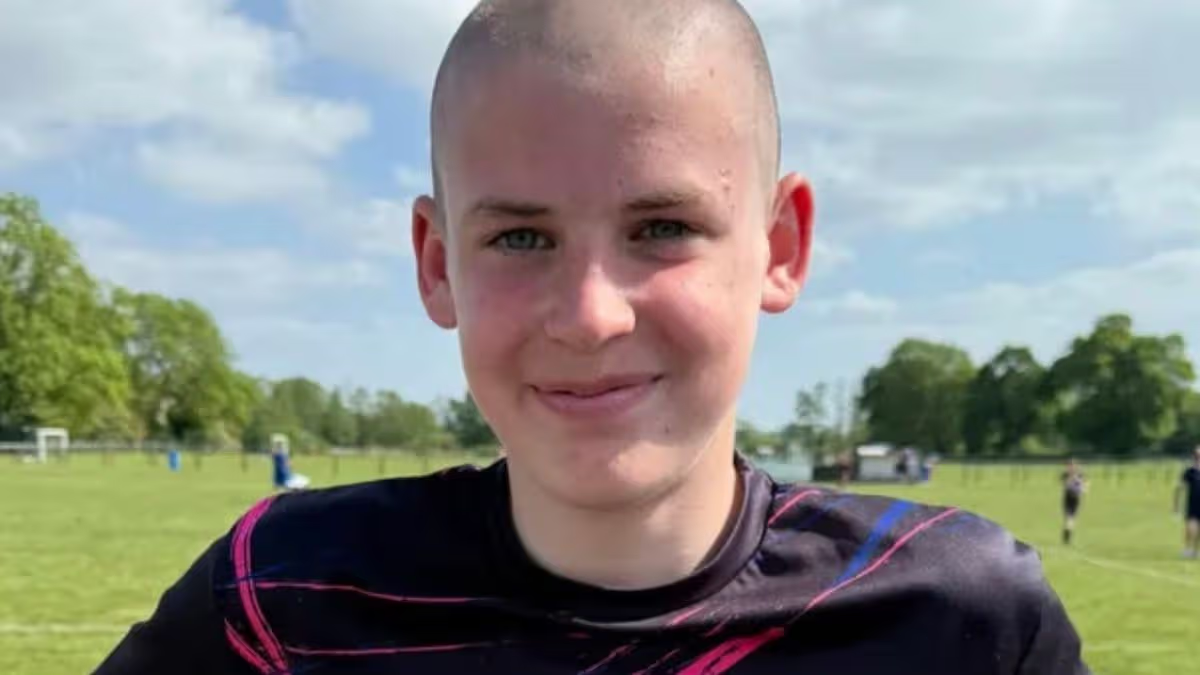
Brodan, now pictured for the first time publicly, emerges from this tragedy not as a statistic, but as a beloved individual—a Year 10 pupil at Sir Graham Balfour School remembered for his smile and his spirit. The profound impact of his loss reverberated immediately through the halls of his current school and his former primary school, Tillington Manor. In a heartfelt social media post, the staff at Tillington Manor expressed their “great sadness and a heavy heart,” emphasizing that Brodan would “always remain a valued part of our school family.” Their words underscored a painful truth in close-knit communities: that the bonds formed in childhood endure, and the loss of a young person is felt collectively, as a rupture in the very fabric of shared memory and hope.
The tribute from his former school poignantly acknowledged the deep waves of grief washing over Stafford, extending thoughts to “everyone who knew and cared for him.” It promised to honor Brodan in a manner befitting the impact he had, in careful liaison with his grieving family when the time is right. This commitment to remembrance highlights how communities strive to find meaning and preserve legacy in the face of senseless tragedy. The message concluded with “heartfelt condolences” to Brodan’s parents, family, friends, and the wider community, holding them in thought during this “incredibly difficult time.” It is a raw and authentic response, reflecting the helplessness felt when words are insufficient, yet the need to express solidarity is overwhelming.
Official statements from Staffordshire Police confirmed the heartbreaking details, noting that “nothing could be done to save the boy” despite the best efforts of all emergency personnel. The clinical language of such reports—“pronounced dead at the scene shortly after 7:30 p.m.”—barely conceals the human drama of the event: the frantic efforts, the fading hope, and the ultimate, grim reality faced by first responders and family alike. The confirmation that his next of kin had been informed is a simple line that carries the weight of the world, marking the moment a family’s life changed forever.
In the aftermath, the focus naturally turns from the how of the accident to the who of the life lost. Brodan Dubickas was more than the victim of a tragic incident; he was a son, a friend, a former pupil remembered by a dedicated school community. As the investigation into the fallen tree continues, the human story remains central. This kind of loss prompts universal reflections on safety, fate, and the fragile nature of life, especially for a teenager on the cusp of adulthood. The public sharing of his image and tributes transforms him from an anonymous name in a news brief to a real person whose absence creates a palpable void.
As Stafford mourns, Brodan’s story is a sobering reminder of how quickly joy can turn to sorrow, and how community becomes a crucial vessel for collective grief and support. The planned efforts to honor his memory will serve as a testament to a life that, though ended far too soon, touched others and mattered deeply. In the quiet of Holmcroft Park and the bustling halls of his schools, Brodan Dubickas will be remembered, his spirit a lingering presence in the hearts of all who mourn the incredible potential and the simple, profound humanity of a 15-year-old boy gone too soon.