


Paragraph 1: A New Geopolitical Vision
In an era marked by global realignments, a fascinating proposal has emerged from public discourse in Canada: the potential for the nation to seek closer ties, or even membership, with the European Union. This idea gains symbolic weight through the figure of Canadian Prime Minister Mark Carney, who holds both Canadian and British passports. He is seen by some as a personification of a bridge—connecting the Anglophone world with a Europe that is increasingly cautious of American isolationism. The concept moves beyond symbolism, however, as recent surveys indicate a tangible shift in Canadian public opinion. A notable 57% of Canadians now express support for the idea of joining the 27-member bloc, driven largely by a desire for economic stability. An overwhelming 84% prioritize forging stronger economic links with Europe as a strategic buffer against the political and trade uncertainties emanating from their southern neighbour, the United States.
Paragraph 2: European Reception and Canada’s Stature
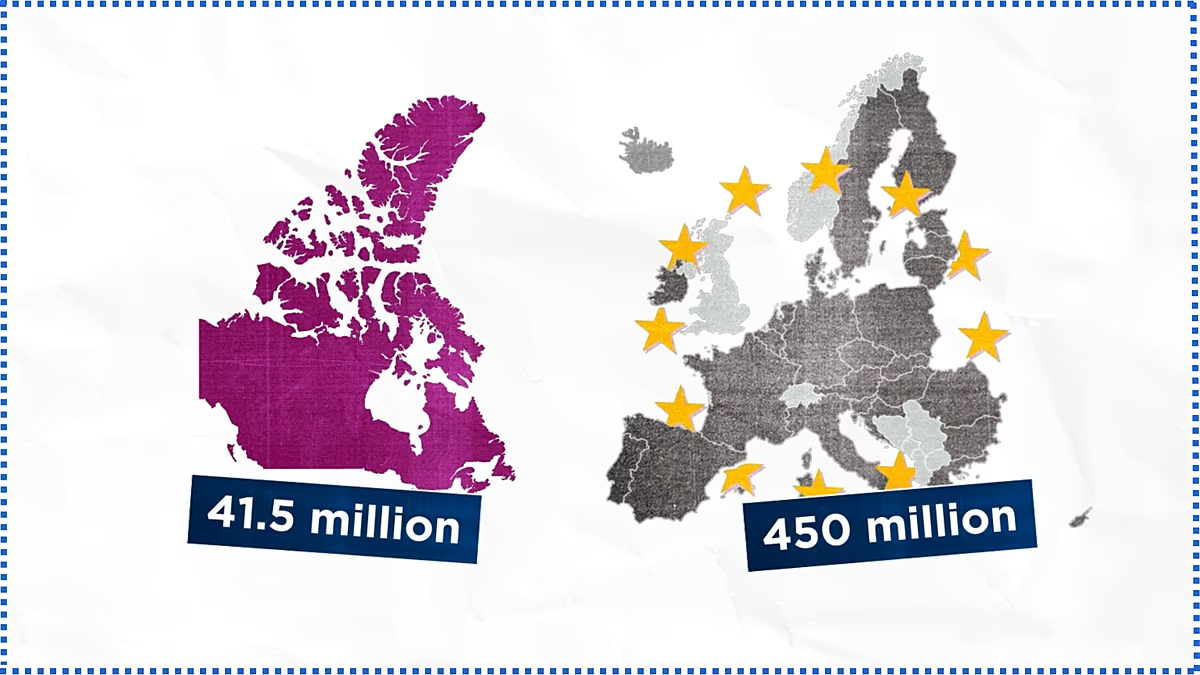
The conversation is not one-sided. Across the Atlantic, public opinion in several key European nations appears receptive. Polls show that a majority of citizens in Germany and Spain back the notion of Canadian accession. In other major countries like Poland, France, and Italy, those in favour significantly outnumber opponents. This openness is likely rooted in a recognition of Canada’s substantial geopolitical and economic weight. With a population of approximately 41.5 million—roughly 10% of the EU’s total—Canada is no minor player. It is a founding member of NATO, a G7 nation, and boasts a GDP per capita that remains higher than the EU average. This economic strength suggests that, were integration to occur, Canada would enter the union as a prosperous net contributor, not a beneficiary of its cohesion funds, adding immediate fiscal value.
Paragraph 3: The Legal and Bureaucratic Hurdle
Despite this wave of public enthusiasm on both sides of the ocean, the path to membership is blocked by a formidable, if polite, reality check from the heart of EU bureaucracy. European Commissioner for Enlargement, Marta Kos, has pointed to a fundamental legal obstacle. Article 49 of the Treaty on European Union stipulates that only a “European state” may apply for membership. Unlike current candidate countries such as Ukraine or historical applicants like Turkey, Canada lacks the geographic presence on the European continent. Furthermore, it does not share the deep, ancient cultural and historical ties that have traditionally defined the European project. This is not a minor procedural detail but a core treaty requirement, meaning that welcoming Canada would necessitate a total legal overhaul of the EU’s foundational principles—a prospect with minimal political appetite in Brussels.
Paragraph 4: A Pragmatic Alternative: The “Close Family” Model
Given the near-insurmountable barrier of full membership, a more plausible and pragmatic future is taking shape in expert discussions. The relationship could evolve towards a bespoke, advanced partnership, mirroring models already in existence within Europe. Nations like Norway and Switzerland are not EU members but have secured profound levels of integration through complex bilateral agreements. They participate deeply in the EU’s single market and various cooperative programmes on security, research, and education, while maintaining formal political independence. For Canada, a similar “close family” bond could be crafted. This model would offer the economic benefits and strategic alignment that Canadians seem to desire—access to the single market, collaboration on security and climate initiatives—while gracefully sidestepping the legal quagmire of full accession and the loss of sovereignty it entails.
Paragraph 5: The Strategic Imperative and Cultural Fit
The drive for this deepened partnership is fueled by more than economics; it is a strategic imperative in a fragmenting world. For Europe, a formalized close alliance with a stable, like-minded democracy like Canada diversifies its global partnerships and strengthens the Western democratic bloc. For Canada, it represents a deliberate diversification of its diplomatic and economic relationships, reducing its historic over-reliance on the United States. Culturally, the fit is natural. Canada’s bilingual English and French foundation mirrors the EU’s own multilingual reality, fostering an innate understanding. The nation’s commitment to multilateralism, peacekeeping, and liberal democratic values aligns seamlessly with the stated ethos of the European Union, making political and policy coordination far more straightforward than with many other global partners.
Paragraph 6: A Future of “Yes” or “Oui”
Ultimately, the question of Canada joining the EU as a full member remains a theoretical “what if” scenario, constrained by treaty law. Yet, the burgeoning public support in both Canada and Europe signals a clear and compelling desire for a fundamentally stronger bond. The future, therefore, lies not in a dramatic accession, but in the meticulous construction of a 21st-century partnership agreement—unprecedented in its depth and scope. It would be a relationship acknowledging shared values, mutual economic interest, and common strategic goals. This journey towards a “close family” status may well be the realistic and impactful path forward. And when presented with this tangible model of deep integration without full membership, Canadians might very well offer their approval. They could say “yes.” Or, in a nod to their heritage and the partnership’s spirit, “oui.”