


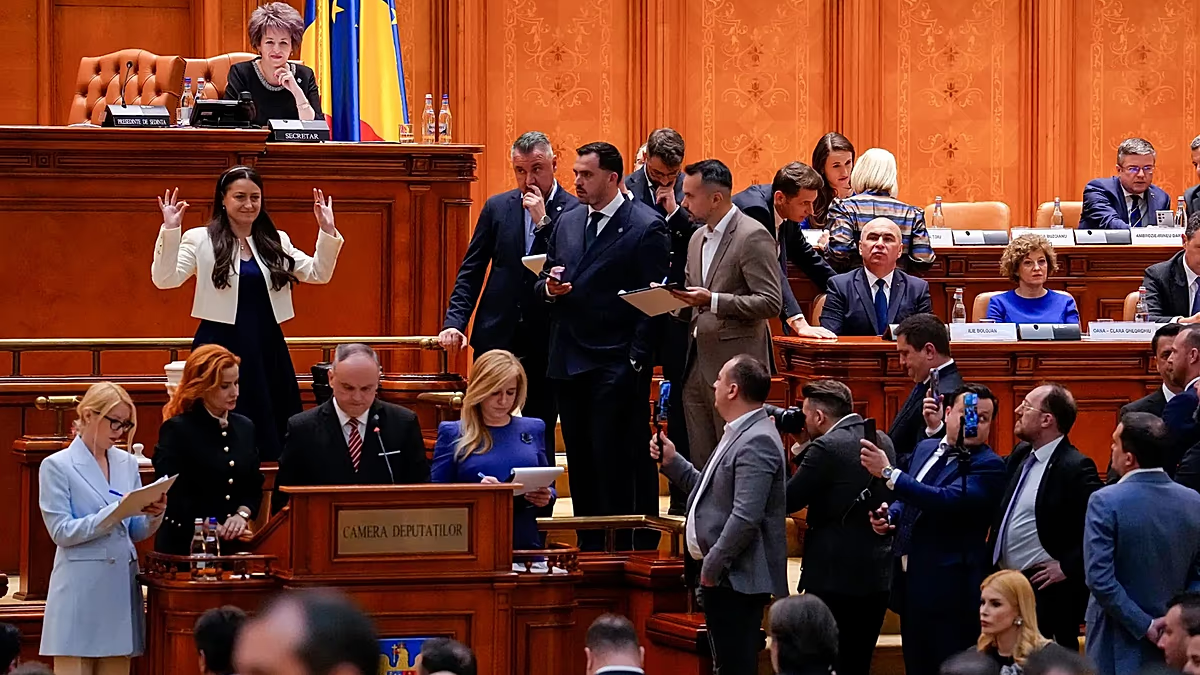
The fragile stability of Romania’s political landscape has shattered once again, as the nation’s pro-European coalition government collapsed on Tuesday following a successful parliamentary no-confidence vote against Prime Minister Ilie Bolojan. This dramatic turn of events plunges the country into a fresh period of turmoil less than a year after the coalition—a tenuous alliance of centre-right, liberal, and minority parties—was sworn in with promises of reform and European integration. The motion, passed by an overwhelming 281 votes to just four, signifies a profound rupture not only in the ruling alliance but in the broader political consensus, marking a severe setback for governance in a nation already struggling with significant economic and social challenges.
The downfall was engineered through an unlikely and telling political marriage between the leftist Social Democratic Party (PSD), which had withdrawn from the coalition in late April, and the hard-right, nationalist Alliance for the Unity of Romanians (AUR). This joint effort underscores the depth of the discontent aimed at Bolojan’s administration and its austerity policies. In a symbolic act of protest, lawmakers from Bolojan’s own National Liberal Party (PNL) and his remaining coalition partners chose to abstain from the vote entirely, rather than mount a defence. Prime Minister Bolojan, striking a defiant yet weary tone, condemned the motion as a “cynical and artificial” document crafted by those with no hands-on experience of the difficult decisions required to govern, arguing it ignored the dire context his government inherited.
That context is one of profound crisis. Romania is grappling with one of the European Union’s highest budget deficits, persistent rampant inflation, and a technical recession, all set against a backdrop of prolonged instability that began with the annulment of a presidential election in late 2024. When Bolojan’s coalition took power in June of last year, its central pledge was to urgently address this fiscal emergency. To that end, the Prime Minister implemented a series of tough measures including tax hikes, freezes on public sector wages and pensions, and cuts to public spending and administration jobs. He defended these actions as painful but necessary to “regain the trust of the markets” in the Romanian state, a stance that put him on a collision course with the PSD and eroded public tolerance for austerity.
The PSD’s critique, however, went beyond mere policy disagreement. The party accused Bolojan of having “failed to implement any genuine reform” during his ten-month tenure and argued that Romania now needs a leader “capable of collaboration.” This language highlights the fundamental breakdown in the coalition’s working relationship, where the exigencies of crisis management clashed with political survivability. Meanwhile, the involvement of the AUR, which voted with the PSD to bring down the government, introduces a more volatile element. AUR leader George Simion framed the vote in starkly populist terms, claiming voters had been promised essentials like “water, food, energy” but had instead “received taxes, war and poverty,” and calling for a return to the direct will of the people.
The path forward is now shrouded in uncertainty and appears fraught with difficulty. As Bucharest-based political consultant Cristian Andrei analysed, the result is a political stalemate where “no one has a majority, or a coalition,” likely requiring weeks of presidential consultation to identify a viable path to a new government. Two tentative options exist, both problematic: a reshuffled version of the old pro-European coalition, but without the ousted Bolojan, or a minority cabinet potentially led by the PSD with support from populist parties like AUR. However, an official PSD-AUR governing coalition is currently seen as improbable, as the president is unlikely to endorse a formula that brings the hard-right AUR directly into government, a move that would alarm European partners.
Consequently, Romania finds itself at a precarious crossroads, facing a prolonged period of indecision that its economy can ill afford. The collapse of this coalition is more than a simple change in administration; it is a symptom of deep-seated fractures within the political class and a growing disconnect between austerity-driven governance and a weary populace. The coming weeks will test the ability of Romania’s institutions to forge a functional government from the fragments of this defeat, all while the pressing issues of deficit, inflation, and recession demand immediate and coherent action. The hope for stability and reform that accompanied the coalition’s formation less than a year ago has now been replaced by the sobering reality of renewed political turbulence.