




A Crisis at the Crossroads: Cyprus Farmers Demand a Rethink on Livestock Culling
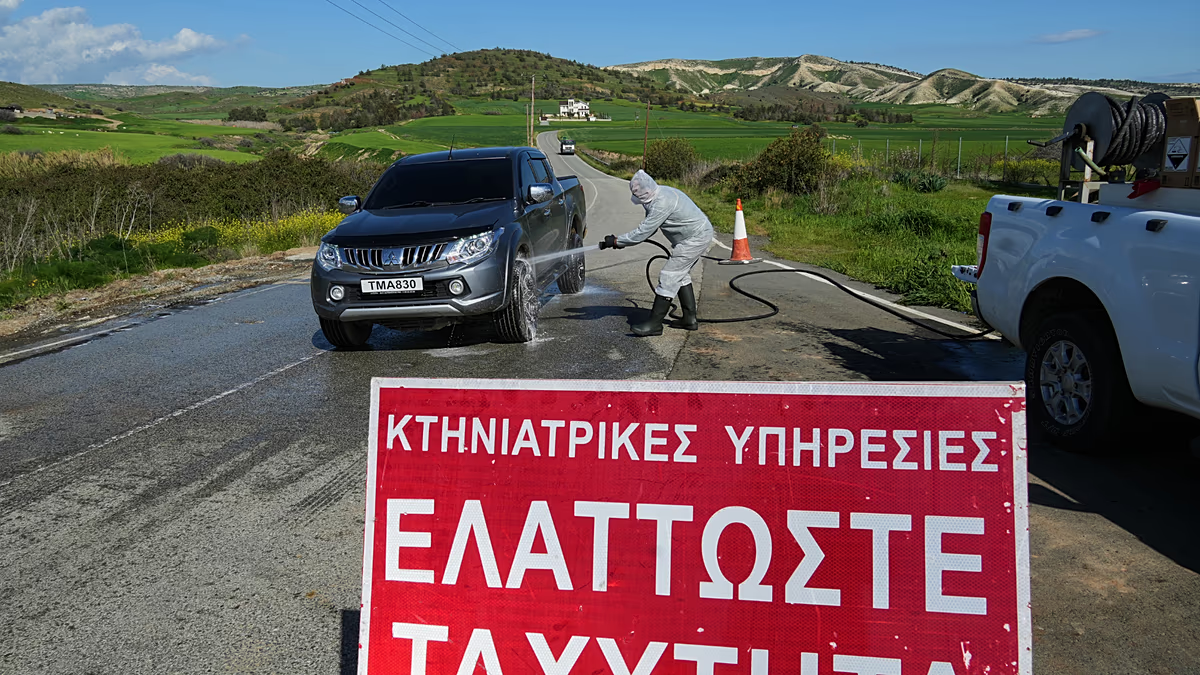
In the sun-drenched fields of Cyprus, a profound crisis is unfolding, pitting the livelihoods of hundreds of farming families against the strict protocols of the European Union. The newly established Cyprus Livestock Association, a collective voice for approximately 200 members, has issued a stark warning to the government: even if long-awaited financial aid is finally approved, it will not be enough to placate their community. The Association has declared itself ready to take “strong action” unless authorities fundamentally reconsider their strategy for managing a devastating animal disease outbreak. This stance signals a deep and volatile frustration, where compensation is viewed not as a solution, but as a mere palliative for a strategy they see as unnecessarily destructive. The farmers feel cornered, believing the current path leads to the irreversible erosion of their herds and their way of life.
The human face of this frustration was articulated by Association spokesperson Stella Petrou in an interview with state broadcaster RIK. Petrou challenged the government’s narrative, asserting that European regulations contain provisions for alternative approaches to crisis management that are being ignored. Her concerns are intensely practical and immediate: farmers still lack clear, detailed information on what any compensation package will actually cover. Will it account for production costs, expensive animal feed, and, crucially, lost future income? Without these assurances, promises of aid feel hollow. While ruling out extreme measures like airport blockades, Petrou confirmed that demonstrations are imminent, targeting symbolic centers of power like the Presidential Palace and major urban roads—a direct appeal to the public and a bid to pressure political leaders where they live and work.
The scale of the loss these farmers are protesting is staggering and deeply personal. To date, the outbreak has necessitated the culling of approximately 38,900 sheep and goats, 2,247 cattle, and 21,500 pigs. These are not merely numbers on a spreadsheet; they represent generations of breeding, daily care, and the primary assets of family-run farms. Data from 110 affected farms translates these figures into a stark perspective: losses equivalent to 9.5% of the national adult sheep and goat population, 2.8% of cattle, and nearly 7.9% of pigs. This constitutes a direct attack on Cyprus’s agricultural backbone and its cultural heritage, threatening products like halloumi cheese, which relies on local sheep and goat milk. For the farmers, each culled animal is a step toward an uncertain future.
In response, the government maintains a position of unwavering adherence to EU law. Government spokesman Konstantinos Letymbiotis has emphatically stated that the veterinary response must strictly follow established EU protocols and cannot be swayed by political pressure. He confirmed that while the President is closely monitoring the situation, there are no plans for a new meeting with farmer representatives, indicating a firm, if not inflexible, stance. Letymbiotis acknowledged the farmers’ distress but positioned public health as the non-negotiable priority. He noted that discussions on compensation are advancing, with announcements pending final procedures, and emphasized that authorities have exhaustively consulted with both stakeholders and EU officials, concluding there is no legal room to deviate from the mandated regulations.
This claim of a single, inflexible EU rulebook was forcefully echoed—and directed against the farmers’ claims—by Dimitris Epaminondas, head of the Pancyprian Veterinary Association. He categorically rejected the idea that viable alternative EU protocols exist, explaining that the bloc enforces a unified eradication strategy precisely to prevent the cross-border spread of disease through trade. Epaminondas presented a grave economic counter-warning: any attempt by Cyprus to deviate from this strategy could trigger a devastating trade embargo from the EU. The most significant casualty of such an embargo could be the iconic export of halloumi cheese, a cornerstone of the Cypriot economy. From this expert viewpoint, the farmers’ proposed path risks not only animal health but the entire export viability of a national treasure.
Thus, Cyprus finds itself at a painful impasse. On one side, a community of farmers, backed by their new Association, argues for pragmatism and the exploration of every possible alternative within the EU framework to save what remains of their herds. They seek not just financial relief, but validation of their expertise and a partnership in crisis management. On the other side, the government and veterinary authorities present a harrowing binary choice: follow the strict culling protocol to the letter or risk catastrophic trade isolation and long-term economic damage. The coming days, likely marked by demonstrations and heightened political tension, will test whether dialogue can bridge this chasm. The outcome will resonate far beyond the farms, impacting Cyprus’s agricultural identity, its economic stability, and its relationship with the European institutions that govern it. The crisis is no longer just about animal disease; it is a fundamental clash between immediate human survival and systemic regulatory imperatives.