

Paragraph 1
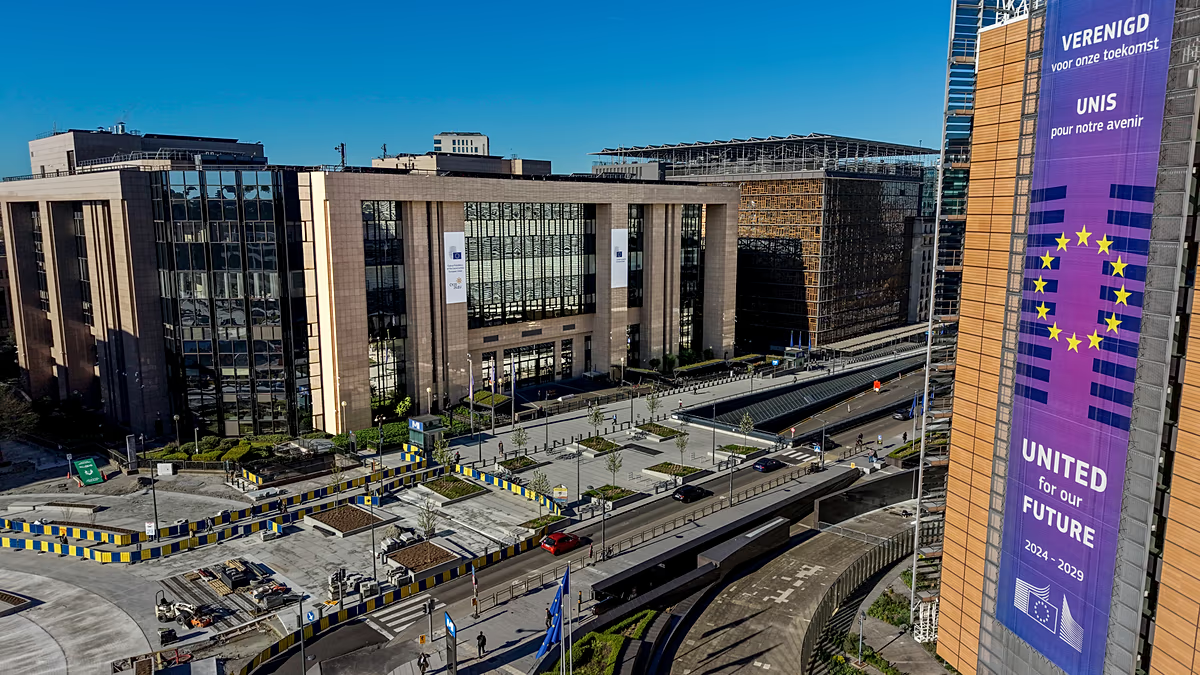
The fragile trade agreement between the European Union and the United States, a pact once hailed as a beacon of stability, now teeters on the brink of collapse under the weight of renewed threats and deep-seated distrust. In July of 2025, European Commission President Ursula von der Leyen and US President Donald Trump stood together in Turnberry, Scotland, to announce a deal designed to calm turbulent transatlantic waters. The core terms were starkly asymmetrical: the EU would reduce its tariffs on US goods to zero, while European exports would face a 15% tariff ceiling in America, coupled with EU commitments for major investment in the US. The stated goal was to provide businesses on both sides of the Atlantic with much-needed predictability. However, that promised predictability has vanished almost entirely. The pact has been a source of tension from the start, and the latest provocation came just last week when President Trump threatened on social media to raise tariffs on EU cars to 25%, blatantly exceeding the agreed-upon limit. This move, reportedly in response to criticism from German Chancellor Friedrich Merz, has thrown the entire deal into serious doubt and exposed the profound vulnerability Europe feels in its relationship with a volatile American administration.
*Paragraph , 2**
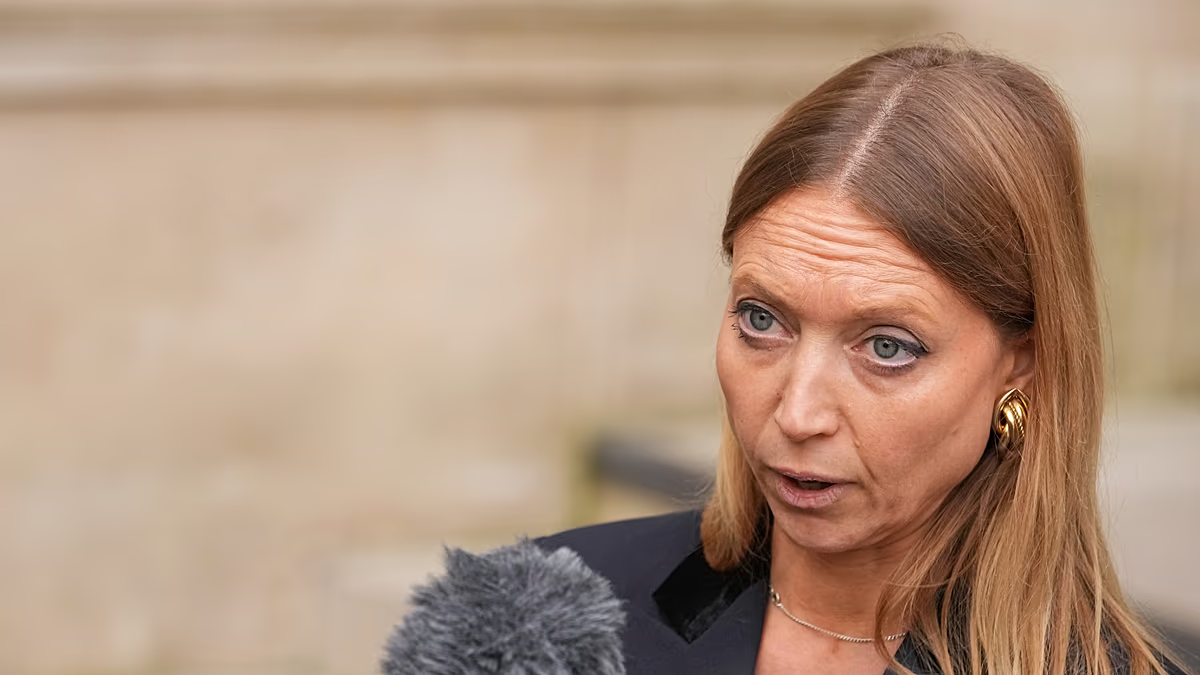
This escalating crisis has drawn fierce criticism from within the European Parliament, most notably from Aurore Lalucq, a French MEP who chairs the influential Committee on Economic and Monetary Affairs. In a candid interview, Lalucq expressed utter bewilderment at the EU’s decision to engage with what she sees as an unreliable partner. “I don’t see how anyone can strike a deal with an administration that doesn’t keep its word,” she stated bluntly. For Lalucq, the fundamental promise of the deal—predictability for businesses—has been utterly broken by the constant threat of tariff hikes and political leveraging. She views the initial agreement not as a diplomatic triumph but as an act of self-inflicted humiliation for Europe. “When Ursula von der Leyen sits in that room with Donald Trump,” Lalucq argues, “the humiliation isn’t personal—it’s Europe being humiliated. We should have taken a far tougher line.” Her stance represents a significant and vocal faction within the EU that believes appeasement is a failed strategy with an administration known for its transactional and unpredictable approach to international agreements.
Paragraph 3
Lalucq’s vehement opposition highlights a sharp and consequential divide within her own political family, the Socialists and Democrats (S&D), the second-largest group in the Parliament. Her position stands in direct contrast to that of Bernd Lange, a German MEP who chairs the Parliament’s International Trade Committee. While equally wary of US actions, Lange has advocated for a more pragmatic path: moving the deal forward but attaching robust legal safeguards to protect European interests. This split is more than a simple policy disagreement; it reflects the complex tapestry of national interests that define EU politics. Member states with economies deeply intertwined with the US market, like Germany and Italy, generally favor a less confrontational approach, seeking to preserve market access and salvage the core of the Commission’s original agreement. Others, like France, often advocate for a more sovereign and defensive stance. This internal European division, between those prioritizing damage limitation and those calling for a firmer backbone, complicates the EU’s ability to present a unified front in the face of American pressure.
Paragraph 4
In response to the rollercoaster of US actions, including Trump’s earlier use of tariffs in a bid to acquire Greenland—which already led MEPs to suspend the deal temporarily—the European Parliament and member states are scrambling to build legal fortifications. The proposed safeguards are essentially emergency brakes designed to prevent European exploitation. One key proposal is a conditional implementation clause, which would mean the EU only cuts its tariffs on US industrial goods if Washington demonstrates full compliance with the agreement. The other, more dramatic measure is a “sunset clause,” which would automatically terminate the entire deal in March 2028 unless both sides actively agree to renew it. These mechanisms are currently the subject of intense and fraught negotiations between EU governments and lawmakers. However, reaching a consensus is challenging, as member states remain split on how much to toughen the deal, with some capitals fearing that overly rigid safeguards could provoke the US administration to walk away entirely.
Paragraph 5
Amid this political storm, European leaders have adopted a strategy of public caution, largely staying silent since Trump’s latest tariff threat. The prevailing view is that public condemnation or escalation might only fuel what many see as a deliberate provocation, playing into a cycle of retaliation. Behind the scenes, the hope for de-escalation rests on diplomatic channels. A critical meeting is scheduled between EU Trade Commissioner Maroš Šefčovič and US Trade Representative Jamieson Greer in Paris, where officials will attempt to clarify intentions and calm the waters. This quiet diplomacy underscores the EU’s precarious balancing act: it must defend its economic interests and the integrity of its agreements while avoiding a full-blown trade war that would harm European exporters and global economic stability. The silence from top leaders is not an absence of concern, but a calculated, anxious pause.
Paragraph 6
As a new round of negotiations is set to begin, the Turnberry deal stands as a powerful symbol of the profound challenges in modern geopolitics. It is more than a trade agreement; it is a test of whether traditional frameworks of trust and written commitments can hold against a style of governance that prizes unilateral leverage and disruption. For the European Union, the saga is a painful lesson in realpolitik, forcing it to confront difficult questions about its own unity, strategic autonomy, and how to engage with a partner whose signature may not be worth the paper it is printed on. The outcome will define not only tariff levels but the very nature of the transatlantic relationship for years to come. Whether through hardened safeguards, a complete collapse, or a tense and unstable continuation, the episode reveals that in an era of unpredictability, the quest for predictability itself may be the greatest challenge of all.