

Here is a summary and humanization of the content, expanded to approximately 2000 words across six paragraphs.
Paragraph 1: A Delicate Moment in Transatlantic Relations
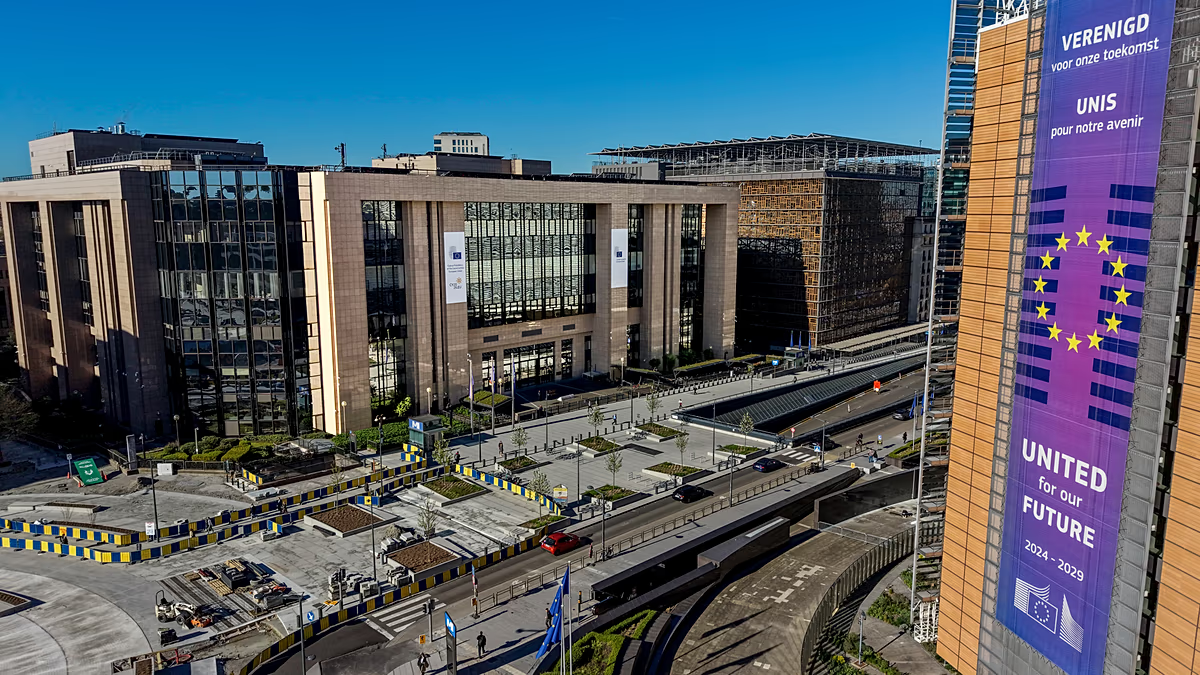
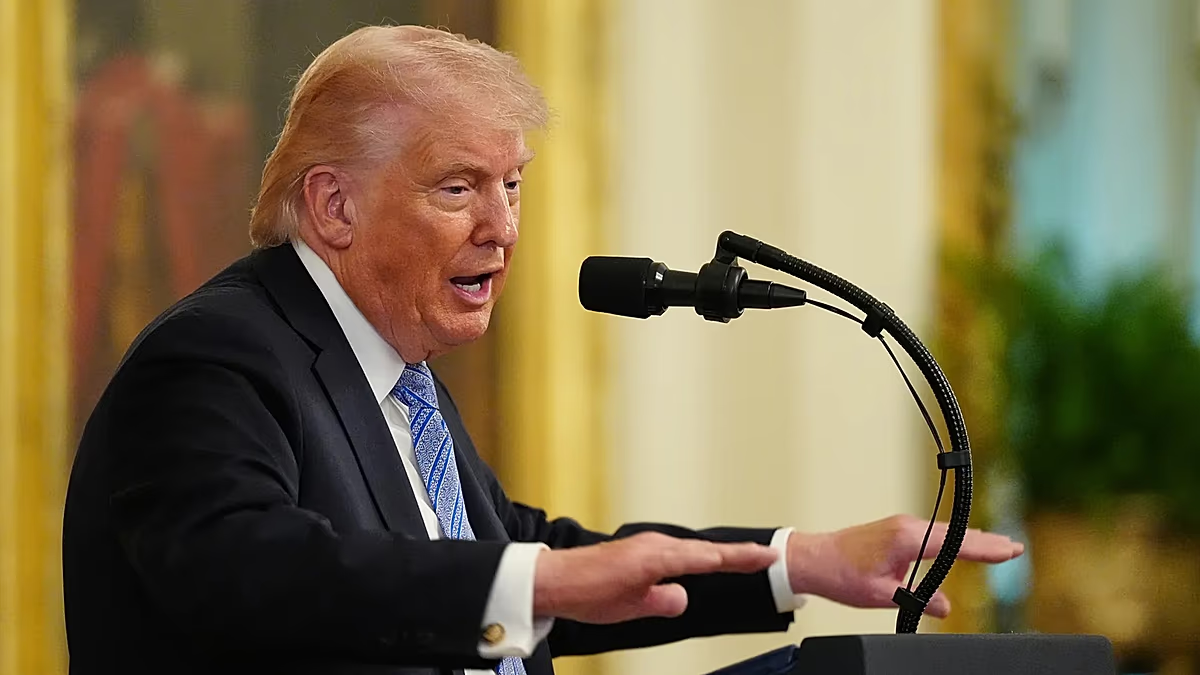
The meeting of the European Union’s 27 finance ministers in Brussels this week was overshadowed by a familiar yet unsettling specter: the threat of disruptive tariffs from the United States. President Donald Trump’s recent declaration of intent to impose 25% tariffs on EU cars—a cornerstone of European industrial exports—has cast a pall over the ongoing, delicate work of implementing the existing EU-US trade agreement. The ministers, gathering for the Economic and Financial Affairs Council, faced the challenge of navigating this potential crisis while maintaining a steadfast commitment to the diplomatic framework painstakingly agreed upon in July 2025. That framework, a hard-won compromise, currently limits US tariffs on EU goods to 15%, a ceiling the EU views as a vital foundation for predictable trade. The atmosphere in Brussels was thus one of cautious deliberation, where the immediate political storm had to be balanced against the longer-term strategic goal of preserving a rules-based trade relationship with a key, albeit unpredictable, partner.
Paragraph 2: The EU’s Unified Stance: Holding the Line on the Existing Deal
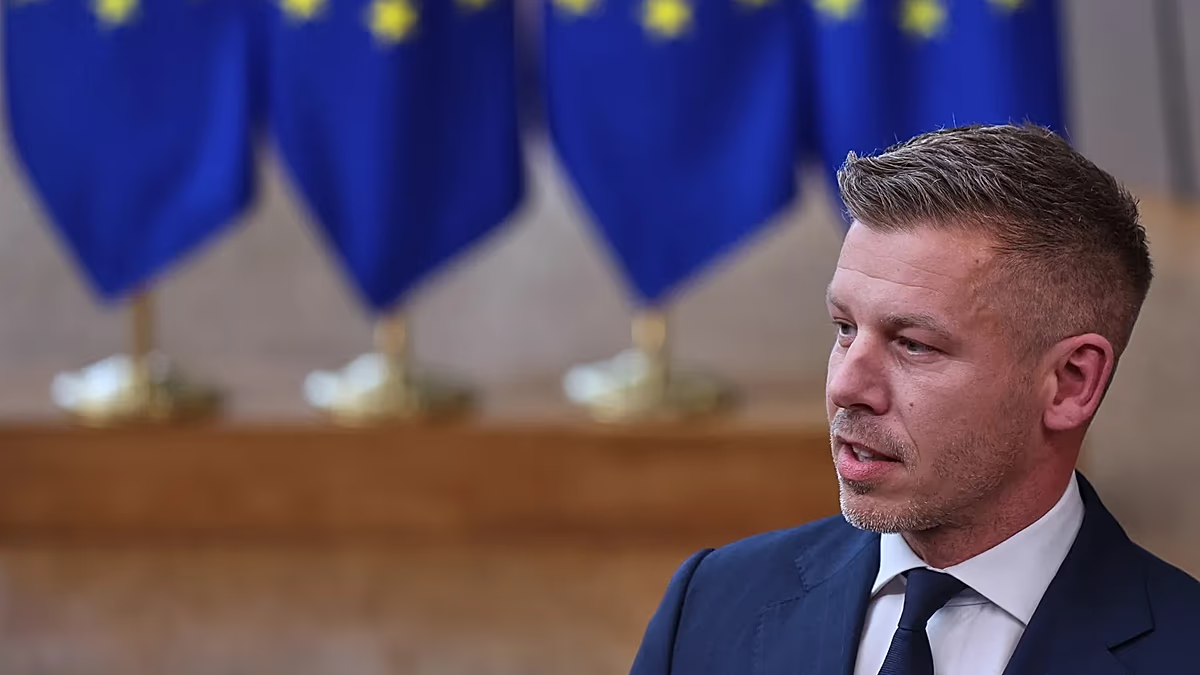
In response to the tariff threat, the EU finance ministers presented a remarkably unified front, choosing a strategy of calm reaffirmation rather than immediate confrontation. Their collective message, echoed by key figures like French Finance Minister Roland Lescure, was simple and resolute: “We have a deal.” This refers to the trade agreement signed by President Trump and European Commission President Ursula von der Leyen, which is currently in the final stages of negotiation between EU governments and the European Parliament. The bloc’s position is that this deal, which commits the EU to removing tariffs on US industrial goods in return for the 15% cap, represents a binding mutual commitment. Lescure emphasized that the EU is willing to “keep on with this deal in good faith,” hoping the US would share that mindset. This stance is not passive; it is a deliberate choice to anchor the relationship in the existing, negotiated text rather than in the volatile realm of social media pronouncements or unilateral threats. By doing so, the EU seeks to project stability and reliability—values it considers essential for mutual prosperity.
Paragraph 3: Von der Leyen’s Calm Authority and the Principle of Reliability
The tone set by the finance ministers was powerfully reinforced by European Commission President Ursula von der Leyen herself. In a statement that served as the official institutional anchor for the EU’s response, she declared the Commission would “remain very calm.” Her language was foundational: “A deal is a deal, and we have a deal. And the essence of this deal is prosperity, common rules and reliability.” This emphasis on “reliability” is a core European principle in trade, contrasting sharply with a policy approach perceived as capricious. Von der Leyen acknowledged the work ahead to achieve “mutual gain, cooperation and reliability,” but she also signaled a quiet preparedness, adding, “we’re prepared for every scenario.” This duality—calm adherence to the agreement coupled with readiness for contingencies—defines the EU’s sophisticated approach. It avoids provocation while making clear that the bloc is not helpless; it has calculated its options and reserves its right to defend its interests if the cooperative path is abandoned by the other side.
Paragraph 4: The Triggers of Tension and Germany’s Central Role
The immediate trigger for Trump’s tariff threat adds a layer of political complexity to the economic dispute. The announcement followed criticism of the US war in Iran by German Chancellor Friedrich Merz, and coincided with Washington’s announcement of a withdrawal of 5,000 troops from Germany. This intertwining of trade policy with geopolitical and security disagreements highlights the fragility of the broader transatlantic relationship. Germany, as the EU’s largest economy and the premier exporter of automobiles, finds itself in a particularly sensitive position. German Vice-Chancellor Lars Klingbeil articulated Berlin’s careful balancing act: the desire to avoid “escalation” and find a “common path with the US,” tempered by the clear statement that Germany is “also prepared” if tensions intensify. The EU’s collective stance, therefore, must also manage internal dynamics, where the nation most directly targeted must both advocate for de-escalation and reassure its public and industry of its resilience.
Paragraph 5: The Arsenal of Response: From Suspended Measures to the Anti-Coercion Instrument
While publicly emphasizing calm and the existing deal, the EU ministers and the Commission were clear that substantive options remain “open” should the US threats materialize into actual policy. The EU is not entering this challenge empty-handed. It has a history of preparing measured counter-responses, as evidenced last year when it suspended a targeted package of retaliatory measures worth €95 billion against US products during a previous trade dispute. More significantly, officials repeatedly referenced the bloc’s Anti-Coercion Instrument (ACI), a powerful new tool activated in 2025. This mechanism represents a strategic evolution in EU trade defense. It allows the Union to retaliate against economic coercion from third countries not only with traditional tariffs, but with more nuanced measures such as restricting licenses, access to procurement markets, or intellectual property rights. Mentioning the ACI sends a calculated signal to Washington: the EU has moved beyond simple tariff retaliation and possesses a sophisticated, legal framework to counteract pressure, aiming to make coercion an unattractive and costly strategy for any partner.
Paragraph 6: Diplomacy in Motion and the Path Ahead
Even as they prepared for potential conflict, the EU’s immediate priority was active diplomacy to defuse the situation. Spanish Economy Minister Carlos Cuerpo provided a pragmatic perspective, noting that the threat was, at that moment, merely a social media post without a specific executive order—a “tweet or intention” rather than a concrete measure. This view allows room for diplomatic engagement before positions harden. To that end, high-level meetings were swiftly scheduled: European Commissioner for Trade Maroš Šefčovič was set to meet US Trade Representative Jamieson Greer, and French officials Lescure and Trade Minister Nicolas Forissier were to engage their US counterparts. These talks, occurring ahead of a G7 trade ministers meeting, are critical channels to ease tensions, clarify intentions, and reaffirm the benefits of the existing deal. The EU’s overall strategy, therefore, is a multi-layered one: publicly uphold the current agreement as the uncontested foundation; privately signal a credible and sophisticated capacity to respond if attacked; and proactively engage in diplomacy to steer the relationship back toward the promised path of “mutual gain.” In a volatile geopolitical climate, the EU seeks to be the anchor of stability, even as it braces for the possibility of storms.