

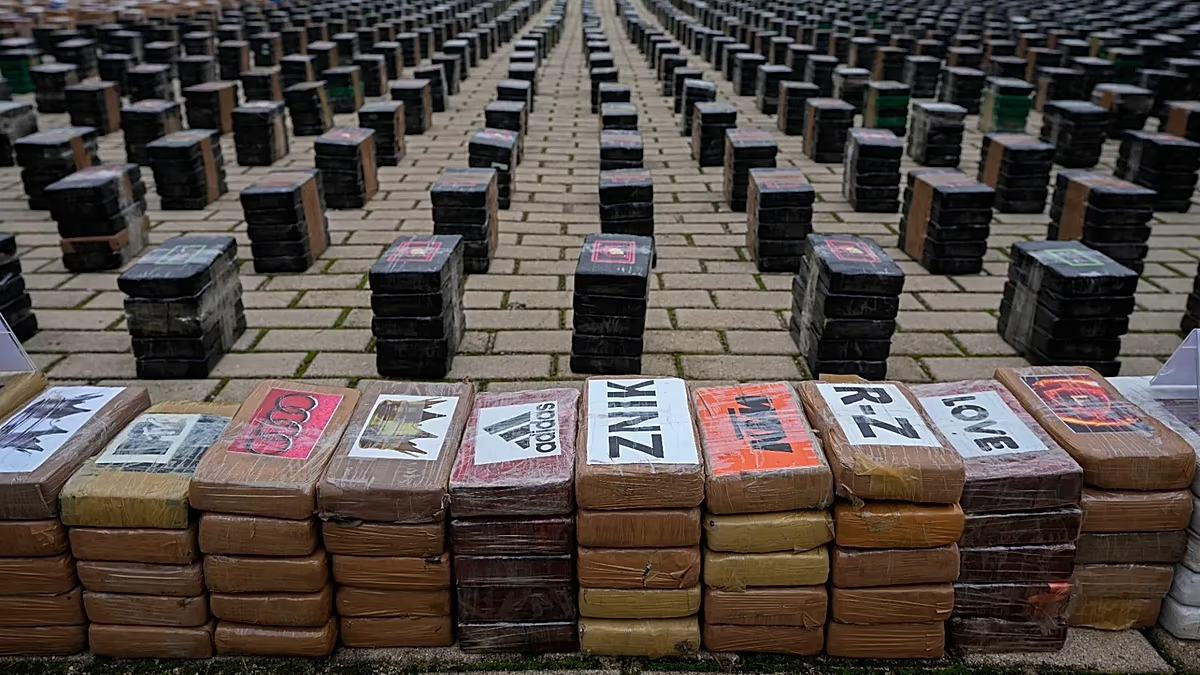
The world’s oceans, vast and often lawless, serve as the arteries of global illicit trade. On a Friday in early April 2026, Spanish law enforcement pierced this shadowy realm with a historic blow. In the international waters of the Atlantic, off the coast of the Canary Islands, the Civil Guard intercepted a cargo vessel. The operation, now shrouded in judicial secrecy by a court order, resulted in the arrest of around twenty individuals. But the true scale of the event became clear only upon inspection: the ship’s hold was reportedly “completely stuffed” with bales of cocaine. Initial estimates from sources within the Civil Guard’s AUGC union point to a seizure of between 35 and 40 tonnes. This staggering quantity—potentially a national record for Spain and among the largest internationally—transforms a routine interdiction into a landmark event in the global fight against narcotics trafficking.
The vessel’s intended route, from Freetown, Sierra Leone, to Benghazi, Libya, tells a story of deceptive logistics. As analysts from the AUGC noted, the unloading of such a colossal volume in Libya “doesn’t make much sense.” Ports there could not discreetly handle forty tonnes of cocaine; such an operation would inevitably “arrouse a lot of suspicion.” Instead, this was almost certainly a transshipment point. The mother ship, a floating warehouse, was likely destined to meet a fleet of smaller, faster vessels in the open sea. These “go-fast” boats would then disperse the cargo across European coasts, a method that allows large shipments to be broken into smaller, more manageable—and less detectable—consignments for final delivery. This intricate, coordinated dance across the waves is the hallmark of sophisticated international criminal networks.
Spanish Interior Minister Fernando Grande-Marlaska publicly hailed the seizure as “one of the biggest, not only nationally but internationally,” a statement that underscores its symbolic weight. Spain’s geographical and historical position makes it a perpetual frontline in Europe’s drug war. Its close ties with Latin America—the primary source region for cocaine—and its proximity to Morocco, a major producer of cannabis, render its ports and vast coastline critical entry points. This record seizure follows a pattern of escalating interdictions. Just two years prior, in 2024, authorities impounded 13 tonnes of cocaine from a container ship in Algeciras, which was then the country’s largest-ever haul. Months before this latest operation, in January 2026, police made their biggest seizure at sea to date, capturing a vessel carrying almost 10 tonnes. This trajectory suggests not only increasing police efficacy but also the relentless, expanding ambition of the trafficking cartels.
Behind these numbers lies a human and economic calamity. Forty tonnes of cocaine represents a tsunami of potential harm. Once distributed, this single shipment could generate billions of euros in illicit revenue, fueling further violence and corruption across continents. The profits finance every link in the chain: from the intimidation of local communities in source countries, to the corruption of port officials, to the brutal street-level disputes in European cities. The arrest of twenty individuals is a minor disruption to a network that likely employs hundreds, if not thousands. This seizure, while devastating to one criminal operation, is a snapshot of a perpetual struggle—a reminder that the ocean remains a battleground where law enforcement victories are temporary, and the enemy’s logistics are as adaptable as the sea itself.
The tactical success also highlights strategic challenges. The use of a ship departing from West Africa (Sierra Leone) for a North African port (Libya) indicates a shifting, flexible geography of crime. Traffickers exploit regions with weaker maritime surveillance or political instability to stage their operations. The choice of Libya, a nation still grappling with conflict and fragmented authority, as a listed destination is particularly telling. It exemplifies how criminal enterprises seamlessly integrate their logistics into the world’s geopolitical fractures, using chaos as a cloak. For European authorities, this means the threat is not static; it evolves, finding new routes and new methods as pressure is applied elsewhere. The international cooperation required to track, intercept, and investigate such a shipment—likely involving multiple intelligence and naval agencies—is as complex as the criminal network it seeks to dismantle.
Ultimately, this historic seizure is a story of both triumph and sobering reality. It is a testament to the vigilance and capability of Spain’s Civil Guard, operating far beyond their territorial waters. It delivers a financial and logistical shock to a major criminal syndicate, temporarily disrupting a flow of drugs that would have devastated communities. Yet, the very scale of the haul—40 tonnes—is also a stark indicator of the prodigious, industrial output of the cocaine trade. It confirms that demand in Europe remains insatiable, and that the criminal supply chains are capable of mobilizing cargoes of a size comparable to legitimate commercial shipments. As the impounded ship sits inspected in a Canary Islands port, it stands as a silent, physical monument to a victory in an endless war. The sea, however, remains vast, and the networks, though wounded, are already plotting their next voyage.