


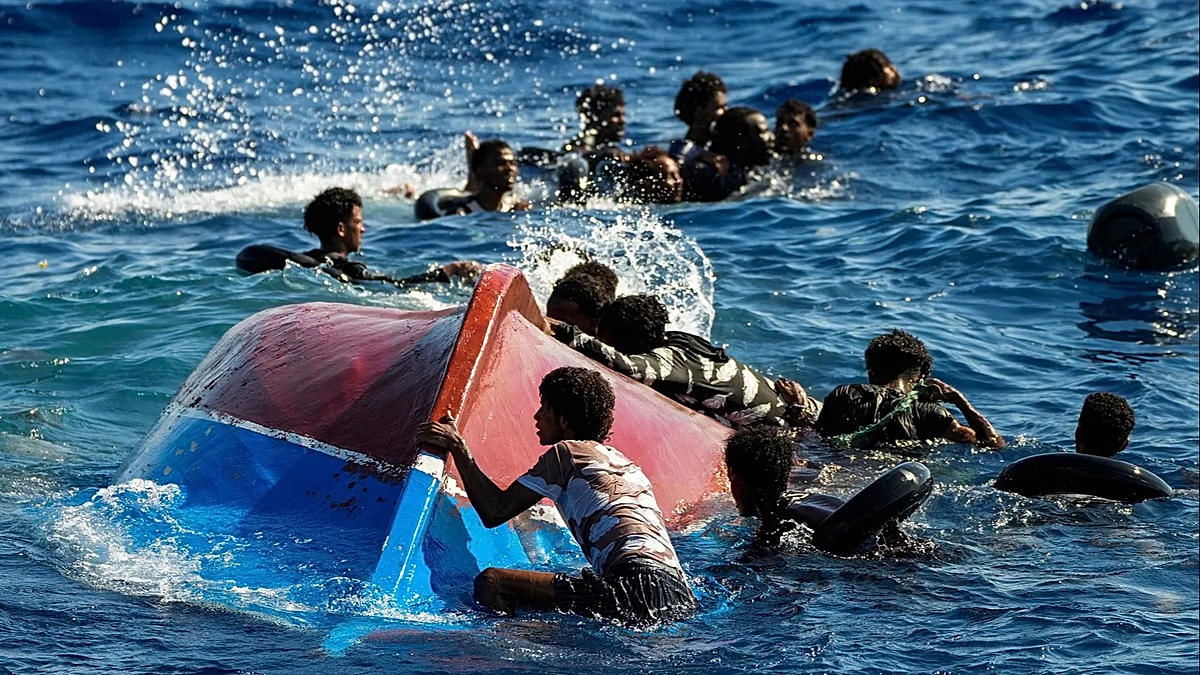
In an era defined by interconnected global challenges, a stark and counterproductive pattern is emerging among the world’s wealthiest nations. As Amy Pope, the Director-General of the United Nations’ International Organization for Migration (IOM), recently warned, significant cuts to international development aid are directly exacerbating the very displacement crises these nations often seek to fortify themselves against. Speaking at the Berlin Climate Mobility Forum, Pope articulated a clear causal link: reducing assistance to the world’s poorest and most fragile regions strips communities of their resilience, making desperate migration not a choice but an inevitability. This paradox lies at the heart of a global policy failure, where short-sighted domestic decisions are creating long-term instability on an international scale.
Pope’s warning is not theoretical; it is borne out by the brutal realities of current crises. She points to Sudan, now the site of the world’s largest displacement crisis, as a tragic case study. As international humanitarian support dwindles in the face of protracted war, more Sudanese are compelled to look “further afield” for safety and survival. This dynamic is being replicated globally. Nations like the United States and Germany have sharply reduced their development budgets—the U.S. under the previous administration slashed USAID programs by 83%, while Germany has cut billions from its own commitments. Simultaneously, these same countries are tightening border controls and restrictive migration policies. Pope identifies this as a politically driven but fundamentally flawed approach: yielding to domestic pressure for “short-term decisions” that ultimately undermine long-term security and stability by fueling the drivers of displacement.
Compounding this man-made policy failure is the relentless, accelerating force of climate change, which Pope describes as having an “enormous impact on migration around the world.” From the existential threat of sea-level rise facing Pacific island nations like Tuvalu to the estimated 10 million displaced by storms in the Philippines or communities across Africa shattered by prolonged drought, environmental disruption is a primary catalyst for movement. Here, the moral and practical imperative intersects sharply. The wealthiest countries, which bear the greatest historical responsibility for the carbon emissions driving this crisis, are now cutting the aid needed to help vulnerable populations adapt. Pope poses a crucial question to these policymakers: “What are they willing to invest now to ensure more stability, more options, less likely occurrence of unplanned migration in the future?” Her plea is to proactively invest in resilience, arguing, “Let’s not wait for the emergency.”
A critical piece of this puzzle, often obscured by politicized rhetoric, is understanding where displacement actually occurs. Contrary to narratives fixated on cross-border movements, the vast majority of displaced people remain within their own countries. IOM data estimates over 700 million internal migrants globally, compared to 304 million international migrants. As Pope explains, “In the first instance, people will stay in their country. They will go somewhere in their country if they can find resources or safety. Then they move to neighbouring countries.” This trajectory underscores a vital strategic insight: supporting communities in situ—by building local opportunity, safety, and climate resilience—is the most effective and humane way to manage displacement. It is, as Pope notes, “a lot less expensive…and will have a more stabilising effect” than dealing with the consequences of large-scale, chaotic cross-border movements later.
Therefore, the solution framework proposed by Pope hinges on reconnecting assistance to human mobility in smart, dignified ways. Instead of severing aid and fortifying borders—a dual action that traps people in desperation until they are forced to flee—the goal must be to “give people agency and opportunity” where they are. This means robust development funding that strengthens healthcare, education, livelihoods, and climate adaptation in origin regions. It means viewing well-managed migration pathways as part of the solution, not just as a problem to be stopped. When people have a meaningful chance at safety and stability at home, the compulsive, dangerous patterns of mass displacement diminish. This approach requires policymakers to shift their perspective, to “look at the issue in terms of where can we provide the most support in a way that saves the most lives.”
Ultimately, Amy Pope’s analysis presents a clear-eyed choice for the international community. The current path of cutting aid while tightening borders is a self-defeating cycle that exports instability and will inevitably lead to greater humanitarian needs and more irregular migration in the future. The alternative path demands courage and long-term vision: honoring climate responsibilities, reinvesting in sustainable development, and stabilizing communities at the source. It recognizes that in our interconnected world, true security cannot be built solely at a border wall; it must be fostered through solidarity, foresight, and intelligent investment in human dignity abroad. The warning from the IOM is unambiguous: failing to make these investments today will guarantee costlier and more complex crises tomorrow.