



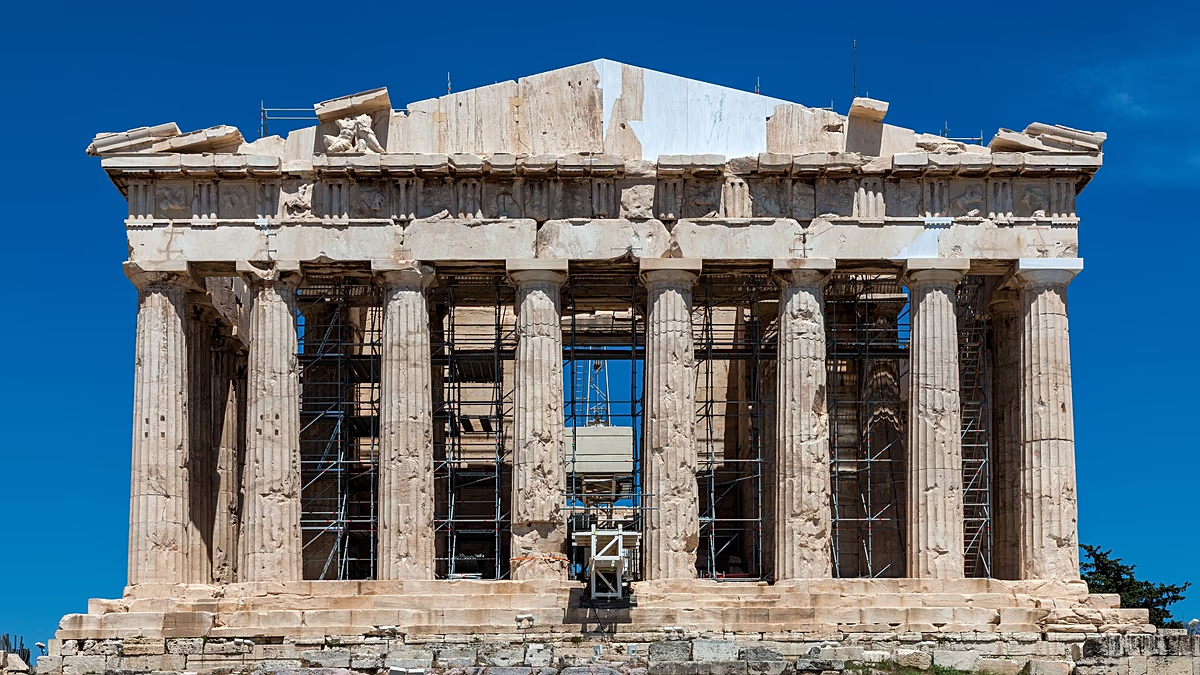
For over two centuries, the western face of the Parthenon, the crown jewel of the Athenian Acropolis, had been partially obscured by a now-familiar lattice of scaffolding. Today, that vision has fundamentally changed. Greece has announced a historic milestone: the completion of a meticulous restoration project focused on the temple’s western pediment, allowing the monument to stand definitively free of its external supports. This moment marks the first time in generations that visitors can behold the Parthenon’s full western silhouette against the Attic sky, a sight lost since the early 19th century. It is more than just the removal of construction equipment; it is the revelation of the temple’s intended architectural harmony, a profound moment for Greece and for global cultural heritage.
The focal point of this achievement was the restoration of the pediment’s orthostates—the large, vertical stone blocks that form the base of the triangular tympanum. Described by Greece’s Ministry of Culture as one of the most complex interventions undertaken by the Acropolis Monuments Restoration Service (YSMA), the project demanded extraordinary precision and innovation. Experts employed highly specialized techniques at every stage, from the careful carving of new, pristine Pentelic marble to the delicate task of hoisting and securing the massive blocks into place nearly fifteen meters above ground. One of the large orthostates was painstakingly restored by bonding together surviving ancient fragments and supplementing them with new marble, while a second was crafted entirely anew. To execute this final placement, a new, functionally advanced scaffolding system was designed, one that met rigorous modern safety standards while being minimally intrusive and aesthetically sympathetic to the ancient structure.
The significance of this work was powerfully underscored by Greece’s Minister of Culture, Lina Mendoni. She described the completion as “an extremely demanding restoration intervention,” resulting in the west pediment being presented in its fullest form in approximately 220 years. “The sight is truly breathtaking,” Mendoni stated. She emphasized that for generations, both Greeks and international visitors had become accustomed to an incomplete view. Now, the pediment is regaining its architectural unity. Importantly, she clarified that the new marble elements are not merely filling gaps; they are essential to restoring the “unique proportions and geometric perfection” of the Parthenon’s western façade. This intervention allows the timeless mathematical and aesthetic principles of Iktinos and Kallikrates, the temple’s architects, to be fully appreciated once more.
Minister Mendoni framed this as a moment of historic importance, not only for the monument or the Acropolis but for world culture itself. “It is a moment that fills us with pride, but also with a sense of responsibility,” she remarked, highlighting the ongoing duty to protect and showcase this foremost symbol of Western civilization. Her words capture the dual emotion of the occasion: the profound joy in seeing a national treasure made whole, coupled with the solemn weight of stewardship. This project stands as a testament to decades of dedicated scientific conservation work on the Acropolis, a long-term commitment that has steadily reversed centuries of damage and neglect.
Financially, this critical phase of preservation was enabled through the European Union’s Recovery and Resilience Facility, illustrating how pan-European support can directly contribute to safeguarding humanity’s shared heritage. The successful completion of the western façade restoration is a powerful example of modern technology and traditional craftsmanship converging for a singular purpose: to stabilize, protect, and ultimately reveal the authentic spirit of an ancient masterpiece. It is a careful, respectful dialogue between the past and the present, where contemporary tools are used not to reinvent, but to reconnect and conserve.
Ultimately, the unveiling of the Parthenon’s western pediment is an invitation. It invites the world to see the temple with new eyes, to perceive its intended balance and grandeur without visual interruption. It represents a closing chapter in a long period of intensive restoration and opens a new one of enhanced appreciation. As the scaffolding recedes into memory, what remains is the enduring power of the Parthenon itself—a symbol of democratic ideals, artistic genius, and cultural resilience—now standing a little more complete, a little more majestic, ready to inspire the next generation of pilgrims who journey to the sacred rock of Athens.