


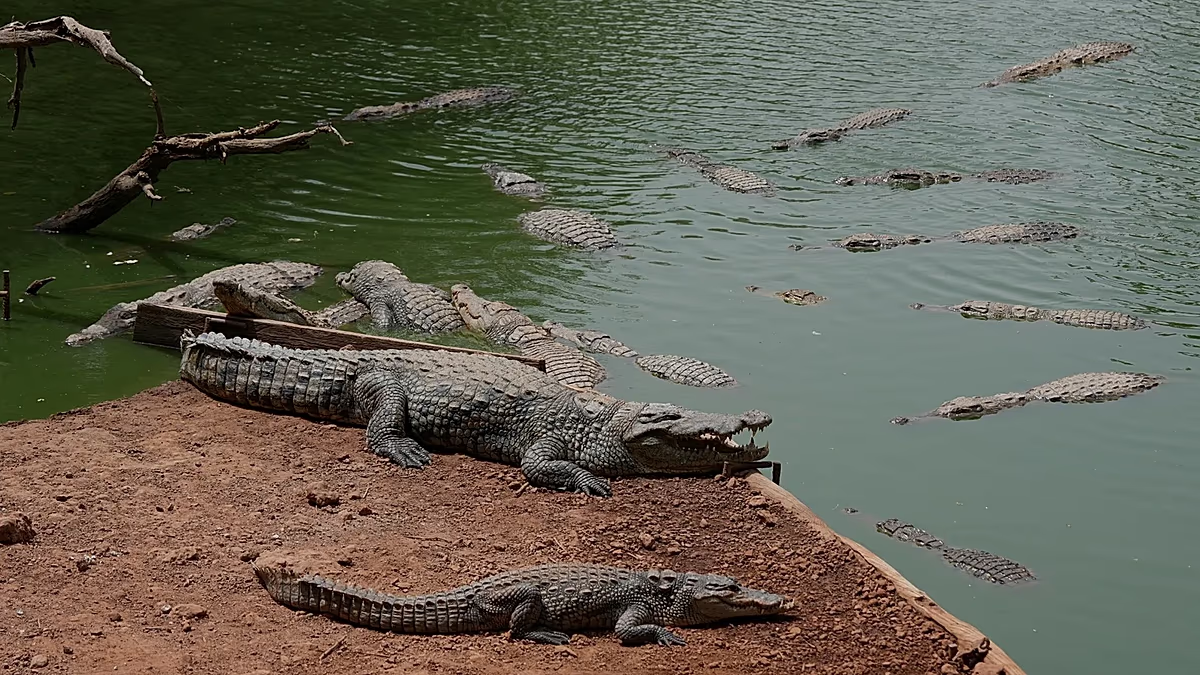
The tranquillity of a family day out was shattered by a deeply distressing incident at a rural English zoo, leaving a community in shock and a young child fighting for his life. On a Thursday afternoon in June, police were called to Johnsons of Old Hurst, a family-run farm and zoo northwest of Cambridge, following reports of a three-year-old boy who had, in the words of authorities, “ended up in the crocodile enclosure.” The immediate aftermath was one of grave concern, as the toddler was rushed to Addenbrooke’纱s Hospital in Cambridge with what were described as serious injuries. His condition was confirmed as critical but stable, a phrase that underscores the precarious nature of his situation. In a statement that raised more questions than it answered, Cambridgeshire Constabulary pointedly did not specify the nature of the injuries or confirm whether they were inflicted by one of the zoo’s crocodiles, leaving a haunting ambiguity about the precise events within the enclosure.
The investigation took a startling and dark turn with the swift arrest of a 30-year-old man from Norfolk on suspicion of attempted murder. This development immediately shifted the narrative from a potential tragic accident to a possible deliberate act. Police were careful to state that they did not believe the arrested man and the young child were known to each other, a detail that only deepened the mystery and sense of horror surrounding the case. Specially trained officers were deployed to support the boy’s family as they maintained a vigil at the hospital, while detectives from the force’s major crime unit began the meticulous work of piecing together the timeline of that fateful lunchtime. The arrest indicates that authorities are operating on the belief that human agency, rather than mere chance or inadequate safety barriers, led to the child’s perilous predicament.
As the legal process unfolds, the human focus remains intensely on the innocent victim at the heart of this ordeal. A three-year-old child, who should have been experiencing a day of wonder among the animals, is instead battling devastating injuries in an intensive care unit. The psychological trauma inflicted upon the boy’s family is immeasurable, compounded by the agonizing uncertainty of his recovery. The broader community of visitors who witnessed the incident or its aftermath are also likely grappling with profound distress. Detective Inspector Verity McCann acknowledged this, stating that officers were speaking to those present “to understand more about the circumstances” of what she termed “this distressing incident.” Each question from investigators must feel like a weight upon those involved, as they try to reconcile a fun family outing with a scene of potential violence.
The location itself, Johnsons of Old Hurst, adds a layer of poignant contrast to the tragedy. Presented as a classic, multi-generational British family destination, its website showcases a butchers, a farm shop, a tea room, and a steakhouse alongside the zoo. It is a place built on notions of wholesome, agricultural leisure, home to over 100 animals ranging from the exotic—lions, tigers, sloth bears—to the more familiar meerkats and capybaras. The crocodile enclosure, now the site of a major crime investigation, would have been just one exhibit among many designed to educate and entertain. This incident forcibly ruptures the assumed covenant of safety between such a venue and its guests, challenging the very idea of these spaces as harmless havens.
The police investigation now carries the heavy responsibility of navigating a complex web of forensics, witness testimony, and motive. Key questions remain unanswered publicly: How did the child come to be in the enclosure? What was the nature of his injuries? What is the alleged connection between the boy and the arrested man, if not a prior acquaintance? The charge of attempted murder suggests prosecutors believe they have evidence of intent, a sinister element that transforms this from a story of a zoo incident into one of alleged premeditated violence against a toddler. Every detail released will be scrutinized as the public seeks to comprehend the incomprehensible. The coming days will see this careful police work continue, as they build a case intended to provide answers and, ultimately, justice.
In summary, this is a story that layers alleged human malice upon the inherent danger of wild animals, set within a context meant for family enjoyment. It encompasses the urgent medical battle of a grievously injured little boy, the shattering of his family’s world, and a criminal investigation into an act of purported brutality. Beyond the immediate shock, it prompts difficult reflections on safety, motive, and the fragile line between a normal day and a life-altering catastrophe. As the child fights for his future in a hospital bed, and detectives labor to establish the truth, the incident at Johnsons of Old Hurst stands as a profoundly unsettling moment, reminding us of the vulnerability of the innocent and the dark currents that can surface anywhere, even in the most seemingly benign of settings.