

A Cautious Endorsement From the Shadows
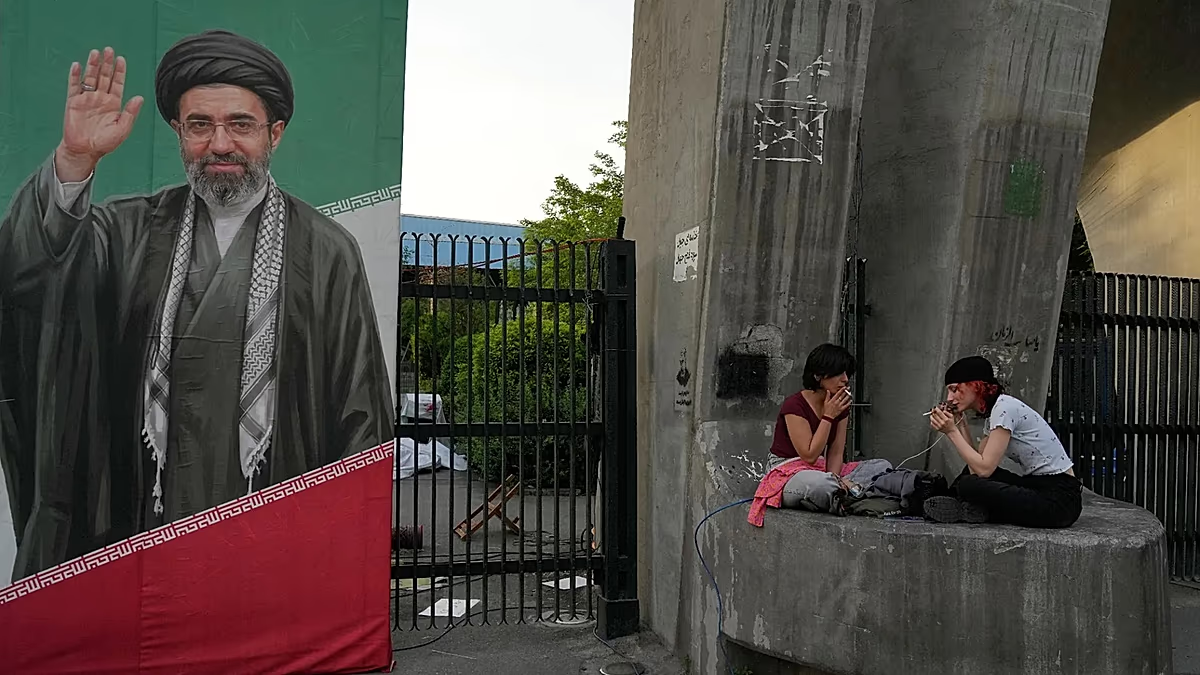
In a carefully worded message delivered via state television, Iran’s Supreme Leader, Ayatollah Mojtaba Khamenei, provided his conditional blessing to a nascent agreement with the United States aimed at ending a devastating regional war. His statement was noteworthy not only for its content but for its source; it marked his first public reaction since ascending to his role in March, following the death of his predecessor in a strike that ignited the broader conflict. Khamenei explicitly stated that his personal view of the memorandum of understanding differed from that of the government, but he had granted permission to proceed based on a solemn commitment from President Masoud Pezeshkian and the Supreme National Security Council. Their pledge, he emphasized, was to protect Iran’s national rights and the interests of its allied “Resistance Front” throughout the process. This framed his endorsement not as enthusiastic support, but as a wary, leaderly act of trust in his subordinates, setting a tone of profound caution for the difficult negotiations ahead.
The American Sales Pitch: Performance Over Promises
Across the ocean, the task of defending the controversial framework deal fell to U.S. Vice President J.D. Vance, who has emerged as its primary public advocate. At a White House briefing, Vance faced a press corps and a political environment skeptical of an agreement that offers Iran significant potential rewards—including sanctions relief, access to a massive reconstruction fund, and resumed oil sales—without a concrete plan for dismantling its nuclear program. Vance’s defense was rooted in a philosophy of strict conditionality and verification. He argued that the deal’s value lay not in the initial documents but in Iran’s subsequent actions. He outlined a 60-day period following the signing wherein specific terms would be finalized, insisting that Iran would only receive benefits upon proving compliance. To demonstrate early U.S. goodwill, he noted the easing of the naval blockade to allow over a dozen ships through, a tangible down payment on the agreement. His message was clear: this is a performance-based arrangement, not a gift.
Navigating a Political Minefield
Vance’s prominent role represents a significant political gamble. A known skeptic of prolonged American military engagements, his success in shepherding this deal to a peaceful conclusion could bolster his credentials, particularly as someone widely expected to seek the presidency in 2028. However, the stakes of failure are equally high, with President Donald Trump himself humorously suggesting he would hold Vance accountable if the agreement collapses. When questioned about becoming a potential “fall guy,” Vance downplayed the comment as typical Trumpian jest, instead focusing on the collective effort of the administration team. His immediate next step, he revealed, is to travel to Switzerland—possibly as soon as the weekend—to lead technical talks on converting the framework into a long-term pact, a mission underscoring his central and risky position in this high-stakes diplomatic endeavor.
A Stark Warning to an Uneasy Ally
Perhaps the most striking moment of Vance’s briefing was his direct and forceful address to the deal’s most vocal international critics: Israel’s leadership. With tensions visibly rising between Trump and Israeli Prime Minister Benjamin Netanyahu, Vance issued an extraordinary rebuke. He advised Israeli officials to reconsider their vehement opposition, bluntly stating that anyone in Israel who believes their greatest problem is the President of the United States needs to “wake up and smell the reality of the situation.” His implication was unambiguous: in a volatile region, Israel risks alienating its most powerful ally over an agreement that, from the American perspective, is designed to de-escalate conflict and will be enforced with rigorous oversight. This public chiding highlighted the fragile state of U.S.-Israeli relations and the administration’s determination to proceed despite key ally disapproval.
The Core Tension: Trust vs. Verification
The unfolding drama around the agreement exposes a fundamental tension. From Tehran, Khamenei’s message radiates deep-seated distrust of American intentions, warning that future face-to-face negotiations “will not mean accepting the enemy’s point of view.” He explicitly accused Trump of negotiating “out of desperation,” revealing a perception of U.S. weakness. Conversely, from Washington, Vance’s entire argument rests on the premise that trust is irrelevant—only verifiable action matters. This dichotomy sets the stage for the Swiss talks, where the devilish details of inspections, timetables, and what constitutes “excessive demands” or sufficient “performance” will be hammered out. The gap between these two starting points—Iran’s defensive sovereignty and America’s demand for provable compliance—is the chasm negotiators must bridge.
An Uncertain Path Forward
Thus, a fragile pathway to ending a destructive war has been tentatively charted, but it is fraught with obstacles. It is anchored by a supreme leader’s reluctant, conditional approval in Iran and championed by a vice president staking his political future on its success in America. The process is already straining a historic alliance with Israel and faces intense scrutiny from critics at home and abroad who question its substance. The coming weeks will test whether the initial gestures of goodwill, like loosening a blockade, can foster enough momentum to overcome decades of hostility and suspicion. The “gentleman’s agreements” and memoranda now give way to the arduous work of building a durable peace, where, as Vance asserted, words alone will not matter—only verifiable change on the ground will determine if this deal moves from a headline into history.