


Europe at a Crossroads: Unlocking Its Economic Potential
Amidst a world stage dominated by geopolitical tensions and security concerns, a parallel conversation of vital importance unfolded in Rome. While G7 leaders grappled with international conflicts, the Future Investment Initiative Institute’s “Priority Europe” summit convened a different cast of global power players: investors, corporate leaders, and policymakers. Their central question was urgent and economic: How can Europe reignite its growth engine and attract the vast capital needed to secure its future? The consensus was clear—Europe possesses immense strengths but is at risk of being left behind unless it decisively cuts regulatory red tape and accelerates essential reforms to compete with the agility of the United States and the dynamism of Asia.
The Call for Clarity and Speed
Richard Attias, Chairman of the FII Institute’s Executive Committee, articulated a direct challenge to European leaders. He affirmed that Europe’s foundational assets—its deep talent pool, culture of innovation, and robust industrial base—are more than sufficient to position it as a leader in the next wave of global growth. However, he warned that these advantages are being undermined by an investment climate seen as overly complex and slow. “Investors are looking for clarity, predictability and speed in decision-making,” Attias stated. His prescription was a move towards greater regulatory flexibility and a radical simplification of bureaucratic processes. The goal is to make capital flow freely into the sectors that will define tomorrow’s economy: artificial intelligence, next-generation digital infrastructure, clean energy, and advanced manufacturing.
Navigating Global Competition
Attias framed this not as an isolated European issue, but as a fierce global competition for finite investment dollars. Europe is no longer competing solely with the United States and its powerful incentive programs like the Inflation Reduction Act. It now faces ambitious emerging economies that are aggressively fast-tracking reforms to lure multinational companies and massive industrial projects. The core of Attias’s argument was not a call to abandon Europe’s high standards in areas like sustainability or consumer protection. Instead, it was a plea for a rebalanced approach that does not stifle innovation or growth. “The world is moving at high speed, and so is capital,” he cautioned. Europe’s ability to achieve true strategic autonomy—to finance its own green transition, develop home-grown critical technologies, and secure its supply chains—hinges entirely on its capacity to mobilize unprecedented scale of both public and private investment.
A Vote of Confidence from Global Capital
This perspective was powerfully echoed by Yasir O. Al Rumayyan, Governor of Saudi Arabia’s Public Investment Fund (PIF) and Chairman of Aramco. His presence underscored the summit’s global relevance, as he leads institutions commanding trillions in assets and generating profits measured in the tens of billions. Al Rumayyan expressed a strong, conditional vote of confidence in Europe’s long-term prospects. He identified the continent as being at a “decisive moment” with “enormous opportunities” in the energy transition, tech innovation, and infrastructure. His message was unambiguous: significant, patient capital from funds like the PIF is ready to be deployed in transformative, long-horizon projects, but only if the right conditions are in place. This means stable, predictable policies that allow investors to see a clear path to returns over decades, not just quarters.
The Symbolism of Rome and the Path Forward
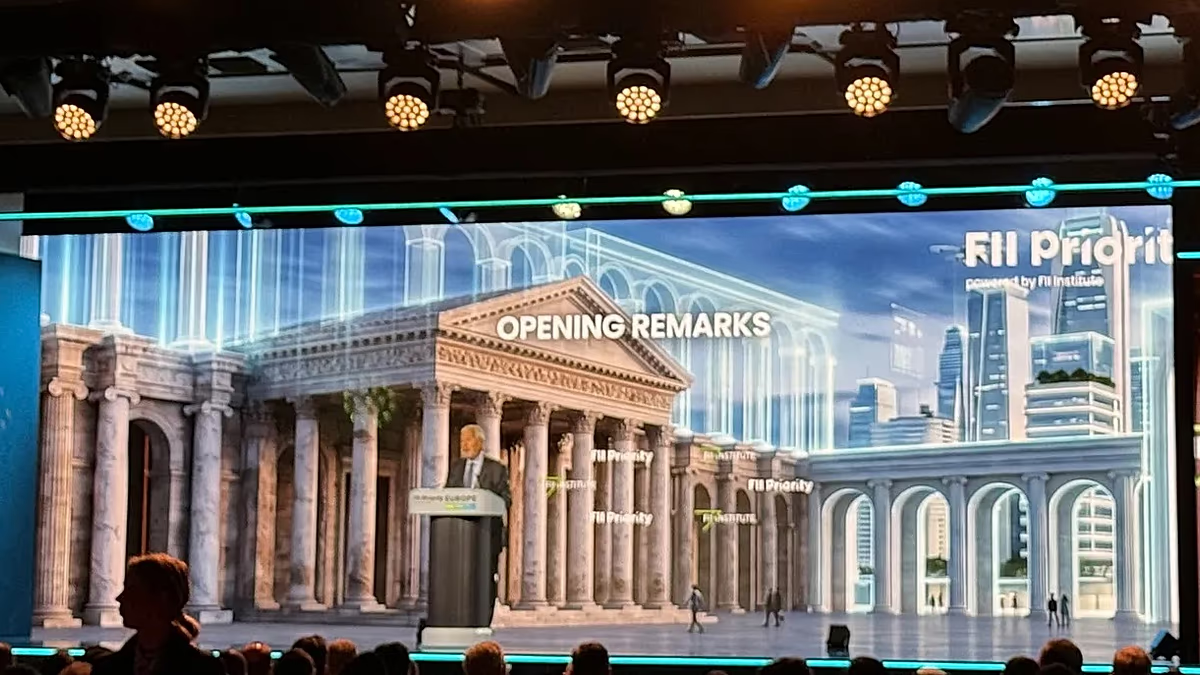
The choice of Rome as the summit’s venue was deeply symbolic. It represented a conscious nod to a continent that has successfully blended a profound historical legacy with a capacity for reinvention. The ancient city served as a living metaphor for the challenge and opportunity at hand: Europe must now harness its storied past to fuel a forward-looking reform agenda. The continent’s intrinsic appeal—its stability, its market size, and its quality of life—remains a powerful magnet for global capital. However, this latent advantage is not enough. The discussions in Rome made it evident that potential must be activated through decisive action. The path to sustained economic growth and renewed global competitiveness requires Europe to streamline, simplify, and speed up, proving it can match its grand ambitions with equally dynamic execution.
A Defining Moment for European Prosperity
In conclusion, the FII Priority Europe summit served as both a stark warning and a compelling rallying cry. It highlighted a critical window of opportunity for Europe to redefine its economic destiny. The continent has all the raw ingredients for success: talent, innovation, industrial might, and the attention of the world’s largest investors. Yet, as speaker after speaker emphasized, these elements are currently hamstrung by self-imposed complexities. The task ahead is not to lower standards, but to raise efficiency; not to shy away from regulation, but to design it with innovation and investment in mind. Europe’s quest for strategic autonomy will be won or lost not just on geopolitical chessboards, but in the less glamorous arenas of bureaucratic reform and regulatory modernization. The message from Rome is that the time for that essential work is now.