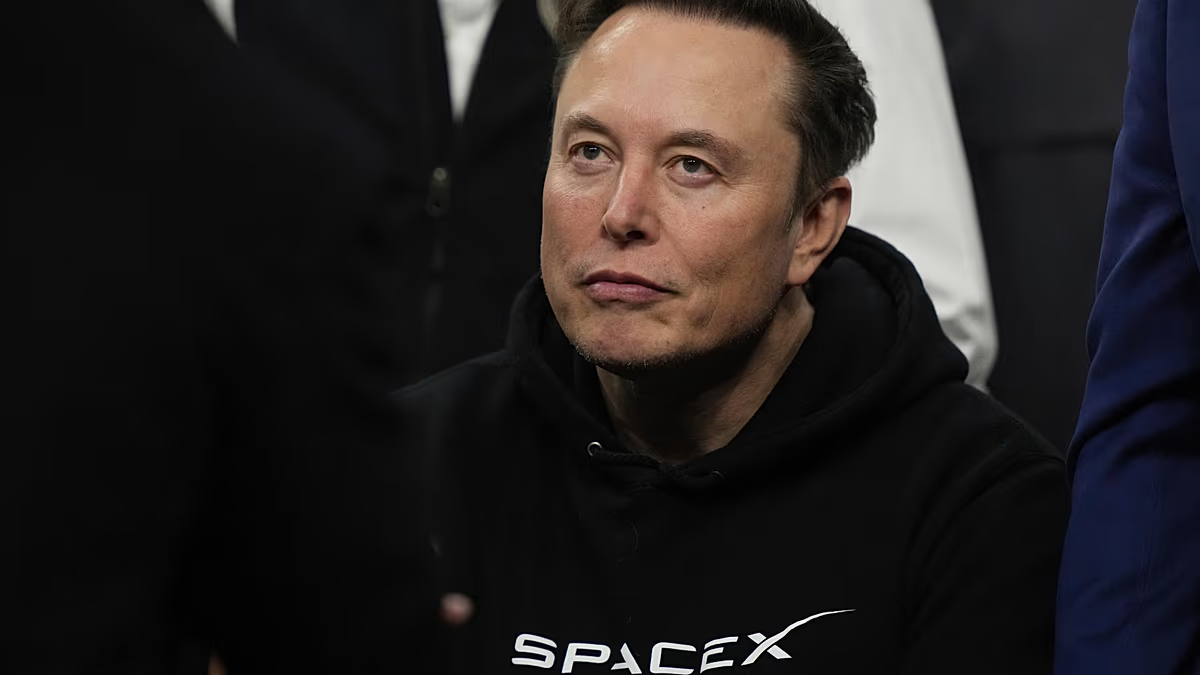




In a financial spectacle that has captivated global markets, Elon Musk’s integrated space and artificial intelligence conglomerate, SpaceX, has concluded its third day of public trading with a staggering valuation of approximately $2.65 trillion. This landmark achievement has propelled the company past retail giant Amazon in the global market-capitalisation rankings, rewriting the upper echelons of the equity leaderboard at a breathtaking pace. The stock settled at $201.8 per share, a figure that underscores a debut week of extraordinary investor fervor. This milestone caps a whirlwind period for the company, which only began trading on the Nasdaq under the ticker SPCX the previous Friday. Its record-shattering initial public offering saw 555.6 million shares priced at $135 each, raising about $75 billion and comfortably eclipsing the previous record held by Saudi Aramco. Following the exercise of the “greenshoe” option by underwriters due to exceptional demand, the total capital raised swelled to $85.7 billion, setting the stage for its dramatic ascent.
The trading session itself was a rollercoaster that highlighted the intense market appetite. At one point on Tuesday, share prices surged to a high of $225.6, briefly catapulting SpaceX’s valuation above the $3 trillion mark and, for a fleeting moment, positioning it ahead of Microsoft as the world’s fourth most valuable company. Although the stock later retreated from this peak, closing below that historic threshold, the intraday spike served as a powerful testament to the frenzy surrounding the listing. Based on the closing price, SpaceX now stands as the world’s fifth most valuable public company, trailing only the tech titans Nvidia, Alphabet (Google’s parent company), Apple, and Microsoft. This positioning reinforces a dominant trend in contemporary markets: eight of the top ten most valuable listed companies are now tethered to the technology and AI sector, a concentration of power and investor confidence that has defined the financial landscape throughout 2026.
Fueling this remarkable surge was a significant strategic announcement made just before Tuesday’s market open. SpaceX revealed an all-stock agreement to acquire Anysphere, the innovative developer behind the AI-powered coding assistant known as Cursor, in a deal valuing the startup at $60 billion. According to regulatory filings, the transaction will see a SpaceX subsidiary merge into Anysphere, making Cursor a wholly-owned division of the conglomerate, with completion expected in the third quarter pending regulatory approvals. This acquisition represents a deliberate and deep push by SpaceX into the competitive enterprise AI market, a domain where rivals like OpenAI and Anthropic have already established significant commercial footholds. It also continues the strategic consolidation of Musk’s AI ambitions, following the company’s merger with his xAI venture earlier in the year.
The path to this acquisition was itself strategically crafted. It stems from an option secured by SpaceX back in April, which presented a binary choice: either acquire Cursor outright for the $60 billion price tag later in the year or pay $10 billion for a more limited partnership to access its advanced computing technology. Opting for the full acquisition signals a bold commitment to owning and integrating cutting-edge AI capabilities directly into the SpaceX ecosystem. This move is not merely an expansion but a fusion of frontiers, aiming to synergize the company’s expertise in large-scale engineering, simulation, and data processing from its space operations with transformative AI software development tools. The market’s enthusiastic response to this news was immediately reflected in the day’s share price climb, illustrating investor approval of SpaceX’s aggressive expansion beyond its aerospace roots.
However, amidst this stratospheric rise, notes of caution have emerged from sceptical quarters. Critics argue that SpaceX’s valuation appears stretched, given that the company has yet to achieve profitability. This perspective is amplified by the structure of the public offering itself, with only a thin slice—approximately 3% to 4%—of the company’s total equity available for public trading. This limited float creates a scarcity of shares that can exaggerate price movements based on supply and demand dynamics rather than fundamental financial metrics. Furthermore, the stock is on a fast-track for inclusion in major indices like the S&P 500, a move that would compel massive passive investment funds to purchase shares, potentially amplifying demand for the already limited supply in the coming days and weeks. This environment creates a volatile mix of genuine transformative potential and speculative momentum.
In conclusion, SpaceX’s debut on the public markets is more than just a successful IPO; it is a cultural and financial moment that underscores the premium investors are placing on companies that promise to redefine the future. By blending the tangible, awe-inspiring ambitions of interplanetary exploration with the transformative, software-driven power of artificial intelligence, Musk’s conglomerate has positioned itself at the nexus of two of this century’s most compelling narratives. While the breakneck speed of its valuation climb invites prudent scrutiny regarding sustainability and fundamentals, the strategic acquisition of Cursor demonstrates a clear intent to build a deeply integrated technological empire. As the dust settles from this frenetic opening week, the world will be watching to see if SpaceX can navigate the immense expectations and deliver on its dual promise of conquering the final frontier and mastering the digital one, all while navigating the pressures that come with being one of the most valuable entities on Earth.