


Here is a summary and humanization of the provided content, expanded to meet the requested length and structured into six cohesive paragraphs.
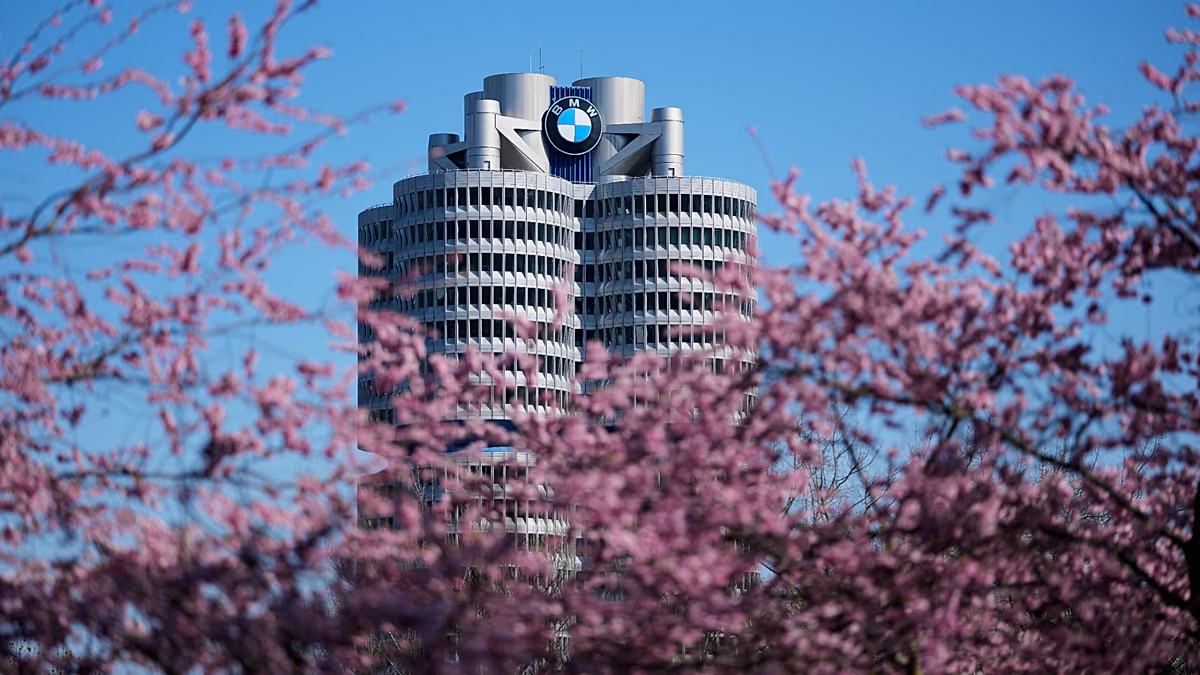
In a sobering announcement that sent shockwaves through the financial markets, the prestigious German automaker BMW AG has sharply revised its outlook for 2026, forecasting a “significant” drop in profits. The Munich-based giant, guardian of iconic brands like BMW, MINI, Rolls-Royce, and BMW Motorrad, cited a perfect storm of economic headwinds as the cause. Most prominent among these are a deepening slowdown in the critical Chinese market and the ongoing ripple effects of the conflict in the Middle East, often referred to as the Iran war. This stark profit warning, a shift from prior expectations of only a moderate decline, prompted an immediate loss of investor confidence, with BMW’s shares plummeting over 7% in European trading as the news broke.
The heart of BMW’s challenge lies in two key regions pulling in opposite directions. In China, the world’s largest automotive market, demand has weakened more than anticipated, triggering what the company describes as “more intense competition.” This suggests a fierce price war and pressure on margins as automakers fight for a share of a shrinking pie. Simultaneously, the geopolitical tensions in the Middle East have delivered a one-two punch: they have dampened global consumer sentiment, making big-ticket purchases like luxury cars a harder sell, while also keeping energy and logistics costs uncomfortably high. While BMW notes some resilience in European and American sales, this growth is simply insufficient to counterbalance the pronounced downturn emanating from China.
Consequently, BMW has been forced to make substantial revisions to its financial targets across the board. The company now expects its vehicle deliveries to dip slightly this year, rather than hold steady. More dramatically, it has slashed its core profitability metric, the automotive EBIT margin, to a projected range of 1% to 3%, a steep fall from the previous guidance of 4% to 6%. Similarly, its target for return on capital employed (ROCE) has been cut by roughly half. These revised figures underscore the severe pressure on its core business operations. The previously stated goal of a moderate profit decline is now off the table, with a significant drop from last year’s robust €10.2 billion in pre-tax profit all but certain.
Faced with this “drastic downturn in market conditions,” as described by Board of Management Chairman Milan Nedeljković, BMW’s response is a decisive turn toward austerity and restructuring. Nedeljković emphasized “speed and efficiency” as the company prepares to intensify and accelerate its existing cost-cutting initiatives. This will involve new structural and efficiency measures, a process that will ironically incur its own one-off costs and further dent earnings in the latter half of 2026. In essence, BMW is investing in a corporate slim-down now to ensure its long-term health and competitiveness. As investment director Russ Mould noted, this move to “look for ways to cut costs” is a natural corporate reflex, but it also places BMW in a growing convoy of automakers navigating a prolonged period of slow growth.
Analysts view BMW’s warning as a microcosm of the broader pressures squeezing the European automotive industry. The sector finds itself caught between geopolitical instability, shifting global demand, and the colossal costs associated with the transition to electric vehicles. Mould’s observation that BMW “simply joins a growing line of car makers stuck in the slow lane for the foreseeable future” paints a picture of an entire industry grappling with a fundamental recalibration. It’s a reminder that even the most storied and robust brands are not immune to the powerful currents of global economics and politics.
Despite the grim profit forecast, BMW offered a few anchors of stability to its shareholders. The company reaffirmed its expectation to generate over €2.5 billion in automotive free cash flow, a sign that its underlying operations, while less profitable, still generate liquidity. Furthermore, it committed to maintaining its dividend payout ratio and its ongoing share buyback program. These moves signal a desire to uphold shareholder returns even during a challenging transition period. The full financial picture will become clearer when the company releases its half-year results as scheduled on July 30, 2026, providing a detailed look at the initial impact of these market challenges and the early stages of its strategic response.