


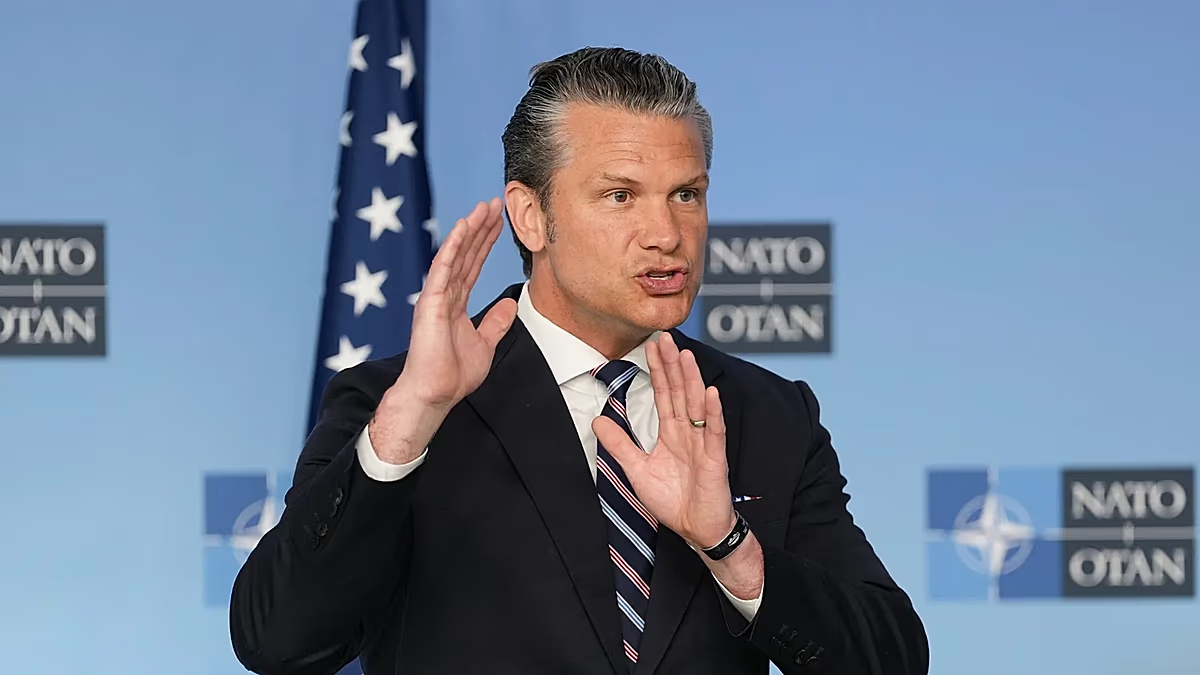
A significant and public rift within the NATO alliance has emerged following a visit to Brussels by U.S. Secretary of War Pete Hegseth. During a meeting of NATO defense ministers, Hegseth launched a blistering critique of European allies, labeling their support during the recent U.S.-led war in Iran as “shameful.” He specifically called out Spain, Italy, and France for refusing the U.S. military access to their bases and airspace. While Germany granted full access from its Ramstein Air Base, Chancellor Frederic Merz’s criticism of the war strategy as “ill-conceived” provoked a direct retaliation from former President Donald Trump, who announced the withdrawal of 5,000 U.S. troops from German soil. This confrontation underscores a deepening transatlantic crisis, moving beyond policy disagreements into the realm of public recrimination and perceived betrayal.
Secretary Hegseth’s criticisms extended far beyond the immediate conflict, framing European societal priorities as a direct threat to collective security. In a speech that echoed the rhetoric of U.S. Vice President JD Vance, Hegseth argued that Europe has focused excessively on issues like climate change and gender equality at the expense of military readiness. He painted a picture of a continent in civilizational decline, citing expanded welfare states, open borders, and cratering defense budgets as evidence that Europe had lost its foundational belief in itself. This ideological broadside framed the spending dispute not merely as a ledger imbalance, but as a fundamental clash of values and priorities between the U.S. and its oldest allies.
The concrete policy announcements that accompanied Hegseth’s rhetoric marked a sharp escalation in pressure. He detailed a new U.S. vision dubbed “NATO 3.0,” centered on a stringent enforcement mechanism for defense spending. While the alliance had previously agreed to a target of spending 5% of GDP on defense by 2035 at the behest of President Trump, Hegseth declared that future U.S. financial contributions to NATO’s common budget would be directly contingent on allies meeting their annual targets. In essence, if European nations fail to spend more, the United States will spend less on the alliance itself. Furthermore, he announced a Pentagon review of U.S. force levels in Europe within six months, signaling potential troop reductions.
The punitive measures were not limited to financial levers. In the weeks leading up to the meeting, the U.S. had informed allies of decisive cuts to NATO’s shared wartime planning. According to reports, the U.S. will withdraw critical high-end military assets from the NATO Force Model, which coordinates alliance capabilities during a conflict. This includes cutting access to deep-strike weapons platforms like long-range B-2 and B-52 bombers, as well as key naval assets such as missile-launching submarines and aircraft carriers. These systems would be redirected to other global theaters, leaving a significant capability gap in NATO’s European defenses and representing a tangible downgrade of the U.S. security guarantee.
In response to this intense pressure, NATO Secretary General Mark Rutte struck a diplomatic but firm tone. In a press conference, he sought to downplay the public acrimony while validating the underlying message on spending. Rutte acknowledged Hegseth’s point that some allies were still “holding back,” and stated that keeping the pressure on was “good.” He emphasized the historic progress already made, noting that allies had added over €90 billion in extra defense spending in 2025 alone. Rutte framed the confrontation as a necessary, if painful, form of alliance honesty: “We need to speak the truth to each other.” However, he insisted that any changes to U.S. force posture must follow a structured process in full consultation with NATO’s military command.
The consensus among NATO officials is clear: this suite of actions—the public shaming, the conditional funding, the troop review, and the asset withdrawals—constitutes a coordinated campaign to punish Europe for its perceived failure during the Iran war. The hopes of some allies that a recent memorandum of understanding aimed at ending hostilities in Iran would ease tensions were quickly dashed by Hegseth’s performance. The episode reveals an alliance at a profound crossroads, grappling not just with budgetary figures but with a fundamental question of solidarity and shared sacrifice. The U.S. is demanding a Europe that is not only wealthier in military hardware but also aligned in strategic outlook, willing to translate economic strength into unambiguous global power projection alongside Washington.