

For over six decades, the narrative from Havana has been steadfast: Cuba’s profound economic struggles are a direct result of the United States’ comprehensive trade embargo, a policy begun in the early 1960s and intensified in recent years into what the government terms a “blockade.” This external pressure has undeniably strangled the island’s economy, restricting access to finance, technology, and markets. However, in a remarkable and frank address to the Communist Party Central Committee, President Miguel Díaz-Canel delivered a pivotal admission. While the U.S. sanctions are a severe and crippling reality, he stated there are “obstacles that don’t come from outside, nor the blockade.” This acknowledgment marks a significant shift in rhetoric, opening the door to a long-avoided conversation about internal systemic failures that have compounded the nation’s crisis.
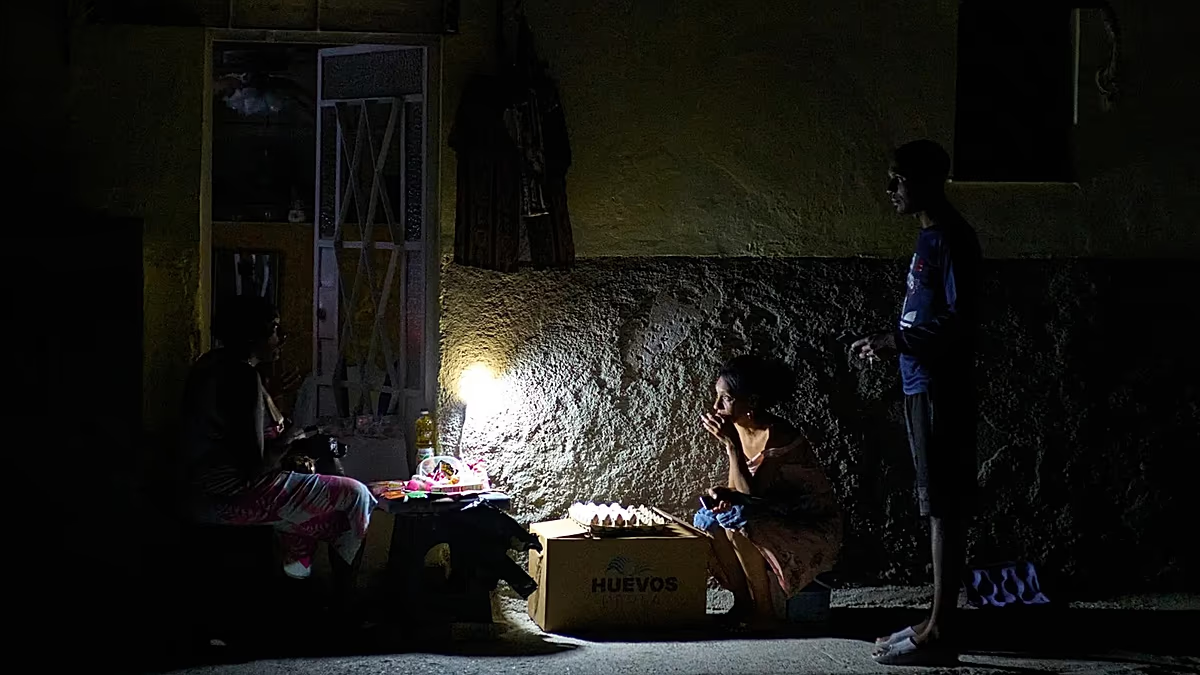
Díaz-Canel pinpointed these internal obstacles with unusual candor, citing “slowness, bureaucracy and norms that impede those who want to produce,” alongside long-postponed decisions. His conclusion was stark: “The situation calls for urgent and necessary changes.” The context for this admission is a society pushed to its absolute limits. An oil blockade imposed by the Trump administration has brought an already moribund economy to the brink of collapse, manifesting in daily life through power cuts lasting over 30 hours and acute shortages of food, fuel, drinking water, and medicine. The president’s message was clear: when daily survival becomes this arduous, the government’s duty is to “change what needs to be changed” rather than solely blaming external forces. This sense of urgency was underscored by the hasty convening of the party meeting, aimed at fast-tracking reforms to stave off total economic disintegration.
The proposed reforms, swiftly endorsed by the Communist Party and expected to be rubber-stamped by the National Assembly, represent an eleventh-hour bid to revitalize the economy. While few concrete details have been released, the direction points toward a cautious opening. Díaz-Canel notably cited the models of China and Vietnam—communist nations that have embraced market mechanisms and foreign investment while maintaining tight political control. The measures are focused on boosting Cuba’s small private sector and, crucially, attracting investment from the vast Cuban diaspora, whose remittances are already a lifeline. This represents a profound, if pragmatic, shift for a system where the state still controls roughly 80% of economic activity. As scholar Michael Bustamante noted, their “backs are up against the wall as never before,” forced into changes partly by unprecedented U.S. pressure.
Anticipating resistance from within his own party’s hardliners, Díaz-Canel explicitly warned that some reforms “will not have absolute consensus but cannot be postponed.” This internal debate highlights the delicate tightrope the leadership must walk. The reforms include granting greater autonomy to inefficient state-owned enterprises and reducing bureaucratic red tape that stifles productivity. However, the shadow of the United States looms large over the entire process. The Trump administration has made no secret of its desire for more than economic tweaks; it seeks a fundamental change in Cuba’s political leadership and model. Rhetoric from U.S. officials, including jokes about a “friendly takeover” or a “stop over” in Havana, reinforces a climate of maximum pressure, wherein any Cuban reforms might be deemed insufficient unless they lead to political capitulation.
The response on the streets of Cuba to these announced changes is a mixture of fragile hope and deep-seated skepticism. For the country’s nascent business class, the reforms offer a glimmer of possibility. Mario Gonzales, a restaurant manager in Havana, expressed a cautious optimism shared by many entrepreneurs, seeing the measures as “a chance that may or may not materialise.” Yet, for a large portion of the population worn down by decades of hardship and unfulfilled promises, the announcements ring hollow. Many, like Iris, a cleaner enduring endless blackouts, dismiss them as too little, too late—merely “state lies.” They point to a history of gradualist reforms that have failed to meaningfully improve daily life, viewing the current crisis as the culmination of six decades of a sclerotic system now buckling under its own weight and external strain.
Thus, Cuba stands at a precipice, navigating a triad of formidable challenges: mitigating the devastating impact of U.S. sanctions, dismantling its own ingrained bureaucratic obstacles, and managing the towering expectations of both its weary populace and a hostile U.S. administration. Díaz-Canel’s admission is a historic first step, breaking a longstanding taboo by acknowledging internal culpability. Yet, words must now translate into tangible, swift action that improves the lives of ordinary Cubans. The world watches to see if Cuba’s communist model can indeed enact the “urgent changes” its president has called for, adapting to survive in the 21st century, or whether this moment will become another chapter in a long story of stalled transformation. The success or failure of this precarious balancing act will determine the island’s trajectory for generations to come.