



Of course. Here is the summary humanized and expanded into six paragraphs.
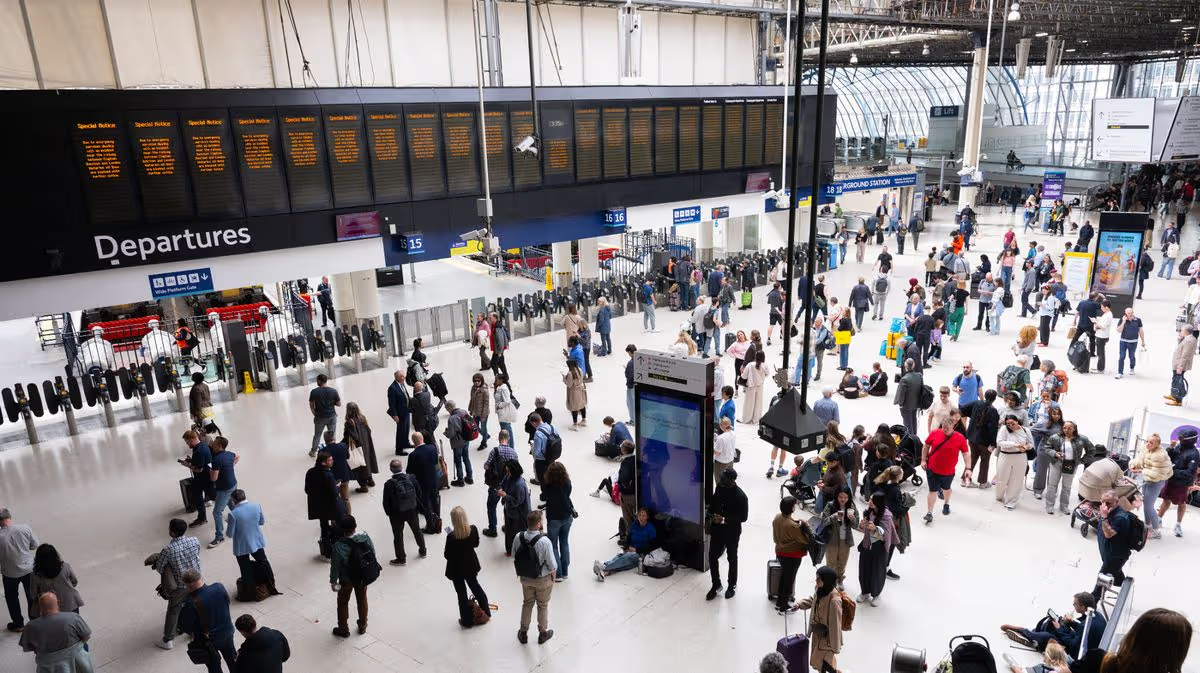
The familiar rhythm of the morning commute has been shattered today for thousands of people across the South of England. Instead of the predictable hum of activity, stations serving London Waterloo, one of the country’s busiest transport hubs, are filled with uncertainty and frustration. A critical technical failure has cascaded through the network, leading to widespread cancellations, lengthy delays, and revised services on virtually all routes. For countless individuals—from office workers with crucial meetings to parents on the school run, and tourists with tight schedules—the day has begun not with purpose, but with an exhausting game of travel contingency planning. The digital departure boards, usually a source of clear instruction, now display a relentless scroll of amber and red warnings, painting a clear picture of a system in distress.
The root of this chaos, as explained by South Western Railway (SWR), lies in a sudden and severe breakdown in the essential communication link between moving trains and the signallers who safely orchestrate their journeys. This isn’t a simple signal failure or a points problem; it is a fundamental rupture in the network’s central nervous system. Imagine the delicate, invisible conversation that allows a railway to function—the constant data exchange confirming a train’s location, speed, and authorization to proceed. That vital dialogue has been disrupted. Without this real-time assurance, the entire system must revert to extreme caution, with signallers unable to grant permissions efficiently and drivers hesitant to proceed without clear confirmation. This single point of failure has rendered the sophisticated network vulnerable, proving how reliant modern rail travel is on unseen digital threads.
Consequently, the disruption is not isolated to a single line or suburb; SWR has confirmed there is “significant disruption across all routes.” From the busy commuter belts in Surrey and Hampshire to the longer-distance lines stretching towards Exeter and Weymouth, the effects are being felt universally. A train cancelled in Woking creates a backlog in Basingstoke; a delay out of Southampton ripples back through Clapham Junction. The network operates as a single, interconnected organism, and the communication illness has infected it entirely. This means alternative travel options are also under immense strain, with replacement bus services struggling to cope and other train operators’ services becoming overcrowded as passengers seek any viable path towards the capital or back to their homes.
For the individual traveller, this systemic failure translates into very personal headaches and hardships. It means the anxiety of knowing a job interview or a client presentation will be missed through no fault of one’s own. It means the stress for parents calculating how to collect children from school if they are still stranded miles away in the afternoon. It represents financial loss for hourly workers who depend on punctuality, and deep inconvenience for those with medical appointments or long-planned family visits. The human cost is measured in missed moments, strained patience, and the mental energy expended on replanning a day that had already been carefully mapped out hours before. The crowd on the platform isn’t just a statistic; it’s a collection of individual plans unraveling in real time.
In response to the crisis, SWR has stated that disruption is expected to continue until at least midday today. This timeline, while providing a framework, offers little comfort to those already caught in the turmoil. Recovery from such a comprehensive technical fault is a painstaking process. Engineers will be working urgently to diagnose and repair the core communication failure, but even once restored, the task of resetting the network begins. Dozens of trains and crews will be out of position, requiring a complex reset of the schedule that will likely cause residual delays and cancellations throughout the afternoon. The operator’s advice to check journey planners before travelling will remain essential, as the road back to normalcy will be gradual, not instantaneous.
This incident serves as a stark reminder of the fragility that underpins our complex, daily infrastructures. We operate on the assumption of seamless connectivity, where technology functions as an invisible facilitator. When it fails, the sudden return to analogue uncertainty is jarring. Today’s events at Waterloo highlight the profound dependence modern society has on reliable digital communication, even in the physically grounded domain of rail travel. As passengers eventually reach their destinations, hours late and weary, the episode will fuel conversations about investment, resilience, and backup systems. For now, however, the focus remains on the slow, careful process of restoring safety and order, and on the resilience of the commuters themselves, navigating yet another unpredictable day in the life of the travelling public.